The History of United States Coinage As Illustrated by the Garrett Collection
Q.David Bowers
When John W. Garrett's two sons entered the family businesses in 1867 he still remained active. In the same year he arranged a dinner for Johns Hopkins, a wealthy Baltimore bachelor, and George Peabody, a London banker who was visiting Baltimore at the time. It was hoped to influence Hopkins to become interested in philanthropy, for he possessed a considerable fortune. It is believed that this meeting may have served as an inspiration to Hopkins, who later wrote his will with a provision for the establishment of Johns Hopkins University and Johns Hopkins Hospital. Twelve trustees were named for each of the two organizations, with John W. Garrett selected as a member of both groups. Johns Hopkins died in December 1873. The university bearing his name opened in autumn 1876. John W. Garrett remained active with the university and participated in its planning until 1883.
John W. Garrett lived in his family house on the southwest corner of Mount Vernon Place and Cathedral Street in Baltimore. This was subsequently enlarged to include a conservatory and an art gallery. Around 1870 Montebello, a stone mansion then on the outskirts of the city, was acquired. To the original estate, which consisted of about 600 acres, additional properties were added to comprise a nearly 3,000 acre spread. Sheep, horses, and cattle were bred there. Members of the British Parliament, bankers, and national political figures were regular visitors at Montebello.
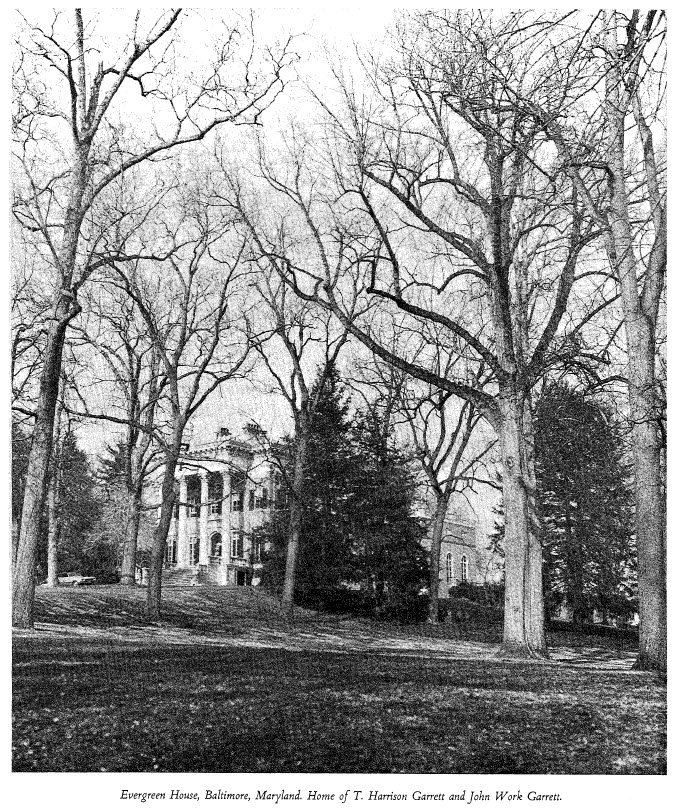
Around 1878 he purchased Evergreen, a lovely estate on Charles Street which is believed to have been built in the 1850s by the Broadbent family. The house, originally built as a classic revival structure, featured a porticoed entrance. Surrounding were many acres of land maintained as an estate and park.
John W. Garrett spent the summer of 1884 at his summer cottage in Deer Park, in Garrett County at the western end of Maryland. The county had been formed in 1872 by dividing Allegheny County and had been named in honor of him. On September 26, 1884, he died from an illness.
T. Harrison Garrett, Collector
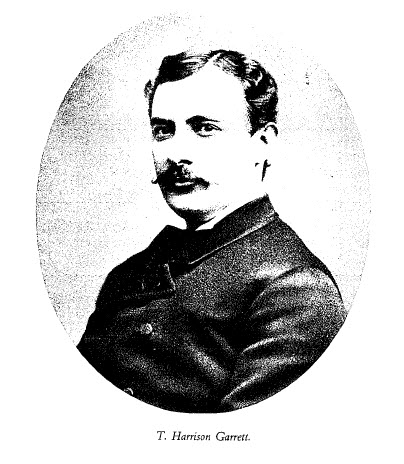
T. (for Thomas) Harrison Garrett, a member of Princeton's class of 1868, did not graduate then. At a later time the institution conferred upon him the degree of Master of Arts. He joined Robert Garrett & Sons and became active in the areas of finance, commodities, and real estate. The firm entered the oil export business by buying crude oil from western Virginia, bringing it to Baltimore by the B&O Railroad, and exporting it. Within the first year of operation 52 million gallons were shipped. The firm was an agent for the Baltimore & Savannah Steamship Co. Their real estate holdings expanded as did their interests in various companies and other commercial endeavors. After Jay Cooke & Co., the firm which acted as agent for the United States Treasury Department in the distribution of bonds, went bankrupt during the Panic of 1873, the business was mainly taken over by Drexel Morgan & Co. Robert Garrett & Sons assisted Morgan, particularly in Europe where the Garretts had many connections. Many government and other bonds were sold in Europe at the time, providing much of the capital for American business finance and expansion. At the time Europeans owned over $1 billion worth of American government securities and an additional $.5 billion in the stocks and bonds of American corporations.
In 1870 T. Harrison Garrett married Alice Whitridge, the daughter of Horatio Whitridge, of Baltimore. They eventually moved into Evergreen, the palatial mansion acquired by his father around 1878. Five children were born to the marriage: John Work, Horatio Whitridge, Robert, and a son and daughter who died in infancy.
Harold A. Williams, biographer of the Garrett family, noted in the history, Robert Garrett & Sons, that T. Harrison Garrett was a man of many interests. He was one of the incorporators of the Academy of Music in Baltimore, a playhouse built in 1875, which was considered to be the finest south of New York City. Among the famous actors who played there were Thomas W. Keene and Sir Henry Irving.
In the mid-1860s, probably about 1865, T. Harrison Garrett, then a student at Princeton, saw for the first time a copper cent of New Jersey made in the 1780s. Already a collector of books, Garrett immediately became interested in numismatics. From that point forward his collection grew.