The History of United States Coinage As Illustrated by the Garrett Collection
Q.David Bowers
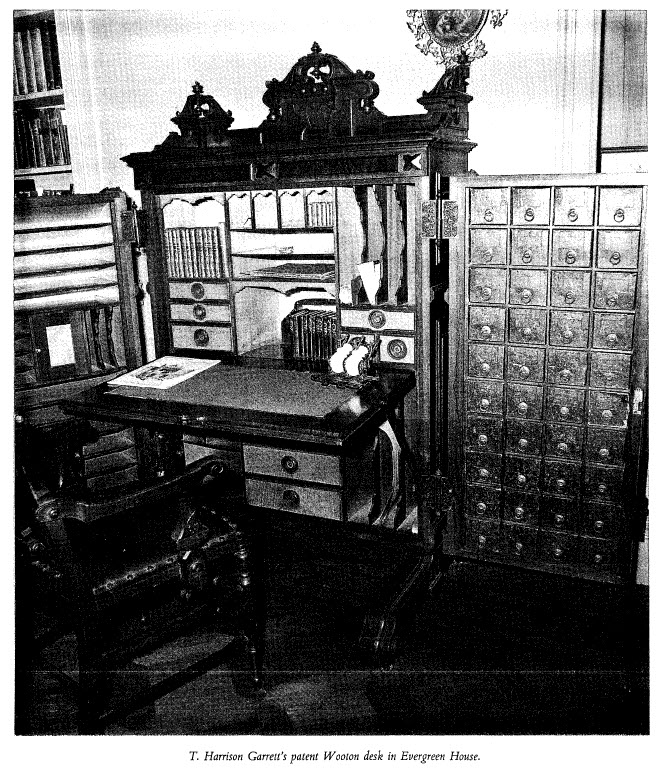
At the same time he devoted intense effort to the study of manuscripts and autographs. His collection eventually grew to include several folios of Shakespeare (the first of which he acquired while a student at Princeton), a collection of the autographs of signers of the Declaration of Independence, and many rare books. In 1885 the Claghorn collection of prints came on the market. The group, numbering 28,000, was one of the finest ever assembled. Garrett purchased it intact. Today these prints, ranging from the era of Schongauer through Whistler, are on permanent loan exhibit at the Baltimore Museum of Art and form the basis for that institution's print collection, considered to be one of the finest in the country.
T. Harrison Garrett was also a member 'Of the Maryland Historical Society and played an important part in the recovery of the Calvert papers that were found on the estate of Col. Henry Harford, near Windsor, England.
Beginning in the late 1870s, T. Harrison Garrett expanded his numismatic horizons and set about building a complete collection of United States coins. Desired was a specimen of each date variety. Mintmark collecting was not popular at the time, and dealers and collectors alike paid little heed to whether or not a coin bore a C, D, or other mint letter. In the silver series, the most important classic was the 1804 silver dollar. In 1883 Garrett obtained the Berg Collection specimen. The 1827 quarter, extant in original and restrike form, was another prime classic. Eventually Garrett acquired two originals, disposing of the less fine piece as a duplicate. The 1802 half dime which belonged to Harold P. Newlin, author of the standard reference work on the series, was incorporated into the Garrett collection, as were many other prime rarities.
In addition to regular United States series, Garrett had a deep interest in coins and medals of the colonial period. Historical detail fascinated him, and the more romantic a coin's history, the more he desired to own it. Ancient coins and coins of the world were also collected with enthusiasm.
From the United States Mint in Philadelphia were acquired copper, silver, and gold Proof sets at the time of issue. Gaps among earlier Proof coins were filled in by purchases at public auction and by private treaty, including an illustrious run of gold Proof sets from the famed Ely Collection.
From the late 1870s through the 1880s T. Harrison Garrett purchased hundreds of different United States and world coins through various auctions catalogued by Woodward, Cogan, Scott, Haseltine, Frossard, and others.
Dr. George Massamore, a Baltimore dentist who also maintained an active coin dealership (he catalogued nearly 50 auction sales from 1880 to 1897), was often employed as an agent. In 1884 Massamore conducted a sale which featured some of Garrett's coins under the heading "Duplicates from an Advanced Collector's Cabinet." Included were such items as an 1875 gold dollar, quarter eagle, and $3 in Proof, an 1815 half eagle, and other rarities. Harold P. Newlin also acted as an agent for Garrett on numerous occasions, as did certain other dealers. While most auction invoices were made 'Out to Mr. Garrett personally, often the names of agents or pseudonyms were used. Hence, the Garrett file of invoices grew to include such buyers' names as DesForges, Newlin, Massamore, South, Harrison, Baltimore,and Hotchkiss.
An active correspondence was maintained with leading dealers. Excerpts selected from nearly 4,100 pieces of correspondence and other data appear in an appendix of the present book and furnish an interesting insight into numismatics of the late 19th century.
By 1885 the coin collection of T. Harrison Garrett was considered to be second only to that of Lorin G. Parmelee in size and completeness in the American series. In the following year, 1886, he acquired intact the famous collection of New Jersey copper cents formed over a long period of years by Dr. Edward Maris, who wrote the standard reference on the series.