The History of United States Coinage As Illustrated by the Garrett Collection
Q.David Bowers
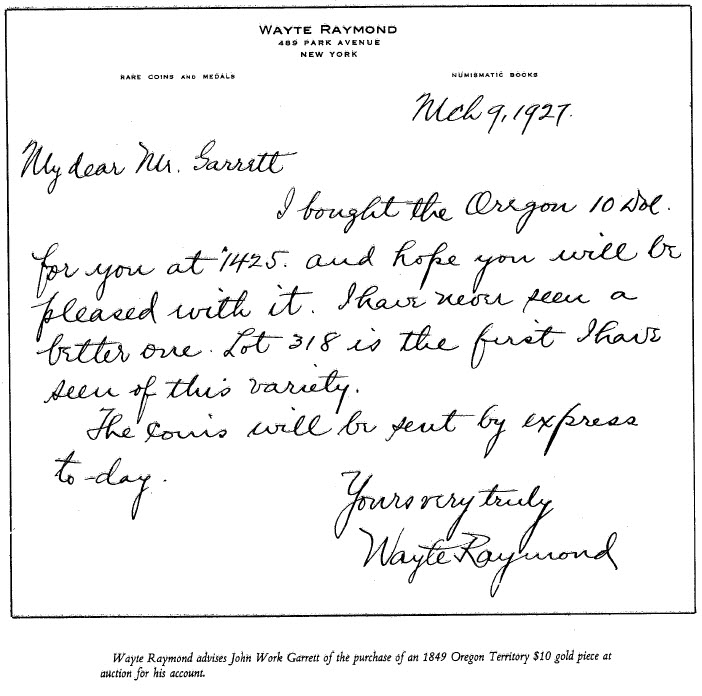
On February 18, 1927, nearly a year later, Garrett's interest in the American collection revived and he wrote to Raymond regarding:
... There are three coins in your sale of March 7, 1927, that I might like to bid on and I should very much like to know your suggestions as to what you think they will bring and whether you can bid on them for me. They are: No. 308 Oregon $10, No. 319 Wass Molitor 1852 $10, and No. 441 $3 1856-S (the latter only if it is the large "S").
On February 19, 1927, Raymond replied:
My estimates on the coins you mentioned are as follows: Lot 308 $2,000 to $3,000. Lot 318 $200 to $350. Lot 441 $7 to $10. The Oregon $10 has the usual center weakness which I believe is peculiar to all specimens known (the letters in the center of the reverse do not show). I will be glad to execute any bids for you.
On February 25, 1927, Garrett placed his bids with Raymond:
I should be very much obliged if you will get for me at the sale of March 7th the following: No. 318 Wass, Molitor & Co. (provided it is in Very Fine condition). The condition is not mentioned in the catalogue, and I do not want one unless it is really a fine specimen; No. 441 provided it is a "large S" variety. As to the Oregon $10, No. 308, I think it hardly worth my while to try for it. If it can be had for not more than $1,500 I will take it.
On February 28, 1927, Wayte Raymond replied:
In regard to the Oregon $10 I will of course bid up to whatever you say. I have entered your bid for $1,500, but if you really want the coin I would advise you to raise this a little. It is really a very fine piece but has of course the weakness in the center of the reverse which all known specimens have.
Lot 308 was subsequently acquired at $1,425 (plus 5% commission) to Raymond. Lot 318 was acquired for $170 (plus 5% commission). At the time it was often the practice for dealers to charge a commission to the buyer, in addition to the successful bids.
The invoice was followed up on March 9, 1927: I bought the Oregon $10 for you at $1,425 and hope you will be pleased with it. I have never seen a better one. Lot 318 is the first I have seen of this variety. The coins will be sent by express today.
On March 14, 1927, Garrett made these comments on the purchase:
I am very well satisfied with the Oregon piece but I want to ask you some questions... In regard to the Wass, Molitor, the "2" of the date seems to be made with a plugged die as it has a distinct circle around it. I know that the 1855 pieces were dated with plugged dies, but I did not know that the earlier dates were, and I can find no description of such a piece in Adams or in the American Numismatic Society's exhibition catalogue. Please let me know something more about it. And I should like to know in addition if you know from which collection these three pieces came.
Raymond provided the following information on March 16, 1927:
In regard to the Wass, Molitor & Co. $10 I am afraid I cannot tell you very much. I noticed the plugged die, and Adams' [illustration] is so hazy that it is impossible to tell if that piece is similar. We have so little opportunity to make comparisons of these coins that it is difficult to arrive at a conclusion. I think Mr. Newcomer has the same variety and do not doubt that he would be glad to show it to you.
The Oregon piece came about two years ago from the collection sold by Mehl as the "Judge Slack Collection." The Wass, Molitor & Co. piece came from a small dealer who acquired it somewhere in the West, I believe. I am leaving for abroad on March 29th and would be glad to know if there is anything special you would like me to be on the lookout for. My address will be the Guaranty Trust Company, Paris, as usual, but as I expect to be traveling in Southern Europe, I will not reach Paris until early in May. I have a few more interesting things to be sent to you this week.