The History of United States Coinage As Illustrated by the Garrett Collection
Q.David Bowers
Correspondence with Lyman H. Low
Correspondence with Low, who earlier dealt with T. Harrison Garrett, is resumed many years later when there is an exchange of letters between John Work Garrett and Low. On June 16, 1922, Low, then located in New Rochelle, New York, wrote to Garrett:
I have yours of the 14th, covering a check for $1.67 received in payment for Lots 335 and 361 207th sale. Lot 363 is also here and I thank you for returning it. It is not on your bid sheet.
There certainly was a strange muddle in both cases and my secretary is to blame for both; he is now away on his summer outing or he might explain how he fell into it however that would not correct the error.
Lot 359 was purchased for you, it appears on your bill and on the bookkeeper's record, but later changed to another bidder and for much less sum-not having the buyers present at the sale, who pushed me to the sum it sold for. I have written to the party and hope to get it back.
Your offer for lot 362 was by error copied against 363. Lot 362 you were outbid nearly four times the amount you gave, therefore there is no possibility of obtaining it. I very much regret that our commencement was not free from mistakes, and all at this end of the line. T. Harrison Garrett was an occasional patron of mine. I believe he was drowned on his yacht off Staten Island some 30 years ago. believe he was drowned on his yacht off Staten Island some 30 years ago.
On June 22, 1922, Garrett replied:
I have received your letter of the 16th. If Lot 359 comes back to you I shall be glad to have it.
I know that my father, the late T. Harrison Garrett, had been a patron of yours. My interest in coins was due to the collection in which he made and which I began to take an interest in only a couple of years ago. He collected chiefly American, colonial and mint and modern European coins, and there was so little that could be profitably added along these lines, or that seemed to interest me, that I have devoted myself to the ancient and medieval series with occasional purchases of Mohammedan and a few miscellaneous items which the collection lacks ... I shall be very glad to hear from you when you have any pieces of these series for sale.
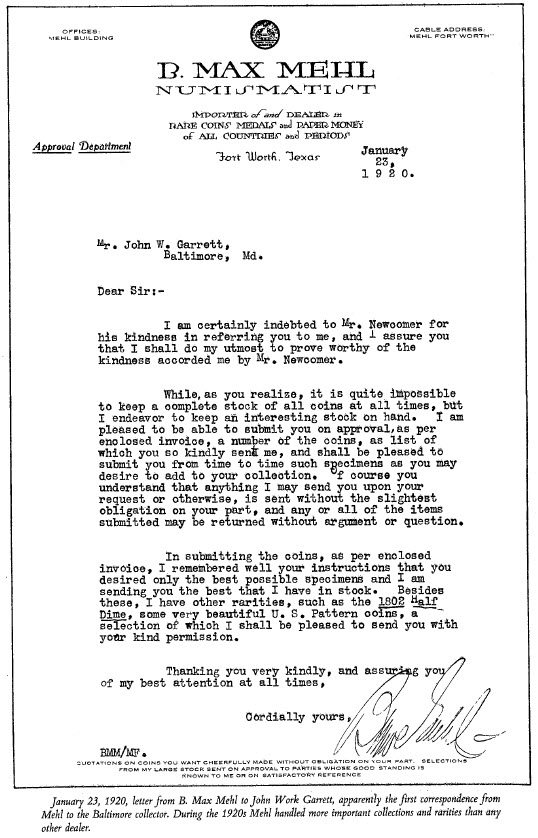
Correspondence with B. Max Mehl
B. Max Mehl, who did business in Ft. Worth, Texas, from the start of his numismatic career in 1904 to his death in 1957, did more to publicize and popularize coin collecting in America than anyone else during the first half of the 20th century. He has been called "the P. T. Barnum of the coin business." Mehl can be contrasted to dealer Wayte Raymond, who during the same approximate period devoted as much attention to numismatic publishing and research as Mehl did to publicity and promotion. Their combination would have been dynamic. Interestingly, this was proposed by Raymond in 1912, but nothing ever came of it.
Born in 1884, B. Max Mehl was from Lithuania. He settled in Ft. Worth, Texas, and intended to follow a career in the shoe business. In 1903 he became acquainted with numismatics, and in the following year he ran his first advertisement in The Numismatist, the official journal of the American Numismatic Association. Mehl's Numismatic Monthly, an informative magazine containing numismatic news, articles, and listings of items for sale, made its appearance in 1908 and continued until 1919.
In the field of coin auctions, actually what today would be termed as "mail bid sales" (for participation was by mail rather than by public attendance), Mehl achieved his greatest prominence. The first Mehl auction took place in 1906. From that time onward he was to conduct over 100 sales. Included would be some of the greatest collections ever to be offered for public competition, including the holdings of William F. Dunham, purchased intact by Mehl and subsequently auctioned (in 1941), the most outstanding collection of American coins to be sold during the second quarter of the 20th century. Other sales included the holdings of H. O. Granberg, A. C. Nygren, Elmer S. Sears, J. H. Manning, James Ten Eyck, Judge Slack, Albert A. Grinnell, Belden E. Roach, Fred Olsen, William C. Atwater, Frederick W. Geiss, William Neil, King Farouk of Egypt, and C. W. Green.