The History of United States Coinage As Illustrated by the Garrett Collection
Q.David Bowers
In 1923 Raymond purchased the Colonel James W. Ellsworth Collection for the astounding price of $100,000. Half of this amount was paid to the seller, the Knoedler Syndicate, by John Work Garrett, who obtained first pick of items he desired from the collection. Included were the remarkable 1783 Nova Constellatio patterns and the 1787 Brasher doubloon, the latter formerly the property of Matthew Stickney.
Wayte Raymond's numismatic interests were cosmopolitan. He conducted auctions, issued price lists, attended conventions, conducted a retail store, was a major distributor of coin albums and holders, and handled the original issuance of several commemorative half dollars. But, his greatest contribution to numismatics stemmed from his interest in research. The Standard Catalogue of United States Coins made available for the first time on a widespread basis information concerning mintage, relative rarity, and other data. During the 1950s he paid Walter Breen to do research in the National Archives in Washington and to conduct other intensive numismatic studies, certain results of which were incorporated into a series of monographs. Much hitherto unknown numismatic information came to light. At the same time he encouraged John J. Ford, Jr. to delve into numismatic history and research.
Most of Wayte Raymond's correspondence during the 1920s with John Work Garrett was on the subject of foreign coinage, however part of it related to the United States series. Excerpts from this American related correspondence are given below.
In 1920 John Work Garrett, having recently acquired the Garrett Collection from his brother Robert, endeavored to fill in gaps by sending want lists to several dealers. In response to this he received numerous shipments. For example, on July 21, 1920, Wayte Raymond sent a shipment, which Garrett retained, containing such items as an 1864 two-cent piece at 75c, an 1866 two-cent piece at 45c, an 1801 dime at $100, an 1851 half dollar at $1.75, an 1840-C half eagle at $15, and numerous other issues. Many of the pieces on the Garrett want list at this time were not necessarily rare. They represented omissions in the collection; pieces which may have been obtained earlier but had strayed or in some instances pieces which T. Harrison Garrett had not been able to obtain in the high grades desired.
On September 14, 1920, Raymond wrote:
I have just acquired the following patterns which may be of interest to you. Silver dollars 1863, 1864, 1865 with motto over eagle as on the type adopted in 1866, at $200 each. Half dollars of 1863, 1864, same type at $125 each. Quarter dollars, 1863, 1864, same type at $75 each.
All of these patterns are excessively rare, and probably not over six of any of them were struck. None of them are in your collection.
On February 5, 1921, Wayte Raymond submitted a $500 invoice for appraising the Garrett Collection of United States coins, medals and tokens, etc. A detailed inventory of 26 typewritten pages was submitted.
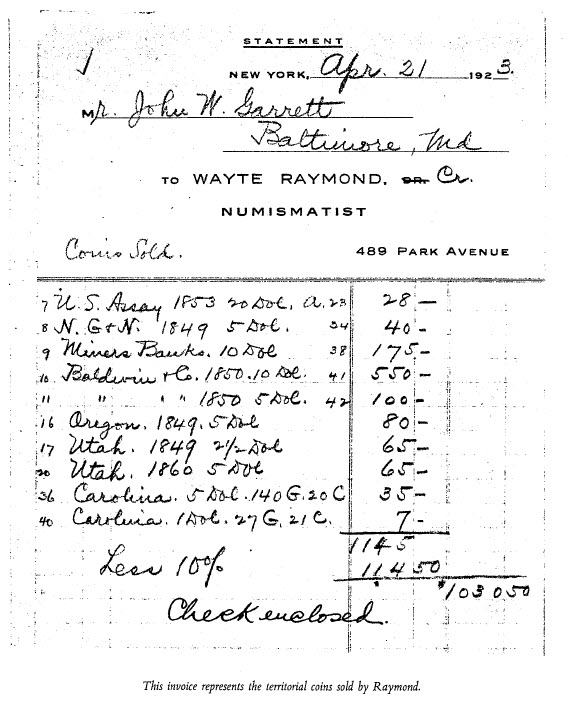
On March 3, 1923, John Work Garrett gave his check for $50,000 to M. Knoedler & Co., New York art dealers, who were agents for the collection of Colonial James W. Ellsworth. Acquired was a vast array of coins, including pattern issues of 1792, United States gold issues and rare colonials. The transaction was arranged through Wayte Raymond who purchased the remainder of the Ellsworth Collection for a matching sum of $50,000, for his own inventory. After the sections acquired by Garrett, were checked against his current holdings, the duplicate and unwanted pieces were consigned to Wayte Raymond to be sold.
On April 3, 1923, Garrett wrote to Raymond: I am very much obliged for your two checks of $164.92 and $554.85 (less $35 for a coin I bought) on account of the Ellsworth coins you have already sold for me.
I am sending you by registered mail today two boxes containing all the other duplicates I wish to sell, with the exception of the New Jersey cents and the California dollars, halves, and quarters, which I have not yet been able to go over. I enclose herewith the cards for these as well as other cards you asked for, and those that I have brought down by mistake. I shall be much obliged if you will consider the prices that can be put on the coins now sent up.