Walter Breen's Encyclopedia of Early United States Cents
Walter Breen
1808
(Mint report:1,109,000)
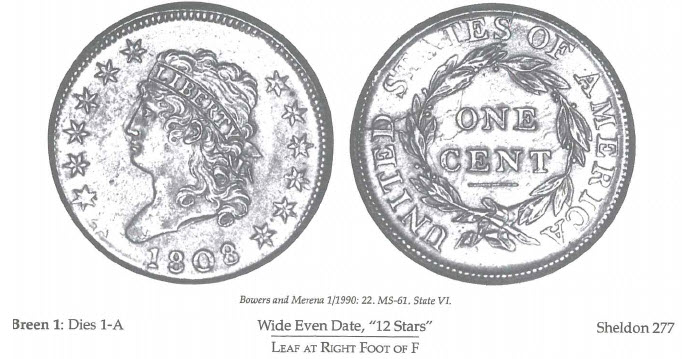
Obverse 1. B. LH. UH. UH. Front edge of the hair ribbon is convex (on other 1808 obverses it is straight). Wide even date with left edge of the curl above center of the final 8. Die scratch down from the right side of T. The first star is often weak and sometimes missing: "Twelve Stars." Lower obverse border is weak, apparently from axial misalignment.
Reverse A. NC. NR. NR. NC. Leaf at D is nearer to the right upright. (N)T is low.
Die states: All die state information from 1808-1814 derives in part from unpublished data assembled by Pete C. Smith in 1988.
I. Perfect reverse, no clash marks and no cracks. McGirk 1A. Untraced, Doubtless of the highest rarity.
II. Obverse has single dash marks from leaves before the face and behind the ribbon. No lump below the chin. Reverse with single dash marks: from lips touching the second inside leaf (clockwise from bottom left), from junction of chin and throat touching O(N), at berry and leaf below S(T), and from truncation below TES. Three
Obverse 1. B. LH. UH. UH. Front edge of the hair ribbon is convex (on other 1808 obverses it is straight). Wide even date with left edge of the curl above center of the final 8. Die scratch down from the right side of T. The first star is often weak and sometimes missing:
"Twelve Stars." Lower obverse border is weak, apparently from axial misalignment.
Reverse A. NC. NR. NR. NC. Leaf at D is nearer to the right upright. (N)T is low.
Die states: All die state information from 1808-1814 derives in part from unpublished data assembled by Pete C. Smith in 1988.
I. Perfect reverse, no clash marks and no cracks. McGirk 1A. Untraced, Doubtless of the highest rarity.
II. Obverse has single dash marks from leaves before the face and behind the ribbon. No lump below the chin. Reverse with single dash marks: from lips touching the second inside leaf (clockwise from bottom left), from junction of chin and throat touching O(N), at berry and leaf below S(T), and from truncation below TES. Three clash marks right of (N)E and (N)T. A bulge begins at TA with the border weak above it, later vanishing.
III. Obverse has double clash marks from leaves before the face and behind the ribbon. Reverse with at least four sets of overlapping clash marks within the wreath. Smith (1985) states 2, 3.
IV. Additional clash marks, at least eight sets in all. More details of inner and outer edges of leaves before face. Reverse has a ridge within the dentils above TATES OF AMB. A small crack develops within D, another extends from D across the wreath, eventually through (E)S to the rim. Smith (1985) state 4.
V. Reverse has at least seven sets of clash marks within the right wreath. Apparently the dies clashed over 20 times in all, but some of the older clash marks have faded. One crack of state IV now extends to the base of O(N) and,later, through N to the space above (N)E. McGirk 1C, Smith (1985) state 5.
VI. The crack of state IV now extends into the field above (N)E. A crack follows the edge of the 10th leaf, above ONE.
VII. The state IV crack now extends through the right wreath and the right foot of A(M) to the rim. A chip is beginning to fall from the letter D (same principle as a retained cud). Smith. (1985) state 6.
VIII Buckling develops before the neck. The reverse has a rim break on three dentils above N. A triangular piece has completely fallen out of the die within the letter D. McGirk 10.
IX. Rim begins to crumble above ED. Both obverse and reverse are flowlined. Smith (1985) state 7.
Equivalents: Proskey 1A. Doughty 208 (3 states).
McGirk 1A through 10. Clapp 1. Sheldon 277. EAC 1. Encyclopedia 1773.
Rarity 2.
Remarks: The right foot of the left upright of NS is weak or broken with upper serifs normal, on all reverses through 1809. Further punch breakage occurred in 1810. On weaker strikings, leaf points at (E)5 and F are between PC and NR.
First star may be visible or invisible in any die state depending on striking quality and wear. This is partly from axial misalignment. This weakness is not a function of the die state.
Pete Smith surmises that the lump below the jaw and the lump left of O(N) happened because the dies (during an episode of repeated clashing) struck a tiny fragment of steel. In 1965, Paul Munson explained the 1804 half cents with "spiked chin, protruding tongue," and incuse parallel lines in right field, by a similar accident, in which a small bolt lay atop a blank and left its marks on the obverse die.