Walter Breen's Encyclopedia of Early United States Cents
Walter Breen
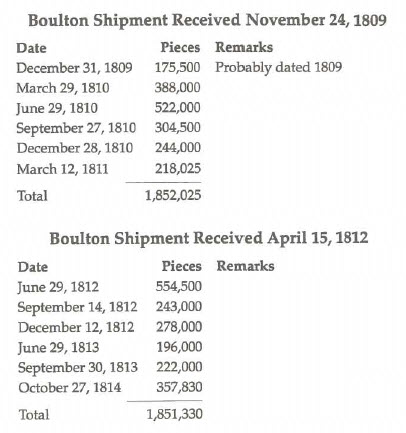
As of December 31, 1807, the Coiner's vaults contained 12,500 coined cents and 1,623,695 cent planchets ready for stamping. (Comptroller's Report, Dec. 31, 1807, American State Papers - Finance.) These lasted until about June 1, 1809. We may speculate that the 102,000 reported by March 31, 1808 were mostly, or all, dated 1807 though struck in 1808 on the new blanks received October 23, 1807. But the 1,109,000 struck in 1808 plus the 47,367 through June 1809 (supposedly exhausting the blanks from the August 1807 shipment) total only 1,156,367: far short of expected from 1,398,833 blanks fit for coining. Part of the discrepancy may come from overweight blanks and part from spoiled cents. Typographical error may play a role.
Boulton's next shipment, November 1809, 44,836 pounds, was not exhausted until March 1811. The figure of 1,863,583 is from Julian.! No more blanks arrived that year, explaining the short supply of 1811s.
The third shipment was made in January 1811 and arrived before May 9, 1812 the Comptroller's Report gives the weight as 54,354lbs. 6 oz. 3 dwt. or 2,264,766 blanks at standard weight. By the time the stock was exhausted in December 1814, the Coiner had made only 1,851,330. Here again overweight blanks and rejects may account for some of the discrepancy.
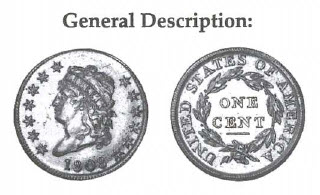
Obverse: Head of Liberty facing left, with Greek pro-file and curly locks bound by a fillet inscribed LIBERTY. Seven stars left, six right, date below, surrounded by a border of radial lines. Head from a device punch raised from a matrix; letters in LIBERTY individually punched into the matrix, so that they do not differ from one working die to another (aside from last-minute retouching of working dies before hardening). Stars individually punched into each working die.
Reverse: Within a continuous wreath showing 27 leaves and 13 berries, the words ONE CENT, a center dot between them and a dash below; statutory inscription around. The wreath with its contents was raised from a matrix; therefore, ONE CENT, dot and dash do not vary in position. Border of radial lines, as on the obverse.
Diameter: Variable, about 18/16" (29 millimeters), as before.
Weight standard: 168 grains (10.89 grams), or 41-2/3 to the pound, as before.
Planchet stock: Boulton planchets, as above.
Method of obverse description
Because the only elements entered by hand in this design are stars and date numerals (aside from minor retouchings on the topmost lock and LIBERTY), the working dies of 1808-1814 require different identification methods from any previous dies. Those used here are adapted from methods developed decades ago for silver and gold coins (most familiar among the Bust Half Nut Club for identifying early half dollar obverses); they focus on positions of end stars ("key stars") with respect to dentils (clockwise, 1st, 7th, 8th and 13th stars).
B = Over space between dentils.
UE = Top edge of dentil.
UH = Upper half of dentil.
C = Center of dentil.
LH = Lower half of dentil.
LE = Bottom edge of dentil.
X = Uncertain position.
Accordingly, each obverse die description will include a group of four letters, respectively designating positions of these four stars. Often these positions are diagnostic by themselves; but in every instance, the remaining description will amplify and confirm them. Occasional weak striking or extensive lapping of dies will show slight variations in these positions; all such variations observed to date are described under Remarks. Weak strikes and coins from worn dies may not show borders clearly enough to use key stars. In every such instance, other descriptive criteria will enable you to identify the die with certainty.