Walter Breen's Encyclopedia of United States and Colonial Proof Coins 1722-1989
Walter Breen
*(?) Silver Dollar. [880] As of June 30 some 12,000 business strikes were reported coined. By law these had to bear the 1895 date. Yet no business strike has been positively established to exist - aside from forgeries created by altering date (transferring a 5 from an 1885, or a 9 from some later date) or more often by removing mintmarks. However, some of the proofs were spent; at least three impaired or frankly circulated ones were recovered from bank sacks in the 1960's. I authenticated two of these and saw the third. A similar event doubtless accounts for the "authenticated business strike" recently publicized; I examined this coin and it is from B-2 dies (below). Forgeries can be spotted by using a microscope (preferably binocular) at the 95 and where a mintmark might have been. Any indication of tooling is grounds for suspicion, but the critical area is where numerals meet the field. It may be necessary to tilt the coin up to nearly a vertical-plane to check this. In the absence of a binocular microscope, the following may help:
All genuine 1895's examined to date come from one or other of the following dies.
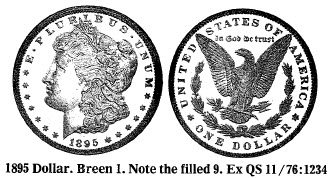
* B-1. Base of 1 slightly more than thickness of upright of 1 above dentils, but still closer to them than are star points. Date slants up to right. Left base of 1 well to r. of center of dentil, r. base of 1 a little r. of left edge; knob of 5 mostly over r. half of dentil, top of 5 points well above top of adjacent star. Recutting below top left serif of 1, which may fade out. Lower part of 9 filled but may exist normal. Die file marks slant up to r., plainest in toe of Land upper left serif of B. Reverse of 1894 above described, with the spines. Rothert:378, Paxman:829 (enlarged ills.), QS 11/76: 1234. This is the less scarce of the two varieties.
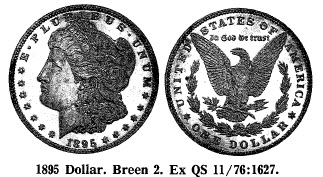
*B-2. Base of 1 less than thickness of upright of 1 above dentils. Left base of 1 almost over left edge, r. base of 1 about over center; knob of 5 above space, top of 5 points at top of a star. Hollow near initial M, at ear and parts of hair. Rev. Similar but spines not visible. Marks:691 (enlarged ill.); QS 11/76:1627. This is scarcer, possibly half as often met with as preceding.
Probably all 12 bags of business strikes (1,000 each) were included in the meltage of 270,232,722 dollars for export to British India as ingots and for domestic coinage, pursuant to the Act of April 23, 1918. The 1963-65 run on the Treasury and later searches located no 1895 Philadelphia dollars. Rumors that a Chicago underworld syndicate turned up a sack about 1960 have remained unverified, not even one specimen showing up. Underworld characters seldom bother to wait 16+ years to take their profits. Had even one such coin been released, it would have been front page news. We may guess that the Chicago sack either contained coins of some other date and/or mint, or that it was a figment of someone's imagination. That would not be the first time some such rumor reached print, giving birth to excited speculations and "Lo, here!" 's, only to be forgotten when the fabulous coins proved to be something quite other than drunken imagination would insist.
A very old Westchester County collector maintained for many years (1940's -60's) that he owned an uncirculated 1895, but he never got around to exhibiting the coin. His own mention that its color and surfaces were atypical rouses my suspicion that it was either a drastically cleaned ex-Proof or a forgery. In this instance, it is definitely unsafe to presume genuineness until falsity is disproven.
As a result of this total disappearance of business strikes, date collector pressure on proofs has sent pirces into orbit somewhere over the heads of most of the astronauts; one might even say well into the Van Allen belt, though Lord knows if the co-author of the dollar book ever owned an 1895. Auction records have recurrently been in the $6,000 to $8,500 range. Several small hoards exist. The coin is always available for a price - but what a price!
Van Allen cites quarterly mintages: 290, 180, 90 and 320, all for sets.
Silver proof sets. [880] These used to be offered fairly frequently -perhaps the same six or eight sets being reoffered -between about 1947 and 1953. Now the original sets have mostly been broken up in order to sell the dollar separately. Some have naturally been reassembled. Garrett's brought $11,500. Quarterly mintages as above.
Quarter Eagle. [119] B-1. Date slants up to r., left base of 1 r. of center of dentil, minute point down from lower part of bun. Same dies used on, apparently, all proofs and some business strikes. Other business strikes -including, alas, some very deceptive prooflike ones -are from B-2 dies:date higher, 5 close to bust, left base of lover r. edge. Many proofs are nicked up. Ullmer:388, "perfectly splendid," brought $1,800; "Rio Rancho": 104, ex "Gilhousen":259, $2,200; Breen 11:664, $2,450.
Half Eagle. [81] Rare, though sometimes available for a price -generally now in low to middle four figures. Garrett: 522 brought $2,200.
Eagle. [56] Date begins low, slants up to r., left base of 1 left of center; polish at IB, Y and eye; floating curls behind neck. Under 30 survive, possibly under 25. Not many auction records recent enough to mean anything: KS 2/60:2814; Wolfson: 778; S. S. Forrest; Ullmer:503 ("rainspot" between 4th and 5th stars), $6,250; Garrett:521; Kern:527; Rovensky:1672.
Double Eagle. [51] In date 1 about central between bust and border, its left base slightly r. of center. In the same rarity class as the eagle, give or take 3 or 4 coins each way. Wolfson:965 may possibly have been a reappearance of Bell I - Baldenhofer:1580.