Walter Breen's Encyclopedia of United States and Colonial Proof Coins 1722-1989
Walter Breen
Silver Dollar. [650] Since the middle 1960's, subject to much speculator activity, at least partly owing to similar games by horse traders in the uncirculated run."Monkey see, monkey do." VAM 1.
Silver proof sets. [600] A few of these are traceable to original mint wrappers, some via Wayte Raymond. Many more have been dispersed and reassembled. Far too many have been given enough cyanide to kill 600 collectors.
Quarter Eagle. [80] *B-1. Bases of 891 faintly recut; high date. Rev. Without the obvious shift on OF AMERICA characterizing the B-2 nonproofs, which should enable a few dubious pieces to be more easily given an accurate grade. Ullmer:384, called "superb!", brought a record $2,700.
Half Eagle. [53] Extremely rare, seldom offered. The most recent auction records appear to be S 5/68:863, Scanlon:2373 at $2,400, and Ullmer:464 at $4,250.
Eagle. [48] Date slants up. Exceedingly rare, rarest denomination of the year. (1) SI. (2) ANS. (3) Eliasberg. (4) KS 2/60:2806, vertical field scratch down from tip of nose. (5) Stoddard, Col. Green, DiBello: 1119, scrubbed. (6) Wolfson: 762, possibly same as next. (7) N.Y. state private collection. Do as many as a dozen survive?
Double Eagle. [52] Date centered, slanting a little up. Rays below TE thin, r. tail feather broken. Bottom obv. border often heavy with marked knife-rim. Subject to extreme date collector pressure as very few remain of the 1,390 business strikes. (1) SI. (2) ANS. (3) Eliasberg. (4) Atwater:1283, Geiss:2016, Dr. Green: 760, Amon Carter Sr. & Jr. (5) WGC: 893, cleaned. (6) Menjou: 1830. (7) "Memorable" : 711, possibly reappearing as DiBello: 1281. (8) Melish: 1018, cleaned, nicked. (9) Wolfson: 953. (10) Dr. BoIt:1353, cleaned to death. (11) KS 5/58:2798, cleaned, possibly same as one of foregoing, (12) Walton:3312, Jay:331, Dines:934, Delp:819. (13) Miles:929, Ullmer:533, $23,000. (14) Bell 11:939, EF ex-proof. The above may include as many as three duplications. In compensation, there are at least three others, possibly more, outside this group.
Gold proof sets. Not over 48 made, possibly under 40.None survive intact aside from those in the complete sets, below.
Complete proof sets. Smithsonian, from Mint, from Coiner April 6; ANS as usual.
1892
Cent. [745] Much like the 1891's; no special peculiarities.
Five Cents. [2745] Same comment.
Minor proof sets. [2745] As presumably 1500 were made outside the silver sets, unsurprisingly many have survived (some ex Wayte Raymond), some integrated into assembled silver sets, others broken up into date collections.
Barber silver coinage. "Created" - if that is the proper word -by Barber's reversing the Morgan dollar portrait of Miss Anna Willess Williams, removing the vegetable matter, modifying her cap, cropping her hair, adding the statutory legend on the dime, motto and stars on the quarter and half. Reverse of the dime is redrawn from Newlin's (1859) "Wreath of Cereals" after Longacre; reverses of the quarter and half are copied from the Great Seal, but minus the heraldic blunder of placing arrows in dexter claw.
Dime. [1245] Despite contrary claims, only one type for the year, only one working hub for either side. S. Kabealo, in his 11 /58 Penn-Ohio sale: 1089-90, showed two rev. varieties, 1089 with both ribbon ends free of wreath (lapped die), 1090 with r. ribbon end touching, latter said to be very rare, "only two seen." They are from the same hub. The free ribbon ends feature comes on proofs with perfect dates (e.g. Lester Merkin, November 1965) as well as on uncs. I would guess that the die, or die state, with ribbon end touching wreath, is scarcer than the other. There are also very minute variations in date position. The wreath is redrawn - not the same hub as 1876-91.
- Double date, placed far to left, first cut lower and still farther left. 1975 GENA: 72. Very rare.
Quarter. [1245] Two types, found on proofs and on uncirculated coins from all three mints; the first type is rarer, representing a hub used only through part of 1892, the second a hub continued apparently throughout the Barber series. Type I: wing at left covers less than half of E in UNITED, allowing middle serif to be plainly visible; wing at r. free of upright of R in AMERICA. Cf. WGC: 259. Scarcer than Type II, though not rare.
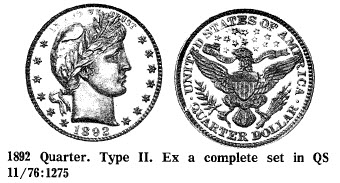
- Type II: Wing at left covers more than half of E in UNITED, including middle serif; wing at r. covers much of upright of R. WGC: 258. This is the one more often seen, probably twice as often as the first. Minute positional die varieties of obv. (placement of date only). Rainbow toning found often on examples of both types. Much hoarded and popular as first year of issue.
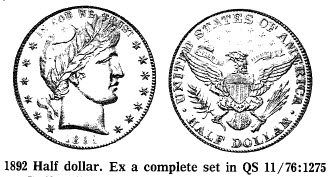
Half Dollar. [1245J No type change and only two microscopic variations in position of date. Too many beautifully toned examples have fallen victims to cyanideor baking soda paste. Hoarded as first year of issue but not to such a large extent as the quarters. Always available for a price.