Walter Breen's Encyclopedia of United States and Colonial Proof Coins 1722-1989
Walter Breen
1893
In this year, the Philadelphia Mint installed its first hydraulic press for striking proofs. No change in appearance of the coins.
Cent. [2192] Several microscopic positional varieties only. Similar to 1892 in physical properties.
Five Cents. [2195] Recut 1. Very scarce. LM 11/65:211.
- Normal date, high with 1 close to bust. LM 11/65:212.
- Normal date, lower with 1 nearer border than bust. LM 11/65:210; Garrett set, others.
Which of the latter two is scarcer cannot yet be determined. There may be other positional varieties. Examples of the three above named were in Lester Merkin's November 1965 auction; the last two varieties brought lower amounts.
Minor proof sets. [2192] Much the same comment as to 1892.
Dimes. [792] B-3. Normal date. There may be two minute positional variants. This is the variety usually seen.
-*B-4. Die file marks in 93, especially the 3, very strongly - to obliterate traces of overdate? Edward Piontkowski collection, and no duplicate seen despite examination of many dozens of specimens since. This one is evidently rare. I bring up the suspicion of why the die file marks, because several plain overdates exist (the discovery coin being an uncirculated piece I found in New York and sold to Henri Heller; it was illustrated on the front page of Coin World some years ago).
- *B-5. 1893/92. Heavily repunched date, some traces of 2, mostly effaced, 93 filled. (1) Ruby I: 1051 at $2,500. (2) Hirt (1975 GENA II): 1163. Two others reported.
Quarters. [792] No notable varieties. Much scarcer than 1892 but not as popular. Too often comes badly cleaned.
Half Dollar. [792] Same comment as to quarter. Silver Dollar. [792] VAM -: closed 9 and 3, no recutting, left base of lover center. Priced high due to much speculator activity both in proofs and in uncirculateds. The 1893's were formerly considered very rare, then John Ford and two others obtained a quantity of bagmarked unc. examples from Treasury sources in New York during the late 1950's. But the speculators have absorbed most of these since then and the price has once again climbed, to the pleasure of those who had been holding on to their proofs.
Silver proof sets. [792] Originals from mint wrappers appear to have mostly gone into obscurity since the mid 1950's. Most of the 792 were broken up on behalf of collectors wanting the silver dollar. Garrett's brought $2,500.
Quarter Eagle. [106] *B-1. Lower knobs of extra 93 left of bases of those digits; not an overdate. For some reason, rather less often seen in proof than the 1892, though the latter is a lower mintage item in proof and non-proof. Possibly more 1893's are impounded in estates, bank vaults or dealers' stocks. Auction record $1,700 in Ullmer: 386.
Half Eagle. [77] Date well to left. Very rare, seldom offered. Only one recent auction record - Ullmer:466, $5,250. Cf. Kern: 404.
Eagle. [55] Date low, slanting up; left base of 1 almost over r. edge; disconnected curls behind neck. Rev. Missing feather below second red stripe, like the 1894 (same die?). Extremely rare, less than two dozen survivors, possibly under 15. Auction record $4,500 in Garrett: 384, but this piece was rubbed on eyebrow.
Double Eagle. [59] Less rare than the eagle, but surely under 30 survivors. Two varieties. Date low, placed to left: Wolfson 959; 76 ANA:3276; date to right, Ullmer:535, $20,000; 76 ANA:3275.
Gold proof sets. Not over 55 and possibly not over 50 made. One of these was probably represented by the four Wolfson coins. Two others survive as part of the complete sets. Cf. Ten Eyck:334.
Complete proof sets. SI and ANS as usual. Former from Coiner, March 13, at face. Latter from Mint, R. C. W. Brock, J. Pierpont Morgan.
Commemoratives 1893 Columbian. Proofs exist of this also; SI (no accession date on record), Newcomb II:870 and about two dozen others. No reliable basis for guessing at mintage. Deceptive early strikes abound, and the only way to be sure your coin -:- or that being offered in a catalogue, etc. - is a proof is the method described for the 1892 Columbian.
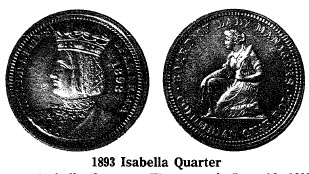
- Isabella Quarter. First struck June 16, 1893. Real proofs are very rare, less than fifteen seen in all. The mirrorlike fields are at least equal to those found on proofs of the regular designs of the year; relief details are extremely sharp, most notably on head and drapery and line of yarn from spindle to distaff on reverse, and on all parts of hair and headdress, jewels, etc., on obverse. Rims are unusually broad, sometimes a full half mm. wider than on normal examples, with sharp inner and outer edges. Compare Smithsonian, Newcomb II: 836, Dr. Green: 1448. I have seen nine in the past 15 years in dealers' hands, but there are dangerous early strikes. No record of mintage, but certainly the number would be smaller than of the halves. The documented fourth specimen issued, very deeply toned, called "prooflike", was KS 5/66: 1430.