Walter Breen's Encyclopedia of United States and Colonial Proof Coins 1722-1989
Walter Breen
1797
Half Disme. Valentine 2, the regularly seen variety with 15 stars. Presented by Mint Director Elias Boudinot to Matthew Boulton, possibly with other coins; later, Waldo Newcomer, Bareford collection. It was exhibited in NYC during the mid 1950's. I saw the piece; it is from the earliest die state, and is carefully struck from brilliantly polished dies on a polished planchet. As Matthew Boulton had long since made proofs with lettered, plain and ornamented edges as specimens of the finest work his Soho Mint could do, presumably this coin was intended as a sample of what the Philadelphia Mint could do using its far more limited facilities. I cannot swear that this half disme was given more than one impression from the dies, but it is a vivid enough impression to raise that question.
To date there is no positive evidence for any other presentation pieces of 1797, and only one other is rumored (aside from the often seen "Nichols find" cents, which do not qualify): the eagle of the first Heraldic reverse die, Breen 2-B, Adams 2, Clapp 2, Newcomer 442. Woodin: 1185 was sold in 1911 for an astoundingly high figure as "Proof" and no equal example has been seen to date. I have not seen the Woodin coin. Occasion: Introduction of the new design.
1798
Quarter Eagle. Close date, 7th star very close to Y, four berries. Breen 1, Adams 1, Clapp 1, Newcomer 675. Not seen; reported in presentation piece state by Ronnie Carr, who saw it in the possession of Leo A. Young about 1959; 1959 ANA:956; possibly later Bell II: 78 (1963). It is described as being in all respects of proof quality, including striking characteristics, though it has a small planchet defect a lamination which may have occurred on exposure to cold weather during the years after striking. Occasion for presentation unknown.
1800
Half Eagle. Breen I-B; Adams 1, Clapp 2, Newcomer 38. Last star away from drapery as usual; rev. 6th star plainly double punched, E nearly centered above space between clouds. Ex Col. James Flanagan (1944):1069, W.F. Webb, Baldenhofer:1206, brilliant proof surface, excellent striking quality.
Eagle. Only the one variety; earliest die state, the crack through various letters in LIBERTY faint. I have Seen two and have heard of several others that qualify as possible presentation pieces; occasion unknown, but if these were actually included among presentation coins, the ceremony must have taken place very late in the year. Most of the mintage of eagles in 1800 consisted of coins dated 1799.
1801
Dollar. See Restrikes and Fantasy Pieces.
1802
Dollar. See Restrikes and Fantasy Pieces.
Half Eagle. Not seen, reliably reported: ex Mehl estate, Justus, Kosoff, May Co. (1960), Dr. Martin Klein.
1803
Dollar. See Restrikes and Fantasy Pieces.
1804
Dollar. Eagle. Plain 4. See Restrikes and Fantasy Pieces.
Eagle. B. I-A, Crosslet 4. Smithsonian Institution, from Mint Cabinet Collection.
1806
Half Dollar. Reed Hawn: 20 at $2,300 may qualify.
1807
Half Dollar. Bust R. Reed Hawn: 24 at $8,500 may qualify. Compare "Dupont": 2044; Ov. 110 in the earliest die state known.
Half Dollar. Bust left, new design by John Reich. Large stars. Ov. 114 = Beistle 12-J, Haseltine 10. "Dupont": 2045. Compare Reed Hawn: 26, $2,300. Occasion for presentation, the new design, Sept. 1807. The similar small stars coin, Ov. 113, in James A. Stack estate: 332, had full proof surfaces but was a weaker impression; it nevertheless brought $2,700.
It is odd that design changes on the half eagle this year, the cent and quarter eagle in 1808, the half cent in 1809, the half eagle again in 1813 and the "quarter dollar in 1815 seem not to have occasioned presentation pieces. Possibly some still await discovery in estates.
1809
Half Dollar. Overton 109, earliest state. William R. Hall, San Francisco, seen at a convention in Sept. 1976.
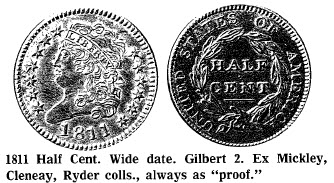
Half Cent. Wide date. Gilbert 2. First of two varieties. Earliest die state, both dies brilliantly polished. Careful strike of needle sharpness," Ex Mickley, J.B. Clemens (1878), Thomas Cleneay (1890), a 1913 Elder sale, Hillyer Ryder, Wayte Raymond, NN 44th Sale, June 1954, to Norweb colI. In all its earlier auction appearances this piece was called a proof. The Joseph Brobston example, also called a "proof" in the fixed-price offering of that collection, was not the same quality. Occasion for presentation unknown.