Walter Breen's Encyclopedia of United States and Colonial Proof Coins 1722-1989
Walter Breen
IV. PROOF COINS AND SETS, OLD TENOR, 1817-1833
1817
This year marked the silver jubilee of the mint's establishment and of the authorizing Act of April 1792; it was also notable for the installation of various items of new equipment, a renovation program whose immediate occasion was the Mint fire of January 1816. The manufacture of unquestionable proofs appears to have begun on a consistent basis in this year. On these proof coins 2 to 4 blows from the dies in a screw press can usually be demonstrated, dies and blanks having first been polished to unusual brilliance.
In all listings to follow, an asterisk denotes varieties of a denomination, known to occur only in proof state. Should the asterisk precede the denomination, it means that the denomination exists for that year only in proof state. (Naturally, impaired or circulated proofs are known of quite a few of these, notably the half-cents of 1836-48 inclusive.) We are hereinafter attempting to standardize the terms original set and assembled set as antonyms. An original set is one in the original mint case or mint wrappers, or in some other way provably consisting of the group of coins issued by the mint at the same time or occasion and retained together since then; its importance is in establishing which varieties were contemporaneous with each other, especially when the mint is known (as in many later years) to have issued proofs in several varieties of each denomination throughout the year. An assembled set, of course, is one made up by the collector by buying the individual denominations. Original sets were mostly broken up in the year of issue by the collector recipients, who added the cents to their cent collections, the dimes to their dime sets, the half dollars to their half dollar runs, etc. It has been taken for granted over the years that the average proof set of any date prior to about 1950 will have been assembled; afterwards sets were commonly collected in original mint boxes (not always a good idea, as they tarnished, and the cellophane envelopes later split, allowing the coins to escape and jangle against each other), but the distinction between original and assembled sets becomes decreasingly important afterwards. However, 19th century original sets remain of great historical importance, and their composition is a continuing research project.
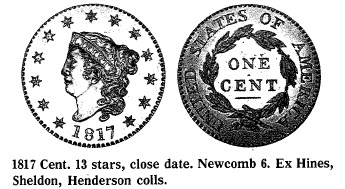
Cent. Newcomb 6. Thirteen stars, close date, leaf midway SO. Known from its mention in the Newcomb book; presumably a Henry Clay Hines coin, subsequently in the Dr. Sheldon and Floyd Starr collections. This coin, or its twin, was described to me as having proof obv., frosty unc. rev. (but with proof characteristics of striking), like the 1817/13half dollar and quite a number of others to follow. Floyd Starr could not locate it, claiming he had mislaid it. At present, the Calif. Specialist has one ex Hines, W. H. Sheldon, E. Henderson, 1947 ANA Convention sale, Lot 1588A; a second was Beckwith:51. Either one is possibly ex Lot 504, Chapman sale, June 17, 1889, and/or Mickley: 2009, later in M.L. Mackenzie coIl. (1869). Cf. also Kagin 69: 268 (3/19/49), "reddish brown," unverified. As Newcomb enunciated criteria for proofs (p.8 of his book on 1816-57 cents) which are, if anything, a little too stringent, presumably the above pieces conform to them. Note that Newcomb mentions having encountered 'obv, proof rev. unc. coins, not distinguishing them from proofs in his variety description; they have often been termed "one-sided proofs."
The Newcomb 6 cent variety was struck fairly early in the year though not at the very beginning, as it is sixth in the established emission sequence (proved by die breaks and style, the first variety having an 1816 reverse): N-2, I, 16, 13, 6, 7, 8, 10, 11, 12, 15, 14, 4, 5, 17, 9 and 3. (Rev. of 14 and 4 are the same die.) Of the four varieties preceding the N-6, only the N-13 and N-16 are common, one is scarce (N-2), the other (N-l) rare. Possibly struck late Jan. or early Feb. 1817.
- N-8. Obv. proof, rev. unc. H. Chapman 12/16:97
- Hines, Philadelphia estate.
The report of an N-9 in proof, T. James Clarke: 151, is not credited here. The coin was not quite full mint state, not even too deceptive.
Half Dollar. 1817/13. Overton 101 = Beistle I-A, Haseltine 1. Privately placed by New Netherlands Coin Co., ex Newcomer, Green, Wayte Raymond's personal set of proof half dollars. Obv. proof, rev. unc., not too carefully made. Probably the earliest variety of the year.
- Unattributed perfect date: lot 739, part I, Newcomb sale, J.C. Morgenthau, 1945, to J. Kelly. Not seen, but Newcomb was presumably as careful in labeling his halves and other silver as he was his cents, so the coin probably is as described.
A set could have been made up consisting of cent and half dollar, no other denominations being made during the year. The wonder is that more proofs of 1817 are not known.
1818
Cent. N-7. Date spaced 1818, double denticle left of first 1; the variety that usually (though not always) shows a crack joining 6th and 7th stars. Listed by Newcomb, this is a ghost that refuses to be put to rest. Both specimens claimed have been discredited: (1) Phila. Estate, ex Hines, Sheldon- a strange piece possibly double struck (?) and buffed. (2) Ex Dr. George P. French (called "the jolly abortionist" by old collectors who knew him in the 1920's), T. James Clarke (notorious for his wishful thinking on grading, even as Dr. French had been), Calif. Specialist, Dr. James O. Sloss, Lee Lahrman (lot 298), Gorlin, Bland. This is a little under mint state and not very deceptive. Cf. Woodward 5th sale: 660 (10/18-22/1864), "Levick et al.," probably ex Lorenzo H. Abbey, which may mean a real proof in some bank vault.
Quarter Dollar. Browning 8, Haseltine 1. Obv. Three denticles crowded together below first 1. Rev. Close 25, the2 very near leaf and the C distant. I know only the Col. Green coin pictured in Browning; but d. Dunham:419. If the Dunham coin was an actual proof, it may have been a reappearance of the Browning-Colonel Green piece, ex Cleneay: 1326 (1890). No others are reported. This and the cent both must have been struck late in the year; in the actual emission sequence as established by die breaks, the N-7 cent is seventh of 10 varieties, and the B-8 quarter is next to last.
Half Dollar. 1818/17 Lg. first 8. Ov. 101; Beistle I-A. Dr. E. Yale Clarke: 215, ex "Alto" sale, C. H. Patten.
- 1818/17 Small 8's. Ov. 102; Beistle 2-B, H-l, Clapp 1. Most recently seen in Maurice Bauman: 32, cleaned; ex T. James Clarke, NN47: 1237, R.E. Cox, and the 1962 N.Y. Metropolitan Convention auction: 1799.
- 1818, normal date, spaced ISIS, S's normal, AT-Slow, E in AMERICA leaning well to r., I's have r. base beginning to split away from upright; recutting on arrowheads. Overton 113; Beistle 10-L, H-12, C-12. (1) Wayte Raymond set,presumably ex Newcomer, Green; may be Cleneay: 1142. If so, borders are wider at top, obv. and rev. (2) Smithsonian, from the Mint collection -believed to be this variety but not checked. (3) Eliasberg, ex George H. Earle (1912), John H. Clapp. This may be Winsor:493. (4) Lichtenfels I: 2741, possibly #1 above or a Brand coin.
No half eagle proof even rumored for this year. If any sets were made up, they must have lacked the half eagle. It is odd that more half dollars are known than quarters and cents.