Walter Breen's Encyclopedia of United States and Colonial Proof Coins 1722-1989
Walter Breen
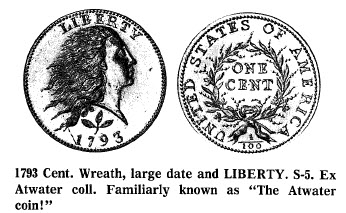
Cent. Wreath type, Sheldon 5, Crosby 6-F. Large date and LIBERTY. A very few struck on burnished blanks carefully centered in the press, possibly given two blows apiece, early in April 1793. Occasion: achievement of a reasonably satisfactory new design for the cent, after so much scurrilous newspaper criticism had been made of Henry Voigt's rather primitive Chain design. Don Taxay has attributed the wreath cents to Adam Eckfeldt. Three or more are known which can qualify as presentation pieces. (1) ANS, ex S. K. Harzfeld, R. B. Winsor, George H. Earle, G. M. Parsons, Clarence S. Bement, Col. James W. Ellsworth, Wayte Raymond, George H. Clapp. (2) Calif. Specialist, ex R. Coulton Davis, Dr. Thomas Hall, Sisson:988 (1916), Virgil Brand, B. G. Johnson, Henry Clay Hines, Dr. W. H. Sheldon. (3) Atwater: 11, now Calif. Specialist. (4) The former Dr. Hall, Brand, Oscar Pearl coin may qualify at this level, though I have not seen it recently enough to remember it clearly from this point of view. The former T. James Clarke piece, ex Henry C. Miller, Howard R. Newcomb, may also be one of these.
Similar. Sheldon 6, Crosby 7-F. Broad leaves, small date and LIBERTY, obv. bulge or convexity from back of hair slanting slightly up to left rim. This was the next variety struck after the rim of Sheldon 5 had broken too heavily over LI and BER, and once again a few appear to have been made on burnished blanks for presentation purposes, most probably to government officials visiting the mint, as they often did during its earliest years. (1) The one most clearly qualifying at this level is the Harold Barefordcoin, ex George F. Seavey (circa 1863), Lorin G. Parmelee, Harlan P. Smith, Dr. Thomas Hall, Virgil Brand, and several dealer intermediaries. (2) Another, slightly finer in color, is the Calif. Specialist coin, ex Parmelee, Dr. Hall, allegedly Dr. Henry Beckwith at private sale, Dr. G. P. French, Henry C. Hines, T. J. Clarke, Dr. Sheldon. This more than once was referred to as a "proof" by former owners, evidence in this instance less of enthusiasm than of awareness that it was something special even among 1793's.
Evidence of presentation coins among the half-cents of this year (struck beginning July 20, 1793) is equivocal. I have seen two or three, many years ago, on exceptionally broad planchets, perfectly centered and unusually sharply struck, but I do not recall any of them as being on burnished blanks. One of these appeared in an early auction as having been presented by Adam Eckfeldt to someone or other as a sample of his work.
Evidence of presentation coins among the Liberty Cap cents of 1793 is still more equivocal. The Eliasberg specimen is possibly the most convincing one, though at some time in its history it was cleaned, not affecting its extraordinary sharpness, but obscuring the original appearance of the surface. This piece came originally through the Chapman brothers, who began as teenage dealers under the patronage of Capt. John W. Haseltine about 1877 in Philadelphia, passing later through the collections of Thomas Cleneay (lot 1800), Peter Mougey (lot 1), Henry Chapman, C. S. Bement, Col. James W. Ellsworth, Wayte Raymond, William Cutler Atwater. (Mougey travelled from Cincinnati to Philadelphia to buy this one coin!) There are two others with finer surfaces, one of them Dr. Sheldon's, another in the John Work Garrett estate now impounded in Johns Hopkins University. But neither of these is equally sharp.
1794
Evidence of presentation coins among the half-cents and cents of this date is lacking.
Half Disme. All four varieties dated 1794 were included, with some dated 1795, in a delivery of 7,756 pieces made on March 30, 1795. Unquestionable presentation pieces exist of three of these, only one known in this state for each variety though ordinary frosty uncirculated specimens exist for V-2, 3 and 4. Possibly the presentation pieces were made earlier, the V-I perhaps in 1794.
Valentine 1 (Newlin 2). Wide date, double leaf at top of r. branch; the numerals are more than their own width away from each other, the 1 7 9 especially widely spaced. The single presentation piece, Lelan Rogers call. ex Lester Merkin, is exceptionally sharply struck (breast and claws sharp, central hair sharp)on a blank burnished before striking; it is well centered and has bold, fairly wide borders.
Valentine 2 (Newlin 3). Close date, crowded between bust and border; double leaf at top of r. branch. Eliasberg's is a presentation piece, similarly struck to last.
V-3 (Newlin 4). Close date, the 1 4 very close to hair and bust, berry almost touches I of UNITED. Eliasberg's is a presentation piece, like the last two.
No evidence of presentation pieces among the half dollars delivered on December 1, 1794, or among the 1794-dated halves coined through Feb. 4, 1975.
Dollar. The unique copper specimen with lettered edge, struck from the same dies presumably early on Oct. 15, 1794 just before the production run of 1758 pieces, does show evidence of having been coined from polished dies on a burnished blank. The stars at left are sharper than on the known silver pieces. It is unique, though several dangerous electrotypes (with false edge lettering) exist and may deceive the unwary. Whereabouts of the true specimen (Adams-Woodin 14, Davis 14, Judd 19) unknown at present; ex Benjamin Haines coll., Jan. 1863, lot 781; John F. McCoy: 1834 (1864); Levick: 1701 (Oct. 1864); Heman Ely: 90 (1884); Parmelee: 12 (1890), where described as "same as regular issue, but in copper: hair sharp and perfect, which is remarkable for this period of coinage: uncirculated, proof surface; unique." It then brought $100, going to Harlan P. Smith bidding under the nom de guerre of "Clay" for Dr. Thomas Hall; thence to Virgil Brand, Brand estate (1928), H.L.P. Brand, Stack's (1951), H.P. Graves, Davis-Graves sale (1954), L. Horowitz, Coin World advertisement, 10/31/73. Silver dollars of 1794, unlike this piece, almost invariably have weak areas at left obv. and rev., rendering left stars, part of date, and parts of UNITED S TA TES hardly visible even on uncirculated or nearly uncirculated specimens; in addition, the hair is seldom well brought up. This copper piece probably did receive two blows from the dies while they were still parallel; after the first few silver ones were made, some accident rendered them skew (not quite in parallel planes) producing the mentioned weakness. (It is known that some of the weakest 1794's were not allowed to leave the mint, but instead used as planchets for striking dollars of 1795.) If it can be established that this copper dollar did in fact receive two blows from the press, then it qualifies as a true proof and the first definitely established to have been issued by the Philadelphia Mint.