
The Oregon Trail Commemorative half dollar was the longest-running issue of any classic commemorative coin. Even though they are now one of the more popular coins in the classic commemorative series, at the time of production, these were controversial because the association responsible for production and distribution created artificial scarcity by issuing coins with low mintage numbers over multiple years. By the time production of these coins ended, the public was ready for something new.
In 1852, one of the most famous settlers on the Oregon Trail, Ezra Meeker, made the journey with his family. He then spent the rest of his life publicizing the Trail and highlighting the sacrifices made by those who made the journey, reminding everyone of those who had died along the way. He made four separate trips along the Trail, highlighting its importance, placing historical markers, and lecturing along the way. In 1922, he founded the Oregon Trail Memorial Association, and a few years later, the association advocated for Washington Congressman John Miller’s proposal to mint coins commemorating the historical event.
Unfortunately, so many commemorative coins had been issued between 1920 and 1925 — 10 different series were minted during that period — that Congress believed these coins no longer honored events of national significance, so they were extremely hesitant to approve any new commemorative pieces. By the time the Oregon Trail commemorative was proposed, multiple other proposed coins had already been rejected by Congress. On January 25, 1926, a bill to mint coins commemorating the Oregon Trail was introduced to the House of Representatives. Meeker was in attendance and testified in favor of the coin. It was approved and passed to the Senate, where Meeker argued that the Oregon Trail was of national, not regional, importance and deserved to be commemorated on a coin. The bill passed the Senate, and on May 10, 1926, Meeker met with President Calvin Coolidge to witness him sign it into law. A unique feature of this bill was the lack of restrictions on which mint could strike the coins or for how long the coins could be struck.

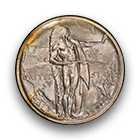
This coin was designed by the husband-and-wife sculpting team of James Earle and Laura Gardin Fraser. James Fraser designed the reverse that features a large covered wagon. This is specifically a Conestoga wagon, which is interesting because that is most likely not the actual wagon used by the pioneers on the Oregon Trail. This is the type of wagon commonly featured in depictions of the Oregon Trail because they are sleek, angular, and attractive. The floor at each end curls up to keep items from falling out, and the canvas top is angled farther out to protect the contents from the weather. However, these were too cumbersome and had mostly outlived their popularity at the time of the trip. The wagons actually used on the trail were most likely prairie schooners, smaller, lighter, flat-bottomed wagons. So, while the coin matches the typical depiction of wagons on the Oregon Trail, it is likely not historically accurate. There are also five stars found under the wagon. We don’t know for sure what these represent, but a theory is that they represent the five states and territories the pioneers traveled through on their journey.
Laura Fraser designed the coin's obverse and made the plaster molds for each design. The design features a map of the United States, with a trail of wagons to illustrate the Oregon Trail. In front of the map, a Native American stands tall, his hand outstretched. Some believe that his hand is outstretched as a sign of peace and welcome; others believe it is a warning of the hardships the new settlers are about to face. The man is pictured wearing a traditional headdress and blanket, carrying a bow.

Ezra Meeker was about to make one of his Oregon Trail journeys, so he wanted the coins struck as soon as possible so he could sell them along the way. The first batch of these coins was struck at the Philadelphia Mint in September 1926. During his journey, Meeker sold them for $1 each, with the profits helping pay for historical markers to highlight the Oregon Trail. Later that year, more coins were produced at the San Francisco Mint. This was an attempt to create a “new variety” of the coin to encourage collectors to buy more. Since not all the coins had been sold, no new ones were produced in 1927, but another batch was struck in 1928 at the Philadelphia Mint. Late that year, Meeker fell ill and passed away. Forever an advocate for remembering the Oregon Trail, his headstone features a reproduction of the coin's obverse.
After Meeker’s death, production on these coins stopped for a few years. In 1933, the new president of the Oregon Trail Memorial Association, Howard Driggs, asked the Mint to resume production of these half dollars. The coins resumed production, and the 1933 Oregon Trail Half Dollars became the first commemorative coins minted at the Denver Mint. Over the next few years, they continued to be minted in small quantities at different mints to create artificial rarity and varieties. In 1938, these coins were minted at all three mints, the first time that had been done for this series. They did the same the following year. Despite the low mintage numbers in 1938 and 1939, none of those issues sold well. Because of this, Congress passed legislation stating that no further commemorative coinage would be authorized beyond those already approved before March 1939. After that, no commemorative coins were minted again until 1946.


 Copper & Nickel
 Silver Coins
 Gold Coins
 Commemoratives
 Others
 Bullion
 World
World
 Coin Market
 Auctions
 Coin Collecting
 PCGS News