The mid-1990s was a busy time for the United States Commemorative Coin program. No fewer than 72 different commemorative issues, including the various proof and uncirculated finishes for given design types, were produced from 1994 through 1997 at the United States Mint; roughly half of these singularly dedicated to honoring the 1996 Summer Olympic Games held in Atlanta, Georgia. Among these myriad commemoratives arose a silver dollar honoring the Special Olympics, an international sports organization established in 1968 for those with intellectual disabilities.
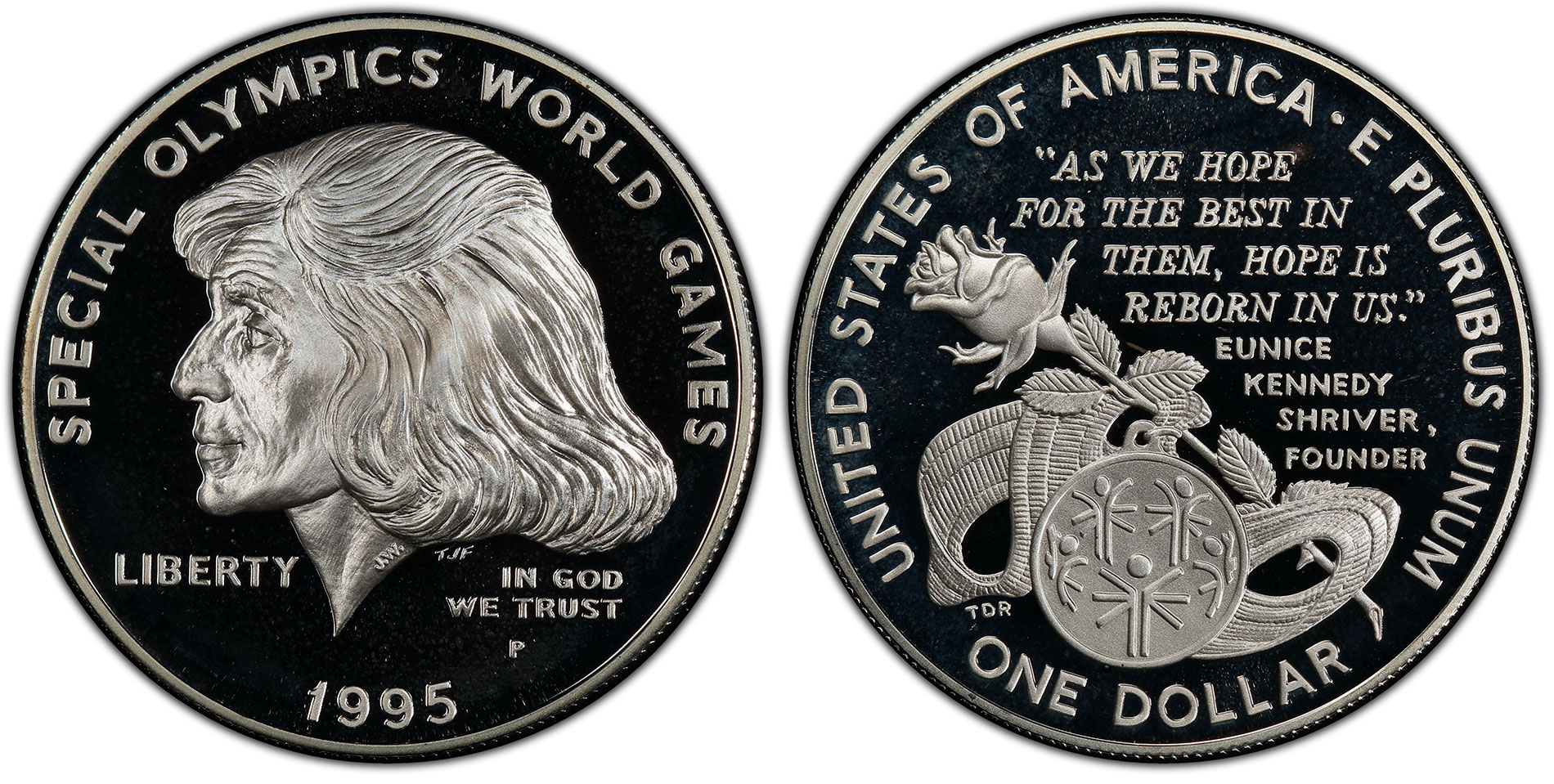
1995-P $1 Special Olympics, DCAM, PCGS PR69DCAM. Click image to enlarge.
Inclusivity is the Name of the Game
The genesis of the Special Olympics is widely attributed to Eunice Kennedy Shriver, the fifth child in the iconic Massachusetts Kennedy clan headed by father Joseph P. and mother Rose Fitzgerald Kennedy. Eunice Kennedy Shriver was especially attuned to the special needs of those with intellectual disabilities. Her older sibling, Rosemary, lived with similar challenges and often accompanied her siblings in a variety of backyard sports, including swimming, sailing, football, and skiing.
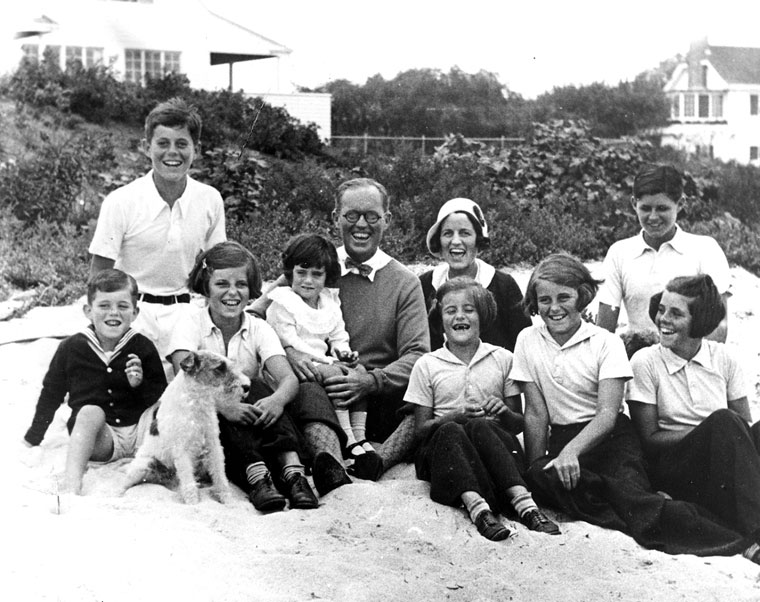
The Kennedy Family at Hyannis Port, Massachusetts, on September 4, 1931. Left-to-right: Robert Kennedy, John F. Kennedy, Eunice Kennedy, Jean Kennedy (on lap of) Joseph P. Kennedy Sr., Rose Fitzgerald Kennedy (pregnant with Edward "Ted" Kennedy), Patricia Kennedy, Kathleen Kennedy, Joseph P. Kennedy Jr. (behind) Rosemary Kennedy; “Buddy,” the family’s dog, is in the foreground. Public domain photo. Click image to enlarge.
From the sisterly bond between Eunice and Rosemary grew a worldwide organization to help enrich and develop the skills of those who would not ordinarily have the opportunity to compete in organized sports. In 1962, Eunice launched a special initiative to help involve youth with intellectual disabilities in a summer day camp known as “Camp Shriver.”
This evolved into the Special Olympics, an event first held at an international level in Chicago, Illinois, in July 1968. Today, the Special Olympics touches the lives of more than 4.7 million individuals across 170 countries. While the Special Olympics embraces a competitive nature amongst its athletes, it equally serves the role of building confidence in those who participate, further enabling them to live their fullest lives inside the sports arena or beyond.
History, Controversy Ensue
Upon seeing the coin, some may wonder how the 1995 Special Olympics Commemorative Dollar honors the sports organization when it quite rather appears to focus more on Eunice Shriver Kennedy. The very appearance of Kennedy on the dollar coin was something of a spectacle upon its release, for she became the first living woman to appear on a United States coin. Other prior appearances of identifiable living individuals on U.S. coins involved the likenesses of Alabama Governor T.E. Kilby on the 1921 Alabama Centennial Half Dollar, then-President Calvin Coolidge on the 1926 Sesquicentennial Half Dollar, Senator Carter Glass on the 1936 Lynchburg (Virginia) Sesquicentennial Half Dollar, and Senator Joseph Robinson on the 1936 Robinson-Arkansas Half Dollar.
The decision to feature Eunice Kennedy Shriver so prominently on the coin, as seen by way of her large left-facing obverse portrait, did not originally sit well with her the Citizens Commemorative Coin Advisory Committee. However, Massachusetts Representative Joseph P. Kennedy II, who helped spearhead the authorization of the coin at the legislative level, led the push to see his aunt honored on the coin dedicated to the Special Olympics cause for which she long advocated.
The coin was soon finalized with the resultant portrait of Eunice Shriver Kennedy on the obverse, designed by T. James Ferrell. The reverse, by Thomas D. Rogers, incorporates a long-stemmed rose, a Special Olympics medal on a competitor’s ribbon, and the following inscription: “’AS WE HOPE FOR THE BEST IN THEM, HOPE IS REBORN IN US.’ EUNICE KENNEDY SHRIVER, FOUNDER.”
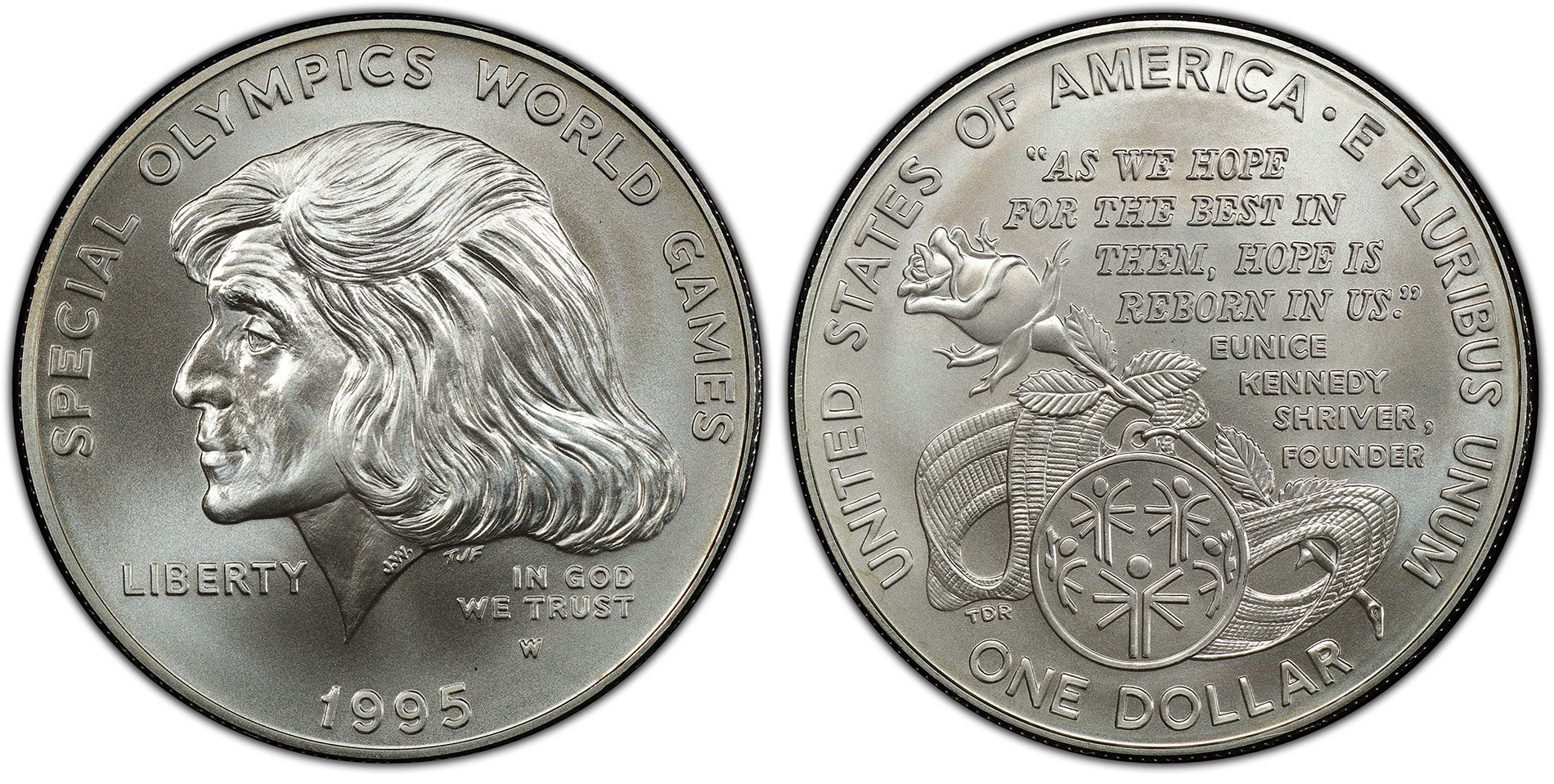
1995-W $1 Special Olympics, PCGS MS70. Click image to enlarge.
Collecting Special Olympics Dollars
A total of 800,000 coins were authorized across both uncirculated and proof formats, though sales of the coin were anemic during a year when several other commemorative coins were also offered. The Special Olympics Dollar was released on May 2, 1995, with uncirculated specimens selling for $32 while proofs had an issue price of $37.
All told, 89,301 uncirculated specimens were distributed while proof sales amounted to 351,764 units. According to numismatic expert Q. David Bowers, some 250,000 proofs were bought by a single corporate organization for later distribution to Special Olympics athletes in 1998. Overall sales figures for the coin would have been absolutely paltry if not for that major transaction.
As with many Modern Commemorative Coins, the Special Olympics Commemorative Dollar isn’t particularly rare or valuable in any grade – even in the numerical grades of “70.” The 1995-W Uncirculated Special Olympics Dollar is readily available in all grades through PCGS MS70, with prices even for those superior specimens in the $75 range according to PCGS CoinFacts. The 1995-P Proof Special Olympics Dollar takes fetches about $235 in a grade of PCGS PR70DCAM, with specimens grading PCGS PR69DCAM far more common and affordable at approximately $40 apiece.
Sources
- “About Eunice Kennedy Shriver.” Special Olympics.
- Bowers, Q. David. A Guide Book of United States Commemorative Coins. Whitman Publishing, 2008.
- Hengeveld, Dennis. “1995 Special Olympics Silver Dollar First to Feature Woman During Lifetime.” Coin Update.
- O’Dowd, Niall. “Rosemary Kennedy: The Sad Life of President Kennedy’s Younger Sister.” Irish Central.
- “Special Olympics World Games Dollar.” Numista.
- “Special Olympics World Games Silver Dollar.” United States Mint.


 Copper & Nickel
 Silver Coins
 Gold Coins
 Commemoratives
 Others
 Bullion
 World
World
 Coin Market
 Auctions
 Coin Collecting
 PCGS News