
The allure of collecting early United States gold coinage is rooted in the history, richness, and rarity that these classic 19th-century coins represent. United States gold coinage of the mid-1820s hearkens to the days when America’s gold rush was centered not on the sunny Pacific shores of California but rather on the wooded mountains of northern Georgia and Western Carolina. Their once-abundant mountainside deposits, said to contain some of the naturally purest gold in the world, helped provide the bullion necessary for a young America to produce a small but respectable supply of gold coinage.
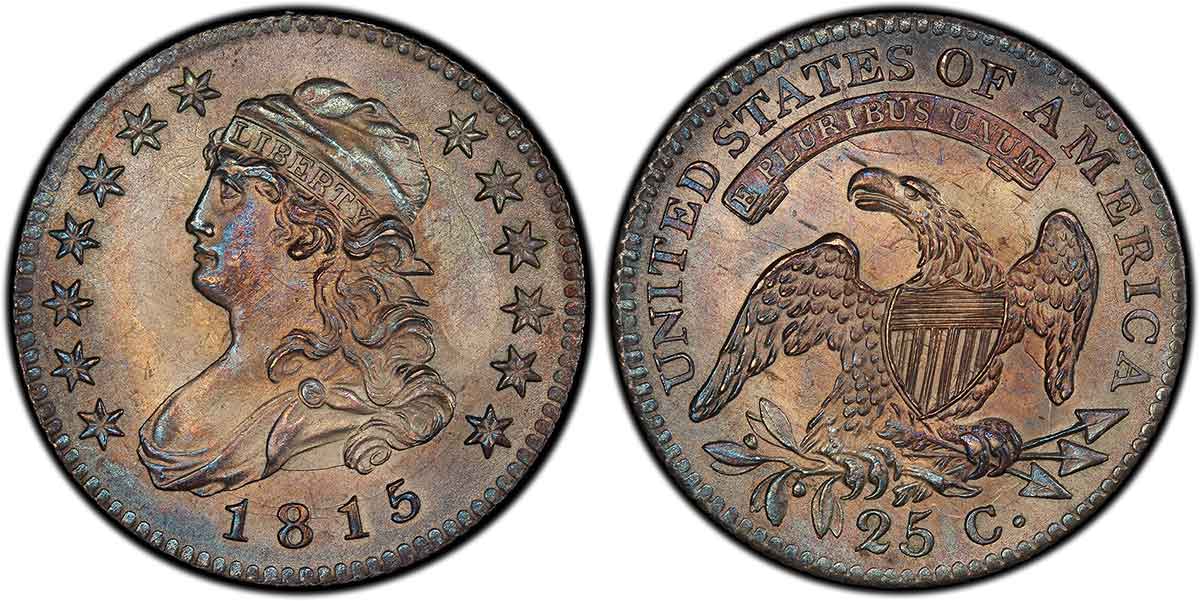
Among the early gold coins hailing from this coveted ore were Capped Bust Quarter Eagles, now revered as rare and sought-after treasures. The large-diameter quarter eagles of 1821 through 1827 checked in at approximately 18.5 millimeters in diameter and were designed by John Reich, a designer whose Capped Bust motif is seen across the spectrum of early 19th-century United States coins.
Unlike many emissions of Reich-designed coinage, such as the voluminously minted Capped Bust Half Dollars, the Capped Bust Quarter Eagles each yielded very small outputs. All issues, with the exception of the 1821 Quarter Eagle, saw mintages of less than 5,000, and several were struck to the tune of fewer than 3,000. The mintages were not intentionally low – they were merely a reflection of the demand for the denomination, and the need for quarter eagles in commerce was relatively low during the 1820s.
Mintage figures provide numismatists a starting point for ascertaining the relative rarity of any coin. Yet, when it comes to early gold, anemic mintages usually reflect a number still many times greater than current populations. Surely, this is the case with Capped Bust Quarter Eagles. Many of the coins that survived initial strains of circulation met their sad fates with smelters when the value of the gold content exceeded their face values. It was something all but inevitable as inflation in the 19th and 20th centuries impacted the buying power of a coin with a visible declared value of $2.50. That, coupled with ever-rising gold prices, which sailed north of $100 by the mid-1970s and nearly touched $1,000 in 1980. Few people would ever consider melting early gold coinage these days for the mere utility of harvesting gold bullion. But the irreparable losses of gold melts over the last century and more have left the numismatic community precious few examples of early U.S. gold coins today.
The true rarity of all coins in the Capped Bust Quarter Eagle series has further become apparent in recent decades. This, as the influence of a robust marketplace and terrific demand for rare coins has brought more examples once held by generations of families out of the woodwork. Yet, early gold coins remain seldom seen even as other series have given up multitudes of fresh finds over the last few decades.
Making early gold coinage even rarer still is the lack of problem-free examples. So often, when a piece is discovered, it is riddled with holes, nicks, bends, deep scrapes, or evidence of past cleanings or polishings. Therefore, problem-free early gold coinage has become a conditional rarity unto itself.
All issues of the Capped Bust Quarter Eagle are categorically rare, most of these offering a grouping of survivors numbering less than a few dozen for any given year. Among these is the 1827 issue, which also happened to be the last of the large-diameter Capped Bust Quarter Eagles. Few of these specimens were preserved for posterity.
“Only 17,042 total examples of the type were produced during its five years of production, making this Capped Head series one of the rarest series in all of numismatics,” explains Kenny Duncan, Jr., of U.S. Coins and Jewelry. All told, just 2,800 strikes were produced of the 1827 Capped Bust Quarter Eagle. “It is estimated that between only 40 and 60 examples of the 1827 exist in all grades,” he added. “In fact, PCGS has certified only 36 examples in all grades from Good to Mint State.”
The 1827 issue offers an estimated few dozen survivors, most of which are believed to be in circulated grades. However, a small number have been miraculously preserved in Mint State grades, giving a select number of collectors tempting opportunities to add an uncirculated example of this historic rarity to their sets.
Just two examples of the 1827 Capped Bust Quarter Eagle were graded MS61, and it offers remarkable eye appeal and other unrivaled qualities that help it stand out above the rest. “A slightly higher-graded example in MS64 brought $144,000 at an auction last November,” recalls Duncan. “Having seen both coins, this one is arguably a bit flashier of an example. This specimen has an exceptional strike, bewildering luster, and eye appeal that you rarely find on pieces of this vintage.”
One fortunate collector with an appetite for desirable early gold has the rare opportunity to acquire a stunning uncirculated example without spending a deep six-figure sum to close the deal. “Premium early gold coins have clearly been taken off the market as our nation prepares to celebrate its semiquincentennial in less than a year,” Duncan remarks. “This is an exceptional piece of American history and a prized early gold example for an advanced numismatic cabinet.”



 Copper & Nickel
 Silver Coins
 Gold Coins
 Commemoratives
 Others
 Bullion
 World
World
 Coin Market
 Auctions
 Coin Collecting
 PCGS News