Silver Dollars & Trade Dollars of the United States - A Complete Encyclopedia
Q. David Bowers
1981-P Anthony Dollar
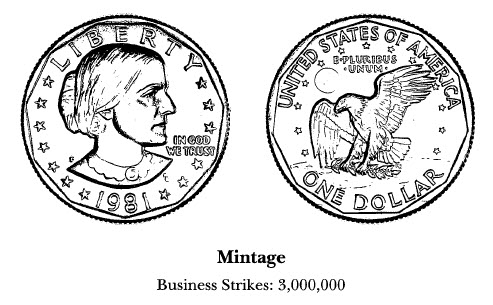
Coinage Context
Last of their kind: By 1981, the Anthony dollar was recognized as a failure as a circulating coin. To the incoming presidential administration of Ronald Reagan, the Anthony dollar was a relic of President Jimmy Carter's failed economic policies. With hundreds of millions of undistributed Anthony dollars piled up in government vaults, there was no reason to mint more for circulation. Three million were made for sale in Mint sets to collectors. Apparently, over 90,000 remained undistributed in this manner.
Numismatic Information
Scarce issue: If any Anthony dollar could be called scarce, the 1981-P is the logical candidate for the honor. The mintage of just three million pieces is the lowest of any date and mintmark in the series. However, as all were made specifically for inclusion in Mint sets to be sold to collectors, there are enough to go around today,
Mint sets: 2,908,145 Uncirculated 1981-P Anthony dollars were included in Mint sets sold by the Treasury to collectors; these sets contained the 1981-P, D and S dollars, plus other denominations cent through half dollar-total face value, $4.82; issue price of set: $11.00 (an increase of $2 from the price of the previous year's set).
Varieties
Business strikes:
1. 1981-P. All are of the same variety.
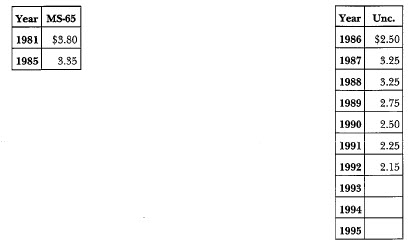
1981-P Anthony: Market Values
1981-P Anthony: Summary of Characteristics
Business Strikes:
Enabling legislation: Act of July 23, 1965 (clad metal), October 10, 1978, and others.
Designer: Frank Gasparro.
Weight and composition: 125 grains (tolerance 4%); outer layers of .750 copper and .250 nickel bonded to inner core of pure copper.
Business strike mintage: 3,000,000.
Comment on availability, MS-65 or better: Common in an absolute sense, but still the scarcest grade level of the issue.
Comment on availability, MS-64: Comment as preceding.
Comment on availability, MS-63: Common; probably a million or more exist.
Comment on availability, MS-60 to 62: Common.
Comment on availability, VF-20 to AU-58: Very scarce, as none were placed into circulation by the government.
Characteristics of striking: Most are well struck. Known hoards of Mint State coins: Does the government still retain some undistributed pieces?
Proofs:
None.
Commentary
This is the lowest-mintage issue in the Anthony series.
Additional Information
The Year 1981 in History
Former movie star Ronald Reagan was inaugurated as president of the United States on January 20. Jimmy Carter went into retirement, becoming involved in many social causes. Carter was regarded as "a good person" who was overwhelmed by national and international situations during his presidency. Also on January 20, Iran released the 52 remaining captives who had been held at the U.S. Embassy in Tehran since November 1979. The Republicans would later be accused of staging the timing to coincide with the inauguration.
In an attempt to improve economic conditions, on February 18 President Reagan recommended a cut of $41 billion in the federal budget drafted by Carter, and also proposed income tax decreases. Reagan was shot and wounded on March 30 by John Hinckley, Jr. Several men accompanying the president were also wounded, most seriously Press Secretary Jim Brady. In April the United States agreed to sell $1 billion worth of military hardware to Saudi Arabia over strong protests from Israel. The 15-month embargo on grain shipments to the U.S.S.R. was lifted on April 24, although the Afghanistan situation was not resolved. U.S. arms sales to the People's Republic of China were permitted in an attempt to establish-closer relations between the countries.' On August 19, Navy planes shot down two Libyan fighters about 60 miles off the coast of Libya after the fighters, claiming sovereignty over the area, opened fire. President Reagan slept through the engagement and learned about it the next morning, Relations with Russia Worsened as martial law was imposed in Poland and the Solidarity movement there was outlawed.
The economy weakened, and a world-wide recession dampened markets for collectibles, including coins and art. The real estate market fell. The inflation rate in 1981, however, was 14%, making double digit increases for three years in a row. National unemployment was at a 7.4% rate. Car sales plummeted. Reagan lifted price controls on oil, and prices bounded upward. Airlines operated at a record loss. On August 3rd, 13,000 air traffic controllers went on strike nationwide. President Reagan announced that unless they returned to work on August 5th they would be fired. Those who did not return to work were eventually replaced; America's labor unions had lost power and would continue to do so.
In the White House, Nancy Reagan dazzled fashion reporters with lavish expenditures on fancy clothes. Not since the Kennedy administration had there been such an interest in this area. Maya Yang Lin, a Yale undergraduate student in architecture, won a nationwide competition to design the Vietnam War Memorial. "The Wall," as it came to be known, was subsequently built in Washington, D.C., and the names of all who died in the war were inscribed on its surfaces.
The coin market still faced a year or two of decline, although solidly collectible issues such as colonials, half cents, large cents, Liberty Seated issues, etc., held their values fairly well or even increased. High-grade silver dollars, gold coins and other issues which had shared in the investment boom experienced widespread reductions. After about 1983 prices would gradually rebuild. Coin grading took many forms. The two main references in print were Official ANA Grading Standards of United States Coins by Abe Kosoff and Kenneth E. Bressett, with introductory material by Q. David Bowers, and Photograde, by James F. Ruddy; but individual interpretations of Mint State and Proof levels varied widely. Standardization of interpretations did not tighten until 1986, when the Professional Coin Grading Service was founded, and some individual differences still continued beyond this point.
The director of the Mint was Stella Hackel Sims (usually referred to as Stella Hackel), who served from November 1977 through April 1981. From July 1981 through July 1991 the director was Donna Pope. .