Silver Dollars & Trade Dollars of the United States - A Complete Encyclopedia
Q. David Bowers
1980-P Anthony Dollar
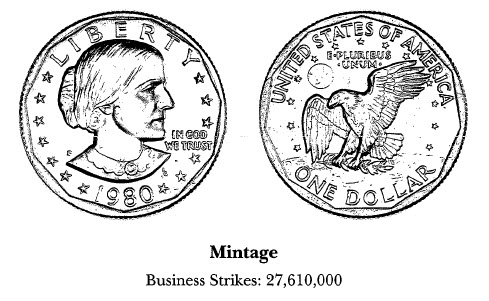
Coinage Context
Handwriting on wall: By 1980, the handwriting was on the wall, there was trouble in paradise, and it was evident that the Philadelphia Mint had struck enough coins for use from now to Kingdom Come. Accordingly, production was scaled back sharply, but to have stopped it completely would have been tantamount to admitting the whole idea was a poor one. Actually, the Jimmy Carter administration and his Mint director (Stella Hackel Sims) never did face the facts. In time, the Anthony dollar simply faded away.
Numismatic Information
Availability: Today, there are more than enough 1980-P Anthony dollars to satisfy numismatic demands, but as a date it is scarcer than its 1979-P predecessor.
The question is this: In some future generation will a reader of a dusty copy of this book wonder why all of its readers didn't each buy thousands of Anthony dollars in bulk at face value in the 1990s? Today, we ignore them as being too common, just as numismatists of a half century ago ignored vast quantities of stored Morgan dollars.
Mint sets: 2,815,066 Uncirculated 1980-P Anthony dollars were included in Mint sets sold by the Treasury to collectors; these sets contained the 1980-P, D and S dollars, plus other denominations cent through half dollar-total face value, $4.82; issue price of set: $9.00.
Varieties
Business strikes:
1. 1980-P. All are of one standard variety with the date close to rim. Walter H. Breen (Encyclopedia, p. 472) suggests that some may exist with date distant from rim, but none has been reported.
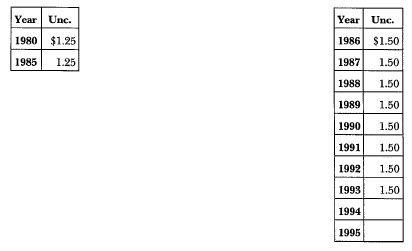
1980-P Anthony: Market Values
1980-P Anthony: Summary of Characteristics
Business Strikes:
Enabling legislation: Act of July 23, 1965 (clad metal), October 10, 1978, and others.
Designer: Frank Gasparro.
Weight and composition: 125 grains (tolerance 4%); outer layers of .750 copper and .250 nickel bonded to inner core of pure copper.
Business strike mintage: 27,610,000.
Comment on availability, MS-65 or better: Common on an absolute basis, but on a relative basis far fewer exist than do of 1979-P, due to the mintage differential.
Comment on availability, MS-64: Comment as preceding.
Comment on availability, MS-63: Plentiful in this grade, but more elusive than the 1979-P issue.
Comment on availability, MS-60 to 62: Most extant 1980-P dollars are in this category.
Comment on availability, VF-20 to AU-58: Relatively few exist in worn grades, but those that do are apt to be at the AU level:"
Characteristics of striking: Usually seen well struck. Known hoards of Mint State coins: Quantities are held by the U.S. Treasury (as of 1993).
Proofs:
None.
Commentary
The 1980-P, with its lower mintage, is more elusive in all grades than is 1979-P, but still enough survive that the issue is common.
Additional Information
The Year 1980 in History
The Jimmy Carter administration experienced a great deal of difficulty in 1980 despite the president's well-meaning and honest intentions. The hostages were still being held at the U.S. Embassy in Iran, casting a cloud over the international scene. Soviet occupation of Afghanistan was agonizing, and relations between the United States and the U.S.S.R. became very cold. To many observers Jimmy Carter seemed to occupy an office larger than he was capable of managing, and he seemed unable to cope with its many problems. Carter canceled a grain order to Russia in protest of the Afghanistan situation, withdrew sales of high technology equipment, and declared that the United States would boycott the 1980 Olympic Games in Russia. On January 23, 1980, Carter stated that force would be used if necessary to keep supply routes open to the Persian Gulf. In February, an FBI sting operation called ABSCAM incriminated 31 publicofficials, including one senator and six representatives.
In a humanitarian move, Carter signed the Refugee Act of 1980 on March 17, broadening the term to include people from any part of the world, and increasing the maximum admitted annually to 320,000 from 290,000. On April 7, diplomatic relations with Iran were suspended. On April 24, a rescue mission to free the hostages failed, and eight were killed in a plane crash associated with the mission. President Carter deregulated certain trucking rates on July 1 and certain railroad rates on October 14th. The Republicans nominated Ronald W. Reagan for president and George Bush for vice president, while the Democrats ran the Carter-Mondale ticket for re-election. Reagan's powerful campaign, coupled with widespread dissatisfaction with the incumbent, scored a Republican victory on November 4.
Inflation continued rampant and by the end of the year had increased to 12.4%, the second year of double-digit inflation, causing annuities and pensions to lose their value and increasing concern over the soundness of the American dollar. Unemployment reached 7.1 %, automobile sales were at their lowest in 19 years, and the Ford Motor Company reported losses of $575million, the largest ever sustained by an American corporation. The country's largest corporation, Exxon, attained $79.1 billion in sales; General Motors was the second largest.
Mt. St. Helens in Washington state erupted on May 18, flattening timber for miles around. The volcano, inactive since 1857, filled the air in the northwestern United States with clouds of microscopic dust. On November 28, Las Vegas' MGM Grand Hotel caught fire, killing 84 people. West Point, the Naval Academy, and the Air Force Academy all graduated their first women cadets. The November 21 "Who Shot JR.?" episode of Dallas, a popular television soap opera, drew more viewers than any other single television program in United States history. Voyager I (launched in September 1977) flew close to Saturn and found additional rings and three new moons; 15 moons were now known.
On Broadway it was the year for revivals, and The Music Man, Brigadoon, and West Side Story were staged. The United States withdrew from the Summer Olympics, as did some 50 other nations. However, in the Winter Olympics in February in Lake Placid, New York, the U.S. hockey team beat the Finnish and Russian hockey teams and won a gold medal. American athlete Eric Heiden won five gold medals in speed skating.
The coin hobby, which had been riding an investment wave for several years, peaked early in 1980, some say at the Central States Numismatic Society Convention in Lincoln, Nebraska. Prices began a fall which would continue for the next several years, bottoming out in 1982-1983. In the meantime, The Garrett Collection sold forThe Johns Hopkins University by Bowers and Ruddy Galleries, Inc. continued to break price records as buyers ignored economic and numismatic conditions to bid for many gems. When the last of the four sales was held in 1981, the collection grossed $25 million, the largest amount ever realized for any rare coin collection at auction. The West Point Bullion Depository (later renamed West Point Mint) began striking ounce and half-ounce gold American Arts Gold Medallions. Collectors ignored them; the program ended in 1984.