Silver Dollars & Trade Dollars of the United States - A Complete Encyclopedia
Q. David Bowers
Problems Between Morgan and Barber
During the spring and summer of 1877 Morgan made several pattern dies, both for gold and silver coins, and had specimens struck on the old screw press. (This press also struck medals and Proof coins for collectors.) By August, William Barber was grow-ing increasingly irritated at Morgan and his special position at the Mint, and suddenly ordered that Morgan not be allowed to use the screw press without written orders from the superintendent.
Morgan reported the intransigence on Barber's part in a letter to the director in Washington. Dr. Linderman was angered that Barber would attempt to sabotage Morgan's work and wrote a very unpleasant letter to the chief engraver, making it clear that no further interference would be tolerated. The screw press was suddenly available to Morgan without a mass of red tape being in the way. Linderman did say, however, that the work was to be given to Superintendent James Pollock, who would see to it being executed in the proper manner.
On August 11 Morgan delivered several galvanos to Pollock, including one for the obverse of Judd-1503 to 1509, the direct ancestor of the Morgan dollar obverse. The new half dollar patterns were well received in Washington, though not, it would appear, in the office of Chief Engraver William Barber. Linderman asked Morgan to put the new eagle, designed for the gold coinage, on the reverse of the half dollar. The design elements of the future Morgan dollar were now in place on a half dollar. The appropriate patterns Gudd-1508 to 1511) were duly struck in September 1877.
Linderman was so impressed with the September half dollar patterns that he showed them to several interested persons in Washington. This was not only to prepare higher officials for his plan to change minor silver coinage designs, but also to prove that his decision to bring Morgan to this country had been a good one. The director had no idea that all his plans in this direction would be thrown into the wastebasket by an unexpected event: the return of the old silver coinage. Fear of impending disaster gripped the hearts of the Silverites.
Preparing for Silver Dollar Legislation
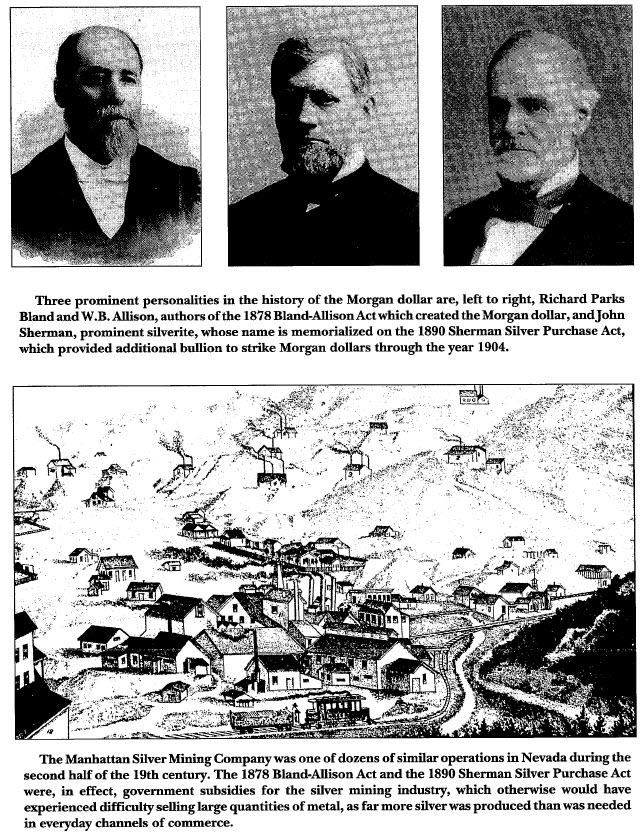
November 1877 saw Representative Richard Bland reintroducing his bill for the free and unlimited coinage of silver dollars. Dr. Linderman saw very clearly, even before Bland had acted, that the silver dollar would soon be reality. Political pressure in the country was simply too great for the president to withstand. The director knew of the uproar over the delay by Longacre in finishing the 1849 double eagle dies, and was determined to be ready when Congress ordered the coinage of silver dollars.
On October 18 Linderman directed Morgan to use the September half dollar design(s) in a dollar format. William Barber was given instructions at the same time, but was told not to create new artwork, but instead to use existing devices. In this respect, of course, the orders were similar, even though Morgan had unofficially been given the edge. Barber circumvented the directions to a certain extent by using a design on which he had been working, presumably not "new" artwork.
It was not long before both Morgan and Barber had prepared dollar dies. In both cases master dies, rather than working dies, seem to have been used to strike patterns. If the dies had broken they would have had to be made again, but the time saved was considerable and worth the risk involved.
Morgan had been very careful in preparing both artwork and dies, and his dollar patterns of early December 1877 struck up with ease, according to Superintendent Pollock. On the other hand, Barber had been careless about the height of his Liberty head, perhaps as a result of rushing to finish the work, and patterns prepared from his dies did not strike up well. Pollock ordered that Barber's patterns be made in copper, a softer metal than coin silver, so that the details of the design could be seen.