Silver Dollars & Trade Dollars of the United States - A Complete Encyclopedia
Q. David Bowers
The Making of Dies
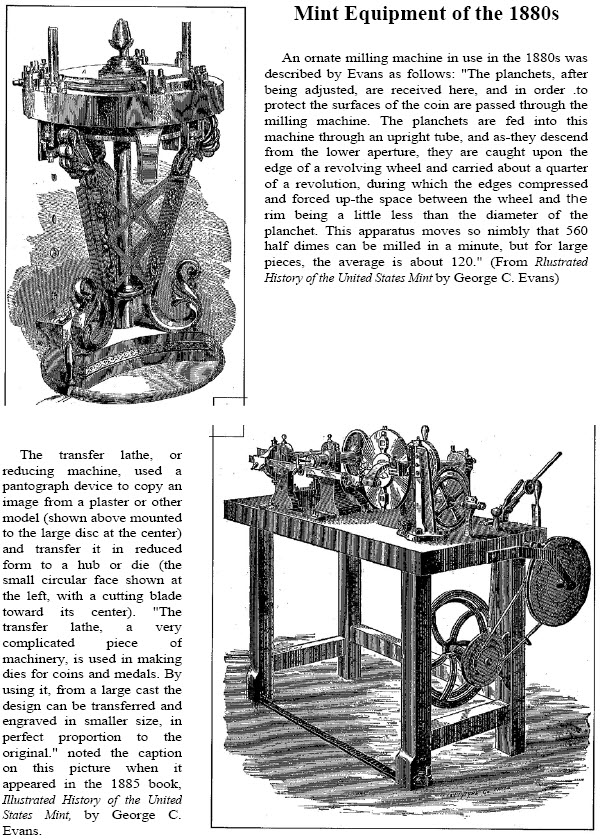
Dies for coins and medals in 1877 were not made in the same manner as today. The engraver's first step was to model an enlarged Liberty head (or eagle, etc.) in clay and then make a plaster mold. From this mold a plaster copy was taken and in turn used to make a copper model, called a galvano. The galvano was placed on the Hill Reducing Machine (which operated on the pantograph principle), producing a steel punch the exact size of the device that would appear on the coin or medal.
This steel punch, called a hub, was then used to make a die. The hub was driven into a blank die and then letter punches were used to put in the appropriate lettering. When this was finished the engraver had what was called a master die. The master die was in turn punched into a blank piece of steel, creating a master hub, which was just like the finished coin, except that the date was normally missing. Master hubs were then used to create working dies, which actually struck the coins.
On occasion, to save time, the engraver would use a master die to strike pattern coins, and it is not always possible for the numismatic historian to determine when this was done. It was also possible to make changes in the artwork at virtually any stage of the work. Morgan was to do just this in the winter of 1877-1878 when his design for the dollar was being completed.
Morgan's Design Progresses
By December 1876 Morgan was well along with his design work and had begun to create the necessary clay models. His head of Liberty based on the profile of Anna Williams, later to be famous on the Morgan dollar, was already underway. The plasters were completed in early January. During the first week of February he was able to strike some pattern half dollars for transmission to Dr. Linderman in Washington. It is uncertain just which trial pieces were executed, but the obverse die appears to be the one used for Judd-1514.
Linderman was pleased with this early effort and made the first of his numerous critiques on the art work. Several suggestions (i.e., orders) were made to Morgan over the next several months. William Barber was also preparing dies for half dollars, and several patterns were struck from his dies also, especially in the summer and autumn of 1877; most of these, however, were artistically inferior to those executed by Morgan.
In the spring of 1877, while Morgan was at work on the half dollar designs, he was also assigned by Linderman two additional tasks, one of which was to bear heavily on the final design for the Morgan dollar of 1878. The first of these commissions was to prepare dies for the Hayes presidential medal. It was to be the first struck specifically for this series, previous medallic presidential portraits having been in the Indian Peace medal series.
The second order was to prepare artwork for proposed design changes on the eagle and half eagle gold coins. Gold was not yet back in active circulation, and would not be until December 1878, but Linderman wanted to be ready with new designs when that time came. By the middle of May 1877 Morgan had already prepared suitable drawings for the gold. It was at this time that he created the eagle which was later to grace the reverse of the Morgan silver dollar.