Silver Dollars & Trade Dollars of the United States - A Complete Encyclopedia
Q. David Bowers
The Standard Dollar Abolished
Mint officials, past and present, denounced the idea of a "standard dollar" and suggested instead that the silver dollar be abolished. They pointed out that it had not circulated within living memory and there was considerable doubt that it had ever seen daily commercial use, even in the 1790s. (A contention belied by the existence then and today of numerous well-worn specimens in numismatic hands.) Because of this unanimous opposition, Knox deleted the standard dollar provision from his draft and Section 15 now listed the half dollar as the largest silver coin.
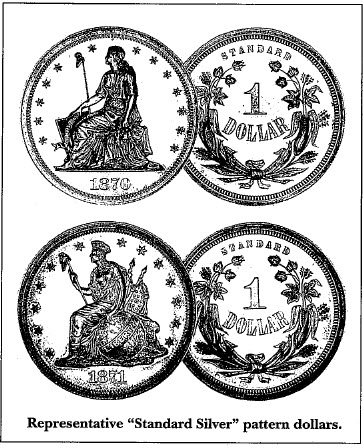
The words "standard dollar" sometimes meant something other than a 384-grain silver dollar. It-had long been a pet project of Mint officials to strike silver coins whose weights would be lowered to the point that they would circulate at par with federal paper currency. This was in direct opposition to the Administration's plan of raising the value of the paper to meet the silver and then the gold. In 1869 and again in 1870 and 1871 a series of "standard" silver pattern coins of reduced weights and diameters were coined at the Philadelphia Mint, from designs by Chief Engraver William Barber and motifs created earlier by James B. Longacre, who had died in 1869. Dollar coins bore the inscription STANDARD / 1/ DOLLAR. It was envisioned that if these lower-weight coins were made in quantity they could be put into circulation to retire millions of tattered Fractional Currency notes. Silver coins had not been seen in pocket change since July 1862, and Mint officials feared that new silver coins, if of full weight, would simply be hoarded.
Debased silver pattern coins were again struck during 1871, but this ended the program. Mint Director James Pollock, who had returned for a second term in 1869 after Linderman had resigned, saw the handwriting on the wall and gave the idea up for lost. The government and public simply would not accept anything less than a return to pre-war standards.
The 1873 Coinage Bill
Meanwhile, the House of Representatives was considering the Knox draft legislation which had been submitted in the summer of 1870. Virtually nothing was done until February 1872 when a House committee amended the bill to insert a provision for a commercial dollar of 420 grains, 900/ 1000 fine silver. Just three months later the whole House of Representatives voted to remove the offending section and replace it with a standard silver dollar weighing 384 grains. The Mint did not acknowledge this with relevant patterns, however.
On December 16, 1872, a Senate committee report amended the House version to insert a trade (commercial) dollar weighing 420 grains, the same as the February amendment prepared by the House committee. There was now a House version with a standard dollar (384 grains) and a Senate version with a trade dollar of 420 grains. The usual conference committee was appointed and it appears that the House Speaker picked those members favorable to the trade dollar concept because that is what came out of conference. The revised bill was passed by the Senate and House of Representatives and signed into law by the President on February 12, 1873. It was to take effect on the first of April.
In later years politicians called this legislation the Crime of '73 on the grounds that it had been rushed past a sleepy Congress with no debates and little consideration. It is true that formal debates were not all that many, but in committee there were spirited arguments and witnesses were certainly free to express their opinion. However, the "Silverites," as the silver forces came later to be known, did not realize in 1872 and 1873 just how fast the value of their metal would fallon the open market. On the other hand, the "Crime of '73" provided excellent political propaganda, even if it were not all that accurate. Then as now, politicians could count on the short memory of the public.