Silver Dollars & Trade Dollars of the United States - A Complete Encyclopedia
Q. David Bowers
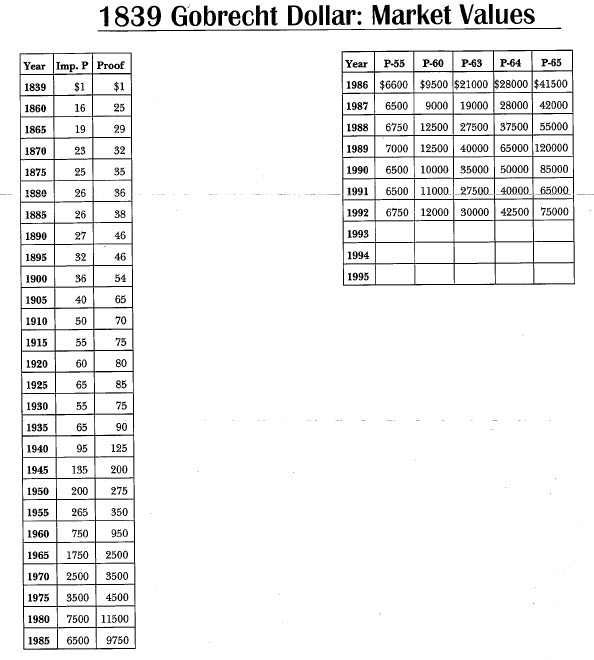
1839 Gobrecht Dollar: Summary of Characteristics
1839 Gobrecht, Plain Rev. Field, R.E.
Enabling legislation: Act of January 18, 1837 Designer of obverse: Christian Gobrecht (after Thomas Sully)
Designer of reverse: Christian Gobrecht (after Titian Peale)
Statutory weight: 412.5 grains; 900 silver, .100 copper Meltdown (silver value) in 1839: $1.023
Dies prepared (original issue): Obverse: 1; Reverse: 1 Business strike mintage: None
Proof mintage: 300 for circulation in 1839, all or nearly all believed to have been struck with die alignment IV; unknown quantity of later issues, with different die alignments. Delivery figures by day (original issue): December 31, 1839: 300.
Approximate population Proof-64 or better (nearly all are alignment IVa): 15-30 (URS-5)
Approximate population Proof-60 to 63 (nearly all are alignment IVa): 50-75 (URS-7)
Approximate population VF-20 to Proof-58 (nearly all are alignment IV): 100 to 150 (URS-8)
Commentary
The 1839 dollar has stars in the obverse field and no stars in the reverse field. The only issue of the later Gobrecht design made for circulation; all were issued with Proof finish.
Additional Information
The Year 1839 in History
In the United States Magazine and Democratic Review, John L. O'Sullivan commented: "The far-reaching, the boundless future will be the era of American greatness. In its magnificent domain of space and time, the nation of many nations is destined to manifest to mankind the excellence of the divine principles to establish on earth the noblest temple ever dedicated .... " (This statement was made in an era of slavery, oppression of women, abuse of children-all biblically rationalized-, exploitation of Native Americans, massive fraud in banking and medicine, and widespread, grinding poverty.)
Henry Clay, long-time aspirant to the White House, consulted advisors before making a speech urging moderation in the cause of abolition. When told that members of each major party were likely to be offended, he replied, "I trust the sentiments and opinions are correct; I had rather be right than be president." In a famous rejoinder an opponent said Clay would never be either.
The Hard Times continued in the United States, and while many new businesses were founded, many old ones experienced financial difficulties. From 1837 through the first few years of the 1840s, bondholders in Europe and America suffered losses on numerous failures of U.S. banks and business ventures and on defaults by the states of Pennsylvania and Maryland. The Adams Express Company was founded and entered service between New York and Boston, and would go on to become one of the largest American carriers of packages.
The "Doubleday legend" holds that West Point cadet Abner Doubleday, 19, of Cooperstown, New York, devised rules in 1839 for the conduct of baseball, including the use of a diamond-shaped field and two teams each with nine players. He did not invent the game. Indeed, in earlier citations, in England, Lady Hervey mentioned it in 1784 correspondence, Jane Austen referred to it in a novel, and it was played at Harvard in the 1820s. The Russians recognized it as an adaptation of their older game of lapta. The credit to Doubleday arose when major league owners ordered a committee of the game's elder statesmen to inquire into the origins of baseball, and after a fire destroyed its final report, committee chairman Albert G. Spalding relied on the sole testimony of an old mining engineer who told of Doubleday's invention. Despite the inaccuracy, 1939 would see a season-long celebration of the game's "birth." Many years later, Cooperstown would become the site of the Baseball Hall of Fame.
Among items on the literary scene were Charles Dickens' novel, Nicholas Nickleby, published in book form after being serialized in a magazine, and Edgar Allan Poe's story, "The Fall of the House of Usher," which appeared in the September issue of Burton'5 Gentleman '5 Magazine. The camera was popularized, and several different people claimed credit for being the first to devise the daguerreotype process, ancestor of modern photography. Romeo etJuliette, a symphony (for voices and a gigantic orchestra) by Hector Berlioz, received its premiere on November 24 in Paris. In Scotland the bicycle was invented, but widespread popularity was decades away.
Britain started the Opium War with China, after Chinese officials destroyed $6 million worth of opium from India (mostly owned by Britons) stored in Canton. The East India Company promoted opium use to keep workers complacent and to provide profitable trade goods to a captive Chinese clientele. Elsewhere, especially in America and Europe, opium was a common ingredient of patent medicines, especially sleeping potions, painkillers, and tranquilizers for babies.
According to the 1840 census, in 1839 the number of people employed in gold mining was 1,046, the amount of capital invested in the industry was $234,300, and the amount of gold extracted amounted to $529,500, of which Virginia produced $52,000, North Carolina $256,000, South Carolina $37,000, Georgia $122,000, Alabama $61,000, and Tennessee $1,500. During the same year the amount deposited for coinage came to $385,000, indicating that about 7/10th of the annual production of gold from 1839 was converted into United States coins.
At the Philadelphia Mint several new portraits of Miss Liberty by Gobrecht appeared on the cents. Two of these later acquired the nicknames Booby Head and Silly Head among collectors. A third, the Braided Hair style, based upon Ben jamin West's effigy of Venus, followed and (after modifications in 1843) continued to the end of the large cent series in 1857. Gobrecht introduced another head on half eagles, and a modified one on eagles; these would continue in use until 1907. His Liberty Seated motif was used for the first time on half dollars, to remain through 1891.