Silver Dollars & Trade Dollars of the United States - A Complete Encyclopedia
Q. David Bowers
1839 Gobrecht Dollar
Coinage Context
Gobrecht issue: In 1860, James Ross Snowden noted this in his book, The Cabinet Collection of the Mint of the United States: "1839. A dollar, of the same type as the pattern dollar of the previous year, was struck. The Director's Report of that time states that 300 of these were coined, but we have been unable to find any memorandum to that effect on any of the Mint Records, where it should properly appear, if such were the case. They are not as rare as the dollars of 1838, and the coinage was probably more extensive. "
Numismatic Information
Proofs: All 1839 Gobrecht dollars were made with Proof finish. All are listed as Judd-104. The attribution of die alignments to original and restrike issues given below differs from that published earlier by R.W. Julian and Walter H. Breen.
In preparing a revisionist view of the Julian-Breen theory, Liberty Seated specialist Larry Briggs commented as follows;' (Letter to the author, March 27, 1992)
My own personal notation and brief on 1839 Gobrecht dollars is this: From 1986 until late 1991 I searched for a so-called "original" 1839 specimen for a client. In that span I looked at 43 different (?) coins; two "originals" and 41 "restrikes." Of the so called restrikes, 39 (!) were impaired (holed, holed and repaired, mounted, or with field repairs of some sort) and/or were in circulated grades from VG to Proof-50, with most in VF grade levels. My personal opinion is that the so-called restrikes are actually originals, and "originals" are really the restrikes.
I find it very hard to accept the statement that restrikes issued for collectors were in almost 98% of my findings spent or holed or looped for keepsakes. It makes more sense to me that these items were actually originals and were saved during the several decades after they were made, whereas actual restrikes would mostly still be in high Proof grades and undamaged. This view is shared by several of my colleagues.
James C. Gray commented as follows: (Letter to the author, May 14, 1992.)
As for 1839 Gobrecht dollars, Walter Breen states on page 436 of his Encyclopedia that originals have Die Alignment I and restrikes have Die Alignment III and may exist in Die Alignment IV. With all due deference to Walter's research, I feel that this is not the case.
I have examined, or seen fully catalogued, approximately twenty (20) 1839 Gobrecht dollars, and all of them have been in Die Alignment IV. It is possible that Walter misread his notes and meant to say that restrikes existed in Die Alignment IV and may exist in Die Alignment III.
I have never seen a single piece dated 1839 in Die Alignment I or Die Alignment III, and about 90% of the of the 20 pieces I have seen in Die Alignment IV have been circulated. In addition, 1839 Gobrecht dollars in Die Alignment IV appear one time for every three appearances of 1836 original Gobrecht dollars, which is about in proportion to their stated mintages. Given the high circulation rate of the 1839s in Die Alignment IV and their appearance about one-third as often as 1836 original dollars, it is my feeling that these coins are indeed the circulating issue of 1839.
In response to the above, Walter H. Breen commented thus; (Letter to the author, April 21, 1992.)
On the 1839 Gobrechts, it is absolutely essential, if we are ever to settle the question of which are originals, which are restrikes, to examine many in both these groups for reverse die state. Originals, whatever the grade, should be from earlier die states; restrikes, whatever the grade, from the later states. Originals should be earlier than the die state of any Judd-105.
Further from Walter H. Breen: (Letter to the author, June 5, 1992.)
I don't care if [other students of the series] insist on calling Alignment III or IV 1839 Gobrechts originals, Alignment I restrikes. The evidence that would convince me is die states: is there even one Alignment I piece with heavier cracks on the reverse than Alignment III or IV coins? I haven't seen one, but I'm certainly willing to look. I have no emotional commitment one way or the other-primarily curiosity. We are only beginning to learn about Gobrechts; your comments on J-104 and 105 are a good effort in the right direction, and that same intensive analysis of die states for others (most of all 1838-9) will someday enable a future researcher to establish an absolute chronology ....
The following analysis-distribution is based upon information from Messrs. Briggs, Gray, Pollock, et al.
Varieties
Proofs:
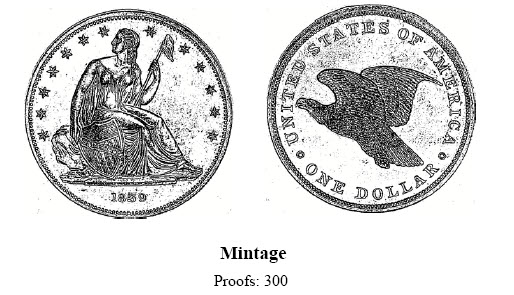
1. Die alignment I. Restrike: Breen-5421; Julian- 25. Obverse: Liberty Seated. Thirteen stars around upper border. No Gobrecht signature or inscription. Reverse: Eagle flying onward and upward in plain field. Silver. Reeded edge. The alignment earlier called "original," but now believed to be a later restrike. Exceedingly rare; in fact, it may not exist. Andrew W. Pollock III was able to find no confirmed auction appearances, and only one tentative one (Superior's sale of the Ebsen Collection, May 1987, Lot 1934; this may be alignment III). In the course of examining leading pattern collections and corresponding with specialists, he has not learned of the existence of even a single specimen.
2. Die alignment II: Reeded edge. No information available. Does this exist? In the course of examining leading pattern collections and corresponding with specialists, Andrew W. Pollock III has not learned of the existence of even a single specimen.
3. Die alignment III. Restrike: Reeded edge. In the course of examining leading pattern collections and corresponding with specialists, Andrew W. Pollock III has not learned of the existence of even a single specimen. On the other hand, plain edge coins (J-105; restrikes) appear on the market occasionally.
4. Die alignment IV. Original: (Letter to the author, June 5, 1992.) Breen-5422; Julian 27. Reverse die without cracks. 300 struck, most of which were put into circulation. Nearly all seen today show evidence of wear. For estimated population see Summary of Characteristics below. Nearly all of the worn pieces are of alignment IV.
4a. Die alignment IV. Restrike: Breen-5422; Julian 27. Later (1858 or later) use of the dies of No. 4, now repolished and with reverse cracks. For estimated population see Summary of Characteristics below. Nearly all of the Proof-60 or finer pieces are of alignment IVa.
Notes concerning a specimen in Auctions by Bowers and Merena, Inc.'s Somerset Sale, May 1992 (earlier in Stack's Garrett Sale, 1976, Lot 255): Weight: 411.9 grains. Die alignment IV. Obverse: With repunching on 5th star, particularly noticeable on the left side, where an undertype point appears slightly to the right of the regular point; repunching on 8th star, below the rightmost star point a "ghost" point in the form of a triangle is seen in the field, barely touching the star. Reverse: With hairline die break through tops of MERI; this break begins in the field below the denticles at the upper right of the first A in AMERICA and goes downward to touch the left side of the letter M, continuing through the tops of MERI. Along the denticles beginning above the right of the last S in STATES, and continuing for much of the space between S and 0 (of OF), is a tiny raised die irregularity running parallel to the denticles. A tiny die break, microscopically visible, connects the tops of NIT; no thorn on D of UNITED. Some diagonal die finish lines slope down to the right from the denticles above IT of UNITED. Earlier state of the die used to coin the J-105 described above.