Silver Dollars & Trade Dollars of the United States - A Complete Encyclopedia
Q. David Bowers
An Overview of the Series 1794-1795 Flowing Hair Dollars
In 1794 the first silver dollars were struck. The mintage has been widely published as 1,758 specimens, a figure taken from the official Mint report. The design is of the Flowing Hair motif with Small Eagle reverse, similar to that used on the half dimes and half dollars dated the same year. The edge of this and other early silver dollars bearing dates through 1804 are lettered: HUNDRED CENTS ONE DOLLAR OR UNIT with ornaments between the words.
According to Jack Collins, who has studied the 1794 dollar in detail, examples of this date exist to the extent of somewhere between 120 and 130 coins. Most survivors show considerable signs of wear, and all show at least some signs of light striking, particularly at the lower left obverse and corresponding part of the reverse.
In American numismatics, the ownership of a 1794 dollar has always been a badge of distinction. Over the years the frequent auction appearances of this date have furnished occasions for numerous tributes to the coin's rarity and desirability.
The attractive Flowing-Hair design was continued in use throughout most of the year 1795; Two main varieties of 1795 Flowing Hair dollars are listed in popular catalogues: the style with two leaves under each wing on the reverse, and that with three leaves, although other characteristics are readily discernible. Seventeen different die varieties are known of 1795 Flowing Hair dollars. However, most demand today comes from collectors desiring but a single specimen for inclusion in a type set. Those acquiring dollars by die varieties are few and far between, due to the basic high cost for even common issues.
Flowing Hair silver dollars of 1795 exist today in all grades. Most often seen on the market are coins in lesser conditions, Good through Very Fine, with Fine to Very Fine being average. Extremely Fine specimens are elusive, AU pieces with original lustre are quite rare, and Uncirculated examples are few and far between. Only a few MS-63 or finer pieces are known.
In keeping with other early silver (and gold) denominations, early silver dollars often show mint-caused adjustment marks, due to filing of the planchets to remove excess silver prior to coining, to bring the piece down to the weight required by law. Adjustment marks usually take the form of parallel or criss-cross grooves or scratches recessed in the sup face of a coin, and are most visible near the rims and at the center. (By contrast, a scratch on a die used to strike a silver dollar will appear as a raised line on the finished coin.)
Striking quality varies from die variety to die variety. Some are more sharply impressed than others. One often-seen variety (1795 BB-27) has weakly defined details in Miss Liberty's hair. Some especially intriguing specimens of the 1795 date have a Mint-inserted silver plug in the center of the coin.
Attributing 1795 Flowing Hair die varieties is easy to do. On the obverse, the positions of the bust, hair curls, stars, letters in LIBERTY, and date numerals in relation to each other are determinants. On the reverse, such variables as the number of berries in the wreath and their positions, the letters of UNITED STATES OF AMERICA in relation to the leaves and berries, the number of leaves below each wing of the eagle, and other features provide keys to attribution.
After a short perusal of the Easy-Finding Guide and examination of the illustrations, each variety will come to life in your eyes and will be easy to identify.
1795-1798 Draped Bust Dollars Small Eagle Reverse
Late in the year 1795 the Draped Bust obverse with Small Eagle reverse was adopted for silver dollar coinage. Artist Gilbert Stuart, contemplating the Flowing Hair motif, remarked in 1795 that "Liberty on the other coins had run mad. We will bind it up and thus render her a steady matron." Accordingly, Stuart created what we know today as the Draped Bust obverse motif.
The new design depicted the draped bosom of Miss Liberty facing right, the word LIBERTY above, the date below, and stars to left and right, on the obverse. The reverse showed an eagle perched on a cloud within a wreath composed of an olive branch to the left and palm leaves to the right, tied with a bow at the bottom. The inscription UNITED STATES OF AMERICA surrounds, with particularly wide spacing between the words. Just two die varieties are known for the 1795 year: BB-51 and BB-52. Each is easy to find.
This style was continued through early 1798 and is similar to' that used on half dimes and dimes of 1796 and 1797, quarters of 1796, and half dollars of 1796 and 1797.
Particularly interesting is the 1795 BB-51 variety with small letters on the reverse. This identical reverse die was used with six different obverses dated 1795, 1796, 1797, and 1798!
All dollars of 1796 and 1797 are of the Draped Bust obverse and Small Eagle reverse type. Silver dollars of both dates exist in several varieties. A rarity is the 1797 issue with the Small Letters reverse, BB-72, struck from the durable reverse die just discussed, first used to coin 1795 BB-51. Nearly all specimens of the 1797 BB-72 dollar are weakly defined on the reverse, due to the shallow relief of the die after it had been resurfaced (relapped). No specimens of 1797 BB-72 exist above the AU level, to my knowledge, and the best grade usually seen is VF.
During the first part of 1798, two varieties of silver dollars of the Draped Bust type with Small Eagle reverse were produced, 1798 BB-81 and BB-82. Coinage was quite limited, as can be estimated from the fact that there are over 30 different die varieties of 1798 silver dollars, of which just two have the Small Eagle reverse style. 1798 Small Eagle dollars are scarce in all grades.
Counting Board Used at the Mint
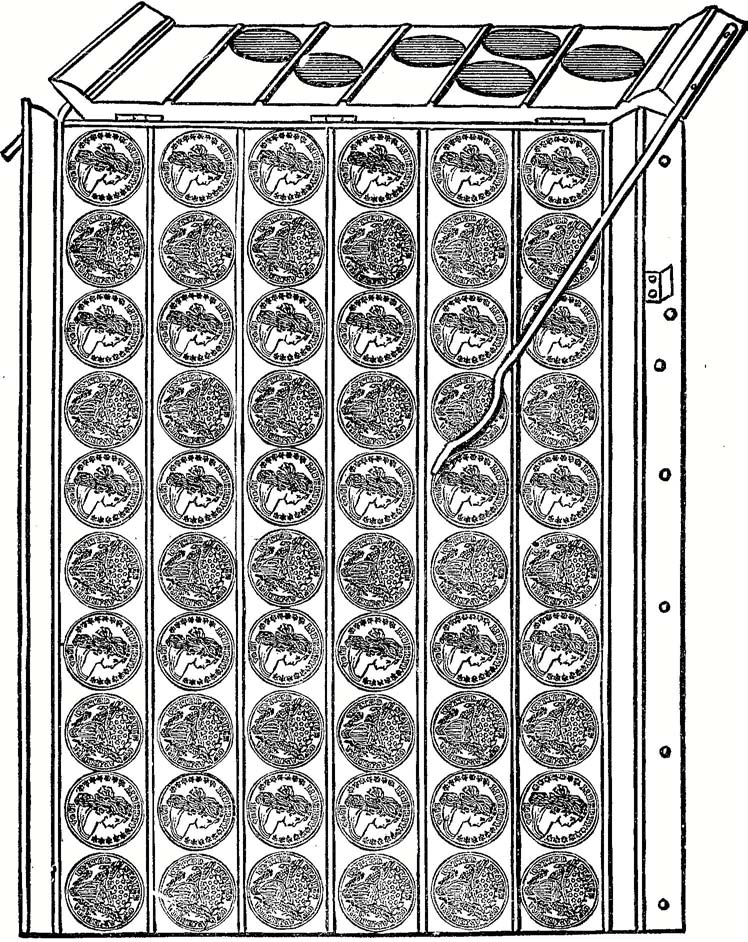
Counting board, used to keep track of silver coins and certain gold issues, as employed in the Philadelphia Mint during the early 19th century. In Illustrated History of the United States Mint, George C. Evans described the device: "The boards are a simple flat surface of wood, with copper partitions the height and size of the coin to be counted, rising from the surface at regular intervals, and running parallel with each other from top to bottom. They somewhat resemble a common household washing board, with the grooves running parallel with the sides but much larger. The boards are worked by hand, over a box, and as the pieces are counted they slide into a drawer prepared to receive them. They are then put into bags and are ready for shipment.