The Early Quarter Dollars of the United States
A. W. Browning
Quarter Dollars of 1834
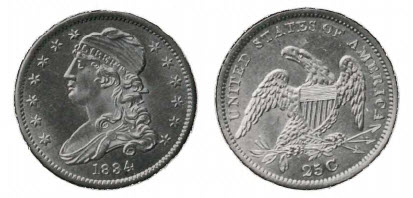
No. 1
Obverse: Upright of 4 in date points to extreme left of curl; upper left star points to Liberty band between end of upper curl and cap; lower left most distant from bust with upper right about half as far from cap; lower right very close to hair.
Reverse: The same as 1833 [Browning] 2 (No period after C.)
Dies perfect in the earlier impressions; in later pieces obverse is cracked in a semicircle, from the left edge below lower left star, over bosom of bust and through lower right star to right edge. Reverse perfect.
This is one of the most common varieties.
Wide date; curl begins left of center of 4; seventh star repunched.
No period after 25 C.
Browning-1; Clapp-3; Duphorne-67; Breen-3925; Haseltine-3.
Rarity-1.
Die States:
I. Perfect. Marriage interrupted to strike the B-2 variety, then resumed, yielding listed later states.
II. Cracked as described in Browning. WGC:114 (AU)
III. III. Clash marks from shield near neck and ear.
IV. Crack, top of cap to border at sixth dentil left of eighth star. NN 61:333, others.
I have not seen the group of die states sold as Bergen:77-80, but from the descriptions, it appears that the repunching on OF and 25 C fades on later strikings. See comments under 1833 B-2.
Usually weak at top of left wing.
Proofs:
1. Mougey:701.
2. Newcomb Collection, exhibited at ANS 1914. Same as 1?
3. Eric P. Newman. Same as 1 or 2?
4. "Dupont":1810, Edgar A. West:666 (5/57).
Common in all grades. Some of the more famous Uncirculateds include (not necessarily in order of quality), besides those mentioned above:
1. Boyd, WGC:113. State I.
2. J.A. Stack:40. Same as above?
3. ANS.
4. J.H. South:484, prooflike,
5. Gardner:1632.
6. Grant Pierce:619, Speir Estate sale:28, 1974 GENA:1329.
7. Ruby I:1161.
8. Reed Hawn:282.
9. "Spring":523 (as "B-2")
Many AU's.
Numerical Condition Census (RWM, Sr. [circa 1992]): 65, 63, 63, 63, 63, 62. High grades in date sets.
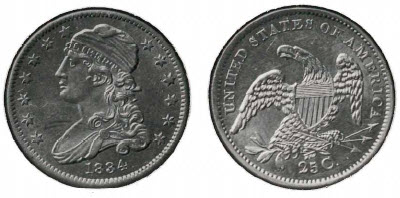
No. 2
Obverse: The same as [Browning] 1.
Reverse: The value, 25 C., spaced closer similar to [Browning] 1, but very high, close to eagle; small, weak period after C. The eagle has a tongue, the only one of this date.
Dies perfect. A scarce variety. Proofs were made from these dies.
Wide date; curl begins left of center of 4; seventh star repunched.
Close high 25 C., small weak period; branch beyond C; forked tongue.
Browning-2; not in Clapp; Duphorne-68; included in Breen-3926; Haseltine-4.
Rarity-4.
Eagle of atypical design on this die, but different from preceding. Note the long curved claws.
Proofs:
1. Mougey:700, H. Chapman, Bement:277.
2. Chapman, Dr. Ruby, Gilhousen:606, Reed Hawn:283, Auction '82:715. Same as above?
3. Boyd, WGC:115, Kern:1420.
4. N.Y. dealer's type set.
5. King of Siam cased Proof set: Mint, November 1834, State Dept., Special Envoy Edmund Roberts, King Ph'ra Nang Klao, King Ph'ra Chom Klao "Mongkut", King Ph'ra Maha Chulalongkorn, private collection.
6. Brand Estate, NN 11/5/54, Norweb:1554, $26,400.
Business strikes are not too difficult to locate in EF and lower grades, but they are very rare Uncirculated:
1. Ruby, Gilhousen:607.
2. David L. Hirt, 1975 GENA:436.
3. Kensington:313.
4. "Prudential":441 (NERCA 5/78). First and last stars flat.
5. 1979 N.Y. Metropolitan:159.
A few others survive.
Numerical Condition Census (RWM, Sr. [circa 1992]): 65, 60Pl 60, 60, 58, 55. High grades in date sets.