The Early Quarter Dollars of the United States
A. W. Browning
Quarter Dollars of 1833
Total number of pieces coined 156,000. Two varieties are known.
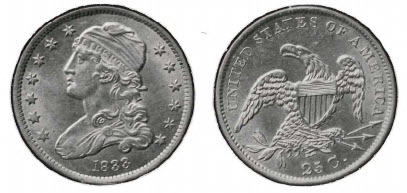
No. 1
Obverse: Last 3 in date under curl but not centered; lower left and upper right stars most distant from bust, about equally distant; lower right close to hair, upper point nearer than lower.
Reverse: Apparently from the same dies as 1831 [Browning] 5 and 6 and 1832 [Browning] 1.
Dies perfect in the earlier impressions, but in later pieces both dies show evidence of having rusted.
This is the most common variety but scarce if sharp and struck before the dies rusted. Proofs were made from these dies.
Period after 25 C.
Browning-1; Clapp-2; Duphorne-65; Breen-3923; Haseltine-2.
Rarity-2.
Die States: I. Perfect.
II. Clash marks, plainest in reverse field.
III. Progressively rusted obverse. Probably struck in 1834. Clapp 3. WGC:110; Ruby I:1160; LM 6/68:286, Austin:559-60 (early and late rusting), others.
Usually weak on lowest curls and lower drapery, especially in State III. Note Plate VI.
Proofs:
1. Eliasberg Estate. State I.
2. Private collection, seen in 1950's, probably Allenburger:894. State I. This is probably the one reappearing in Bowers & Ruddy RCR 14 (April-May 1972). It is still impossible to match these with earlier reports (McCoy:513 to Levick; Parmelee:1025; Cleneay:1345, slightly impaired; Mougey:698).
Uncirculateds include many others, and are not necessarily in order of quality.
1. Boyd, WGC:109. State I.
2. Reed Hawn:281. State II (clash marks, plainest on reverse).
3. Boyd, WGC:110. State III (rustic obverse die).
4. Speir Estate sale:27. Prooflike.
5. Merkin 6/68:286.
6. J.A. Stack:38.
7. Norweb:1551; others.
Numerical Condition Census (RWM, Sr. [circa 1992]): 65, 64, 60, 60, 60, 60. High grades in date sets.
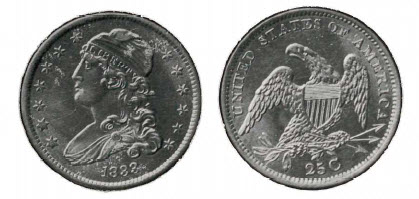
No. 2
Obverse: The same as [Browning] 1.
Reverse: No period after C, in value, 25 C., 5 and C are further apart than in [Browning] 1; upper part of eagle's wing at left extends up higher than in [Browning] 1; tips of claws at left double engraved; in legend word OF re-engraved and letters are connected at top; first A in AMERICA re-engraved. The eagle has no tongue.
Obverse die in this variety always shows marks because of the die having rusted. Reverse perfect.
A rare variety, particularly when sharp.
No period after C; double stripes to shield.
Browning-2; Clapp-1; Duphorne-66; Breen-3924; Haseltine-1.
Rarity-1.
Obverse always rusted; probably struck in 1834.
Reverse, unlike any other die in the series, has double stripes in shield (all others have triple), evidently after the style of half dimes and dimes of the period. This eagle is altogether unlike any other in design, and may represent another device punch entered into this die blank after one blow from the regular one; note the upturned claws and traces of normal ones (mostly effaced). Legend blundered: O in OF over another F, other letters misplaced and corrected. See Coin World 1/20/82, p. 70, where this is discussed at length with enlarged photographs.
Die States: I. Obverse rusted, as in late B-1's.
II. Clash marks on neck and near ear from shield. Eliasberg Estate.
Proofs.
1. Newcomb Collection, exhibited at ANS 1914.
2. Boyd, WGC:111.
Uncirculated survivors are very rare; among others the following:
1. Clapp, Eliasberg Estate. State II. Philip Strauss Estate (5/59):1720, to W(?).
2. J.A. Stack:39.
3. Allenburger:895.
Numerical Condition Census (RWM, Sr. [circa 1992]): 65, 63PL, 63, 63, 60, 60. High grades in date sets.