The History of United States Coinage As Illustrated by the Garrett Collection
Q.David Bowers
The citizens of Colorado Territory, nearly 30,000 in number, desired to have an official United States branch mint to provide a greater quantity of coins for circulation and to act as a depository for bullion. On December 19, 1861, a bill to this effect was introduced in Congress by Hiram P. Bennett. The legislation passed the House and Senate and became effective on April 21, 1862. By this time the owners of Clark, Gruber & Co., having minted gold coins in the total amount of $594,305, desired to sell the building and related facilities. A description of the firm's assets was provided:
A private mint in Denver owned by Clark, Gruber & Co. is a two-story brick building 25 feet front by 40 feet deep with a basement opening out on level ground at the back end of the building.
Walls of basement story 2 feet thick; 2 floor 16 inches [referring to the thickness of the walls]; 3 floor 12 inches; upper story 4 rooms plastered 11 feet high. 2 story level with the street in front 13 feet high plastered and painted open front. Glass 30x40 in transepts lights above doors. 4 double doors in front, side doors and stairs back leading up to 3 story. Partition 10 feet from back wall. A well furnished circular oak counter and 4 desks of like quality; door and stairs leading down to basement. Basement room contains the machinery and apparatus for coining. Basement 9 feet high with large double doors in rear end and 4 windows plastered. Engine house 16x20 feet, brick. 3 doors and windows. Acid room adjoining 8x20, with 1 door and window. 7 acid furnaces built in the outer wall; flues of same 25 feet high, flues and furnaces 12 to 14 inches square. Melting furnaces are 3x4 feet outside, 16 inches square inside, 18 inches deep, iron bars for grates. All the rooms and apartments fitted up with the necessary furniture ...
The rolling, milling, punching, and coining machinery may all be run at the same time. All is in perfect working order and good machinery made by the best workmen in Philadelphia and New York ready for working United States coin by substituting United States dies.
Lot on which building stands is 15x125 feet enclosed by board fence 8 feet high. Good well supplying ample water for all purposes.
Appended was a list of machinery, including a pair of 6-inch rollers, a coining press, a milling machine, punching press, two melting furnaces, six acid furnaces, one cupel furnace, one steam engine of 8 to 10 horsepower and fixtures, one pair of level shears, 450 crucibles, and various accessories and supplies.
It was stated that the capacity for coining at a 10-hour-per-day rate would be $120,000 value in double eagles, $60,000 value in eagles, $30,000 value of half eagles, and $15,000 in quarter eagles. "This is the speed at which it is ordinarily run; but double that amount may be coined in the same time if desired."
As the earlier production of Clark, Gruber & Co. did not come close to the maximum capacity of the coining press, it is probable that the presses were run only occa-sionally, for a greater amount of time proportionately was needed to assay, refine, and prepare the metal for coining.
Evaluation of the Clark, Gruber & Co. offer took a long time. On the evening of August 18, 1862, about 300 people, irritated with the delay, gathered at a meeting to discuss the problem. The government was urged to act promptly. On November 25, 1862, the secretary of the Treasury offered $25,000 for the building and its contents. Congress on March 3, 1863, passed a resolution which enabled the secretary of the Treasury to obtain title to the mint. Actual government possession took place in April of the same year. Clark, Gruber & Co. vacated in May and moved to a building adjacent to Warren Hussey's Bank on F Street.
It was intended to begin coinage in Denver right away, but this was not accomplished. It was not until several decades later, in February 1906, that coins were actually struck in Denver by the United States government, and that was done not at the Clark, Gruber & Co. plant but at the new Denver Mint. On June 30, 1906, Congress passed an act which provided for the sale of the Clark, Gruber & Co. mint building, which it had owned since March 3, 1863. On August 28, 1906, the high bid of $31,000 offered by Charles Boettcher of Denver was accepted. The new owner tore the building down in September 1907, despite the fact that it was not until August 11, 1909, that the title transfer was finally completed.
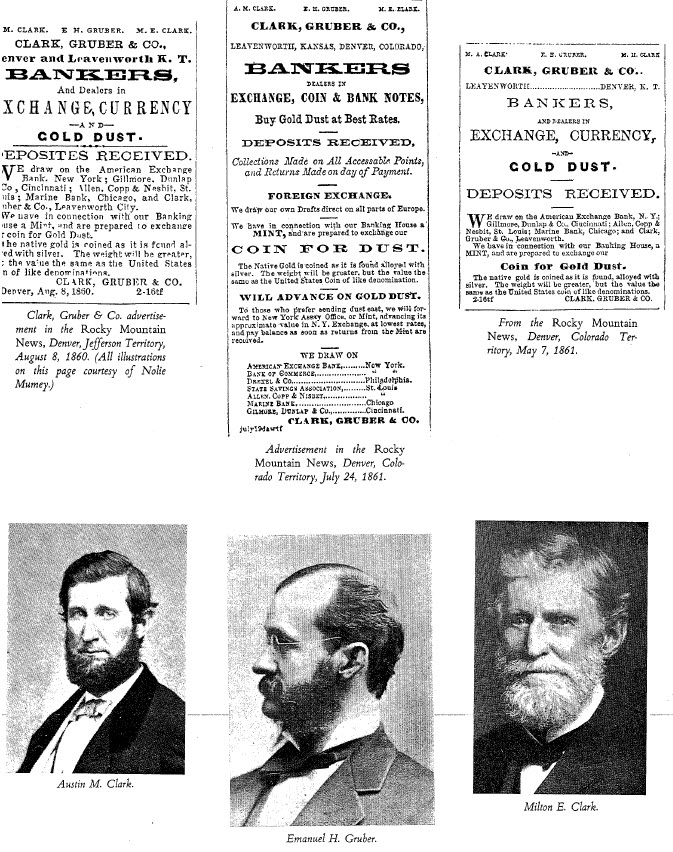
On March 10, 1864, Emanuel Henry Gruber withdrew from Clark, Gruber & Co. The Clark brothers continued under the name of Clark & Co. until May 9, 1865, when the business was transferred to the First National Bank in Denver, an organization of which the Clarks were founders and stockholders. The Central City branch was sold to George T. Clark, who was first cashier of the First National Bank in Denver, and Evan Smith. The business, which later included a branch at Georgetown, was continued under the name of George T. Clark & Co. Through out the 1860s the main office of Clark, Gruber & Co. remained in Leavenworth, Kansas. Accounting and financial reports were prepared in the Kansas facility.
Gruber, following his March 10, 1864 resignation, returned to Leavenworth, where he continued in the banking business until 1866. He had business interests in New York and Louisiana as well. In July 1878 he went to Leadville, Colorado, then experiencing a silver boom, and became an owner of the Pendery Mine. A three-story building, the Gruber Block, was erected in Leadville in the summer of 1880 at Harrison Avenue between Fourth and Fifth streets. By August 15th of that year every square foot of space in the facility, then considered to be the best business location in Leadville, was rented.
By the end of 1882 Gruber had suffered some financial reverses in his mining investments. He left Leadville and moved to Gunnison. In July 1883 he relocated to Denver, where he engaged in the selling of mining claims, real estate, and insurance until 1892, when he moved to Cripple Creek. Located on the western side of Pikes Peak, Cripple Creek was a boom town. Gold had been discovered there, and miners, including many from the Central City and Georgetown areas (which were then experiencing a depression, for mining had turned from emphasis on gold to silver, and silver prices were low), came to seek new fortunes. Overnight many people became wealthy, and within a few years the Cripple Creek area had grown to include 60,000 people, including over 30 millionaires. Gruber stayed in the area during its most prosperous times. He left in 1904 because the altitude, about 9,500 above sea level, was unfavorable for his wife's health.
Numerous die trials were made of the various Clark, Gruber & Co. issues. Most closely followed the regular issues (of Clark, Gruber & Co.) in design, although one, a pattern 1860 double eagle struck in copper, featured Pikes Peak in the shape of a pyramid and was presumably rejected due to its unnatural appearance.