The History of United States Coinage As Illustrated by the Garrett Collection
Q.David Bowers
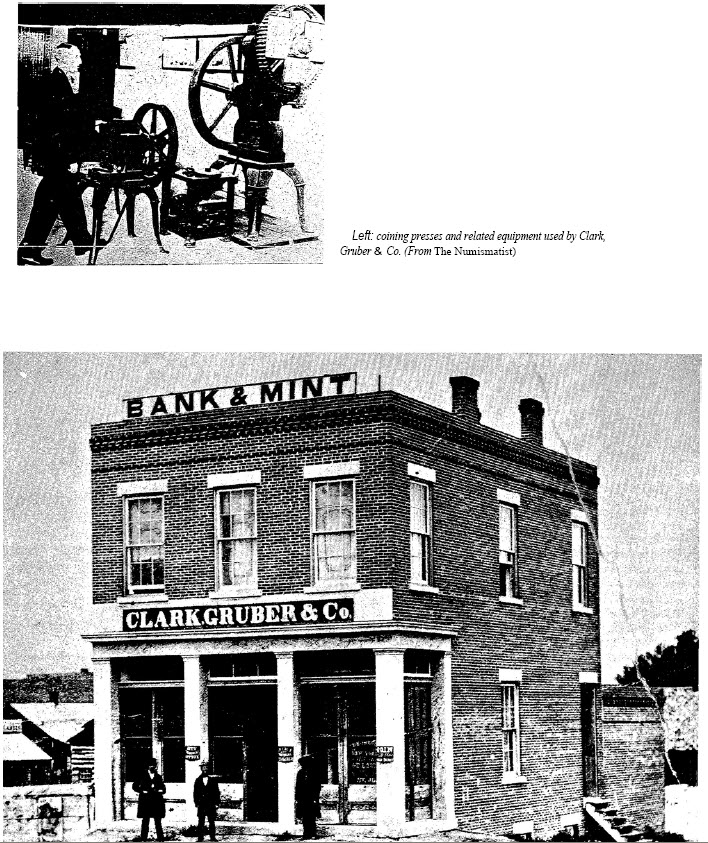
The Rocky Mountain News carried an advertisement for Clark, Gruber & Co. on August 8, 1860:
We have in connection with our banking house a mint and are prepared to exchange our coin for gold dust.
The native gold is coined as it is found alloyed with silver. The weight will be greater, but the value the same as the United States coin of like denominations.
The Rocky Mountain News reported on the continuing progress of the firm in an article in the August 29, 1860 issue:
OUR MINT. Clark Gruber & Co. melted and coined about $18,000 in $10, $5, and $2.50 pieces. As specimens of coinage these pieces are far superior to any of the private mint drops issued in San Francisco, and are nearly as perfect as the regular United States Mint issues. The faces of the $5s and $2.50s are a good imitation of the government coinage-the head of the Goddess of Liberty, surrounded with thirteen stars, with the name of "Clark & Co." occupying the head tiara. The reverse is occupied, of course, with "our noble bird" encircled by the words "Pikes Peak Gold, Denver 2 1/2D." Altogether it is a creditable piece of work, and we hope to see hosts of it in circulation before the snow flies. The fineness of this coin is 828 1/2; and the excess of weight over U.S. coin is 23 grains in a $10 piece. The value in gold is the same as government coin of like denomination, with an additional value in silver alloy equal to near 1%. Deduct the cost of coining at the U.S. mint, about ½%, and the actual worth of Clark & Co.' s coin is ½% more than any other coinage.
The initial coinages were of the $10 and $20 denominations. Later, pieces of $2:50 and $5 were made, as noted in the preceding article. By October 1860 the coins were in wide circulation throughout the "Jefferson" Territory. The mint operated both day and night, and by October $120,000 worth had been struck.
Toward the end of 1860 Clark, Gruber & Co. opened a branch office in Central City, Colorado. At the time, Central City, and its neighbor, Black Hawk, were among the most active gold mining areas. In 1861 bank notes of $5 face value were issued. As they were backed in gold, in 1862 they were worth more than United States notes, which at that time sold at a sharp discount from government gold coinage.
In 1861 new dies were produced. Gold content of the Clark, Gruber & Co. coins was increased to 1 % more than that used by the United States government mints. The Colorado Republican and Rocky Mountain Herald wrote on August 3, 1861, of a visit to the coining establishment:
We yesterday stepped into the fine banking house of Messrs. Clark, Gruber & Co. and by invitation of the gentlemanly proprietors took a look at the machinery and fixtures for minting ... The gold is first refined by chemicals, then put into a crucible, melted, and run into bars. Then it is run through a rolling machine, which reduces it to the proper thickness; it is then taken to a punching machine where it is cut in the proper size; a man then takes it and reduces it to the proper weight, when it is taken to the die and stamped, then the edges are milled, which is the finishing stroke.