The History of United States Coinage As Illustrated by the Garrett Collection
Q.David Bowers
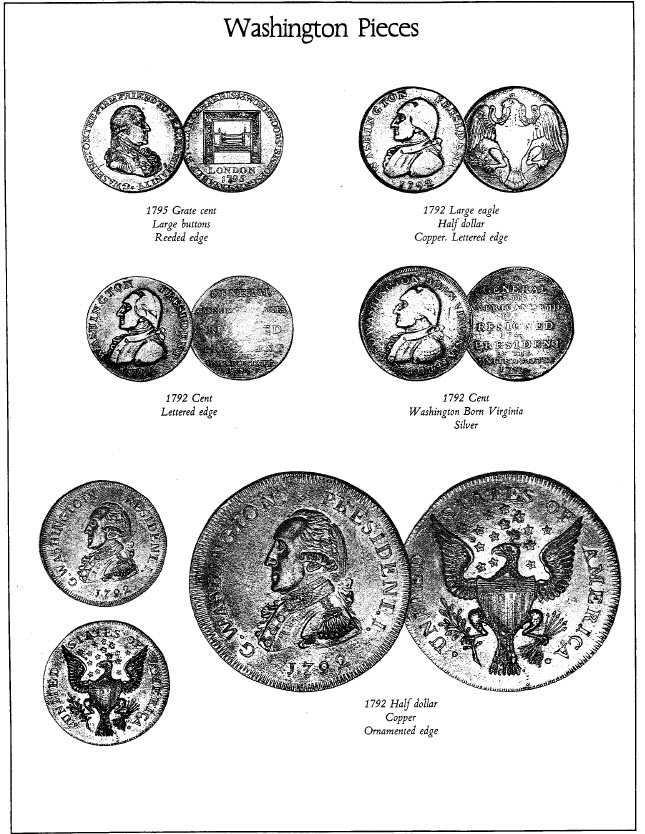
George Washington formed a popular subject for many of these tokens. Several dozen different varieties bearing his bust and name were struck in England. The date of the pieces did not necessarily refer to the time of issue. The pieces dated 1783, for example, are believed by numismatists and scholars today to have been struck at a later date. As the portrait of Washington was not readily available in England, and as engraving styles varied from craftsman to craftsman, issues have a wide variety of portrait appearances.
Thomas Wells Ingram, following designs by Edward Savage and others, produced issues dated 1783. Numismatists today believe that these were struck sometime in the 1820 era.
Another 1783-dated production is a close copy of the reverse of a United States copper cent of about the year 1803, with the exception that the country name is spelled as UNITY STATES OF AMERICA, perhaps as an attempt to evade counterfeiting laws. A 1791-dated halfpenny has on the obverse a portrait of Washington, in this instance fairly realistic, with the inscription WASHINGTON PRESIDENT surrounding. The reverse represents a nonsensical combination and shows a sailing ship surrounded with the legend LIVERPOOL HALFPENNY. On the edge of this piece is lettered PAYABLE IN ANGLESEY LONDON OR LIVERPOOL. This was issued as part of the token-collecting fad. Also satisfying the whims of collectors at the time were several varieties of a 1795 halfpenny known today as the "grate token." The obverse depicts Washington surrounded with the inscription G. WASHINGTON THE FIRM FRIEND TO PEACE & HUMANITY. The reverse shows a coal-burning fireplace and grate with LONDON 1795 below, and the inscription PAY ABLE BY CLARK & HARRIS 13 WORMWOODS BISHOPSGATE. This particular piece was struck by Kempson & Son, prolific issuers of tokens.
Also issued for collectors were several different varieties of Liberty and Security halfpennies and pennies. The halfpenny in its most traditional form features a portrait of Washington on the obverse with his name surrounding. The reverse shows an eagle perched on a shield with the inscription LIBERTY AND SECURITY 1795. Variations to intrigue collectors were made with such reverses as a design with the standing goddess "Hope" and an anchor with the legend IRISHHALFPENNY surrounding. Issued at the same time and bearing the same design as the standard halfpenny was the large copper Liberty and Security penny. The edge was lettered AN ASYLUM FOR THE OPPRESS'D OF ALLNA TIONS, a tribute to America as a haven for refugees. Still another issue, the rare "Roman Head cent," usually referred to in 19th century catalogues as the "Naked Bustcent," bears the portrait of Washington as a Roman emperor. The intention, no doubt, was satirical. Another important piece of the era is that dated 1791 which bears Washington's portrait on the obverse and the legend WASHINGTON PRESIDENT. The reverse was made in two forms: a small eagle with upraised wings, and a larger eagle with downcast wings, both with the denomination ONE CENT. These pieces were made in large numbers in England and shipped to a Philadelphia merchant for distribution. The likeness in this instance is quite realistic.
A controversial token, also of English origin, is that portraying a fanciful bust on the obverse with the inscription GEORGIUS TRIUMPHO surrounding. The reverse depicts a standing goddess behind a railing composed of 13 bars and £leur de lis, the latter being a French emblem. The legend VOCE POPOLI surrounds. Presumably this refers to the end of hostilities in the Revolutionary War when in 1783 the: final British troops departed for home, following the D81 surrender by Cornwallis. As is the case with many issues, the exact circumstances of production and distribution may never be known.
Another intriguing British production of the time is the so-called' 'Double. Head cent" which bears a fanciful portrait of Washington on both sides. Above one portrait is the inscription WASHINGTON, and above the other identical portrait on the other side, ONE CENT.