The History of United States Coinage As Illustrated by the Garrett Collection
Q.David Bowers
In March 1797 he returned to Mount Vernon to look forward to a life of leisure and retirement. On December 12, 1799 he contracted acute laryngitis after a ride on horseback through snow and bitter cold. He was confined to bed, and medical attention was sought. Remedies included the applying of leeches and drawing blood four times. A paste consisting of dried beetles was applied to his throat. At ten in the evening on December 14, 1799 he died.
As the news spread from Mount Vernon, the entire country went into mourning. Perhaps the sentiment of the entire nation was best expressed by the inscription on a medal at the time by engraver Jacob Perkins, of Newburyport, Massachusetts: HE IS IN GLORY, THE WORLD IN TEARS.
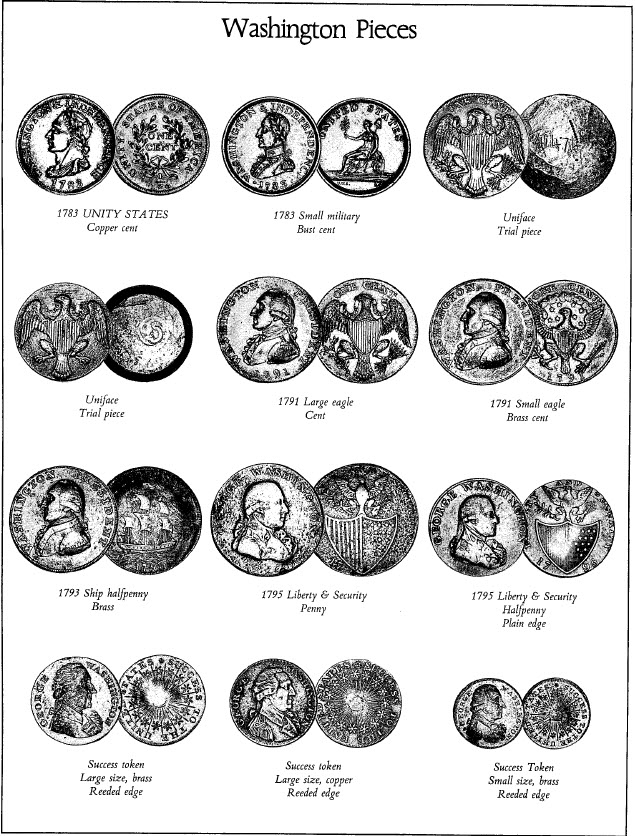
The field of Washington numismatic material is vast and encompasses thousands of pieces. In 1885 W. S. Baker described 651 different varieties made up to that time, and since then many others have been produced.
The earliest medal relating to Washington is believed to be the piece struck in Paris in 1778 to the order of Voltaire. The obverse depicts an imaginary portrait of Washington, as no graphic likeness was available to the engravers in France at that time. The inscription noted that Washington was general of the Continental Army in America. The reverse showed the instruments of war including a cannon, mortar, drum, trumpet, and flags. Many examples were struck in bronze, a small number in silver, and a very few in tin.
So far as is known, the first medal produced in America honoring George Washington is the so-called "Manly Medal.' Engraved by Samuel Brooks, the Manly Medal features a portrait of Washington as an aged man. Baker believes that the model which inspired the portrait was furnished by Joseph Wright, who earlier (in 1784) executed a portrait of Washington from life.
On March 3, 1790, The Pennsylvania Packet and Daily Advertiser offered these medals for sale. Featured was a certificate dated February 22, 1790 (Washington's birthday anniversary) by Thomas Mifflin, governor of Pennsylvania; Richard Peters, speaker of the House of Assembly; Christian Febiger, treasurer; and Francis Johnston, colonel of the army, who declared that the portrait was" a strong and expressive likeness and worthy of the attention of the citizens of the United States of America." Prices were given as one dollar for a medal in "fine white metal, to resemble silver," two dollars for a "fine gold-colored metal," four dollars for a fine silver metal, and it was noted that gold impressions were available at a price "in proportion to weight."
To minimize metal movement while being struck and to facilitate production, the Manly Medals were cast in their approximate form and then were struck with dies to sharpen the details.
The obverse inscription reads GEO. WASHINGTON BORN VIRGINIA FEB. 11, 1732. The reverse, in multiple lines, consists solely of this inscription: GENERAL OF THE AMERICAN ARMIES 1775. RESIGNED, 1783. PRESIDENT OF THE UNITED STATES 1789. At the bottom in tiny letters appears the name of the issuer J . MANLY & C.
One of the most important of all early Washington medals is the "Washington before Boston" piece. The evacuation of the British from Boston on March 17, 1776, following their failure to secure Dorchester Heights, resulted in great celebration. On March 25th the Continental Congress passed this resolution:
. .. that the thanks of this Congress in their own name and in the name of the thirteen united colonies whom they represent, be presented to his Excellency Gen. Washington and the officers and soldiers under his command for their wise and spirited conduct in the siege and acquisition of Boston; that a medal of gold be struck in commemoration of this great event and presented to his Excellency; and that a committee of three be appointed to prepare a letter of thanks, and a proper device for the medal.
John Adams, John Jay, and Stephan Hopkins comprised the committee. Following the end of the Revolutionary War, the resolution was acted on by placing an order in Paris in 1786. Pierre Simon Duvivier was the engraver. Designs were provided by the Royal Academy of Inscriptions and Belles Lettres. The portrait was from a bust by Jean Houdon, who modeled the bust from a cast of Washington's face taken at Mount Vernon in October 1785.
One specimen was struck in gold for presentation to Washington. It subsequently passed from the Washington family to Daniel Webster. Later, in 1876, 50 public-minded Boston citizens raised $5,000 to purchase the medal and present it to the city. It subsequently reposed in the Boston Public Library. A few impressions were struck in silver metal for different Revolutionary War heroes. In later years restrikes were made from the original dies. The demand was so great that additional dies, similar in concept to the original but differing in certain design details, were made. Copies are still available today from the Paris Mint.
From about 1787 to 1796 the collecting of halfpenny-size copper tokens became a national fad in England, as related earlier in this text. While some pieces were produced to ease a shortage of circulating currency, most were made to satisfy the whims of collectors. Private engravers and mints competed with each other to turn out a wide variety of issues portraying subjects as varied as Lady Godiva, alligators, and British cathedrals. Often the obverse die of one token was deliberately combined or muled with a reverse ofanother token not related to the first.