The History of United States Coinage As Illustrated by the Garrett Collection
Q.David Bowers
Correspondence from David Proskey
On June 4, 1884, David Proskey, writing from the office of Proskey Brothers, manufacturers of yellow pine lumber and cypress shingles, and general storekeepers, 4448 River Street, Paterson, New Jersey, offered T. Harrison Garrett colonial issues from a recent find:
Enclosed please find rubbings of four rare copper colonials recently dug up on a farm in this state. Each is for sale at the price marked, with a full guarantee of genuineness. The "Inimica Tyrannis" I believe is better than that in the Bushnell Collection-the "non Vi" certainly is-the Nova Eborac is of the scarce variety described in Lot 894 Bushnell. The Bar cent is the first specimen I have seen for years which could be warranted genuine.
Should you care for any of these pieces they could be sent to you on approval.
Respectfully yours, David Proskey.
Communication from J. W. Scott & Co.
T. Harrison Garrett subscribed for an 1879 restrike of the 1861 Confederate States of America half dollar made by Scott & Co. of New York. On October 17, 1879, Garrett received a printed circular, dated October 17, 1879, from Scott which noted:
It is with great pleasure that we present you with the restrike Confederate Half Dollar, subscribed for in the 4th ult., and hope it will meet with your approbation. We regret the delay in forwarding, which was caused by the die breaking on the first trial, it then had to be set in a heavy steel band to prevent further damage; before risking the die again on the hard silver, we thought it advisable to strike the requisite number (500) in white metal, with the. following inscription for a reverse: "ORIGINALS STRUCK BY ORDER OF C. S. A. IN NEW ORLEANS 1861. REV. SAME AS U.S. (FROM ORIGINAL DIE SCOTT)." These will be sold in any quantity to those who subscribe to the Silver Confederate piece; at 50 cents each. It was with difficulty we procured the 500 half dollars of a special mintage on which the pieces had been struck by a new method over genuine 1861 N.O. mint U.S. half dollars, and in consequence they must rank high above ordinary restruck coins.
The die (damaged only sufficiently to prevent restriking) is a very valuable and interesting relic, and is now for sale. Price $50.
Up to the 10th inst. we received orders for 567 pieces; the odd 67 subscribers have been supplied from a like number of patrons who ordered two copies; this we conclude would be the more equitable plan for all parties concerned. Amateurs who ordered two will please remember that by this plan they will certainly get one; whereas if they had gone for chances they might have been left without any. We have received quite a number of orders since the 10th inst. all of which we are unable to fill, unless some of our subscribers, who get two, will kindly return one, for which we will be pleased to pay $2.50.
Respectfully, Scott & Company.
Correspondence with H. P. Smith
On December 18, 1884, H. P; Smith, a well known New York City coin dealer, wrote from 269 West 52nd Street of that city to offer an 1822 half eagle, a prime rarity. The coin was not purchased by Garrett: I have an 1822 $5 gold piece, nicks but Fine. Will sell at $600. If you wish me to send on approval will be happy to do so. I understood from Richard Cogan that you had sent a list of the American gold that you wanted to his brother George, and that the 1822 was not on the list. If you have one in your collection there will be no necessity for you to answer this note. Correspondence with The United States Mint in Philadelphia
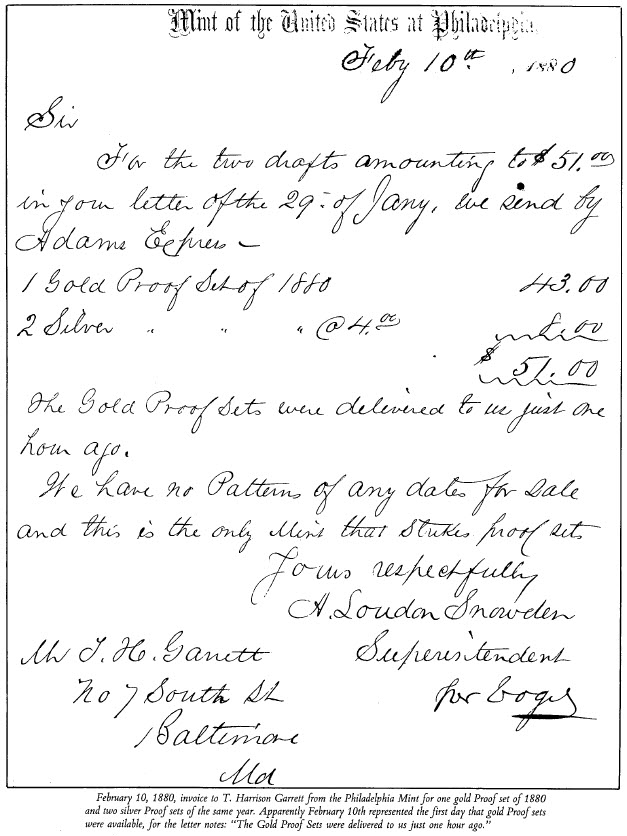
There was regular correspondence between T. Harrison Garrett and the United States Mint at Philadelphia. Each year Garrett purchased gold and silver Proof coins. In addition, he developed a deep interest in medals and often ordered pieces of various series.
For example, on September 4, 1879, he received a receipt from A. Loudon Snowden, superintendent of the United States Mint:
In return for the drafts for $43 gold and $8 currency enclosed in your letter of the second, we send by Adams Express, one gold Proof set of 1879 $43; two silver Proof sets of 1879 $4 each, total $51.