The History of United States Coinage As Illustrated by the Garrett Collection
Q.David Bowers
His written contributions to the numismatic field include A Descriptive Catalogue of Hard Times Tokens, first published in Boston in 1886, and an association with C. Wyllys Betts,who compiled a reference on American colonial history as illustrated by medals and related numismatic items. Today, Low is particularly remembered for his work in the Hard Times tokens series. Specimens are still attributed to his original numbers.
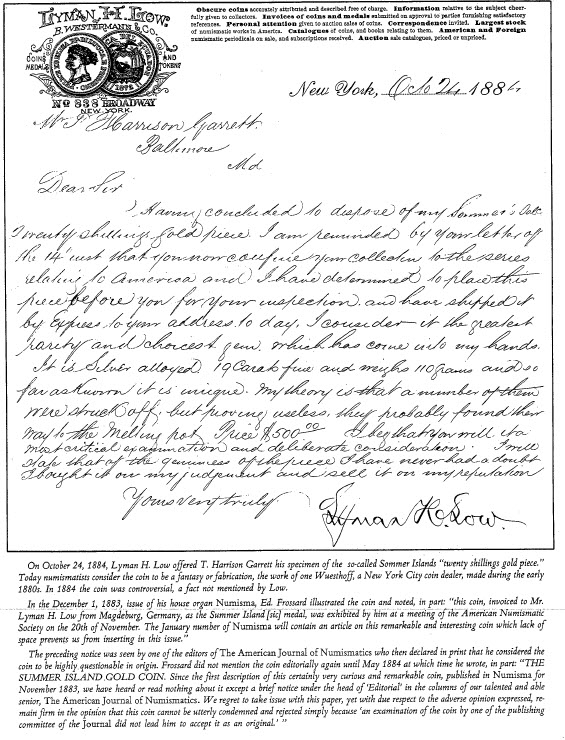
The primary transaction between Lyman H. Low and T. Harrison Garrett was a fraud, inasmuch as the Sommer Islands "20 shilling" piece described was a fraudulent fantasy conceived by Wuesthoff, a New York dealer, who was located at 113 Canal Street during the 1880s. Whether or not Low was aware of the deception is not known today. During his lifetime T. Harrison Garrett never realized that the coin purchased from Mr. Low was a fantasy made about the same time he paid the substantial price of $500 for it. On October 21, 1884, Lyman H. Low wrote T. Harrison Garrett:
Having concluded to dispose of my Sommers Isle 20 shilling gold piece I am reminded by your letter of the 14th that you now confine your collection to the series relating to America, and I have determined to place this piece before you for your inspection, and have shipped it by express to your address today. I consider it the greatest rarity and choicest gem which has come into my hands. It is silver alloyed, 19 carats fine, and weighs 110 grams, and so far as is known it is unique. My theory is that a number of them were struck off, but proving useless, they probably found their way to the melting pot. Price $500. I beg that you will take a most critical examination and deliberate consideration. I will state that of the genuineness of the piece I have never had a doubt. I bought it on my judgment and sell it on my reputation.
On October 29, 1884, Low wrote again:
Yours of the 27th duly received. In reply I state that the only history I have of the piece is that it came from Germany about a year ago labeled "Sommers Island gold medal," showing clearly in my mind the lack of numismatic intelligence on the part of the owner as to the real name and denomination of the coin. A more correct knowledge would undoubtedly have prevented it from falling into my hands. The record of the coinage for the islands are indeed meager. The shilling and sixpence alone have brief mention, by some stated to be brass, but the fact is that all specimens of them I have seen were copper and had the appearance of being washed with silver. A little over a year ago a threepence was discovered on the island and quickly found its way here and into a noted cabinet. Hence there is no history of either the threepence or the twenty shilling pieces to detail to you as much as I should like to furnish it. As regards to the price I attach to it I will say I arrived at such conclusion after the most mature deliberation, and I feel that continued thought on the subject would lead me to a still higher appreciation of the value. The New York doubloon [Brasher], Good Samaritan shilling, and Lord Baltimore penny have all realized higher figures. I class this with the greatest rarities both in point of historical interest and market value.
On October 31, 1884, Low wrote to Garrett:
I have received yours of the 30th with a check for $500 for the Sommers Island XX shilling gold piece for which please accept my best thanks. I am especially gratified that it has found a resting place with so many other noted pieces of the American series which I believe you to possess. I hope it may be my good fortune to be the means of further ornamenting your cabinet.
On January 5, 1885, Low offered Garrett a group of colonial coins:
Some ten days since I purchased a small collection of American colonial coins. I have just finished preparing them and propose to give you first choice. There is a fair percentage of good things and one especially rare. I have carefully estimated the values and forwarded to you today charges prepaid. They are mostly numbered according to Maris and Crosby. Should you find a large percentage which you do not already own which may be increased by the possible improvement in condition over these you now have, I offer an incentive for you to take them all at a discount of 10'70 off. Offered were various pieces valued from 25c to $40, the latter for a New York copper of 1787. On September 2, 1885, Low wrote: