Walter Breen's Encyclopedia of Early United States Cents
Walter Breen
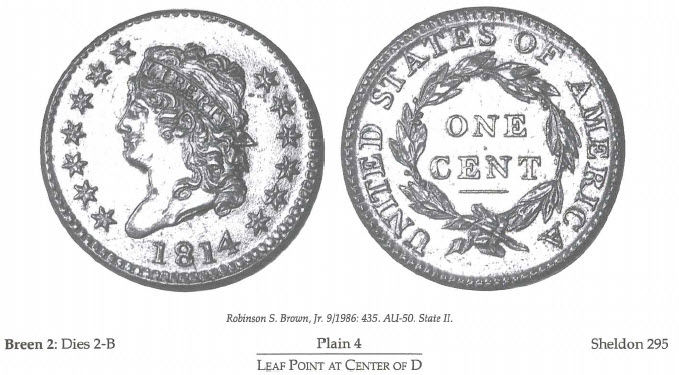
Obverse 2. B. LH. LH. LE. Plain 4, its crossbar ending in a long sharp point. Closer date than foregoing with the 8 repunched. RT are repunched and T is high, leaning left. Single curl behind eye. Eleventh and 12th stars are closer together than others.
Reverse B. C. R. NR. PC. Bases of UN are slightly above I, bases of IT are very close, and A is minutely high. See Remarks.
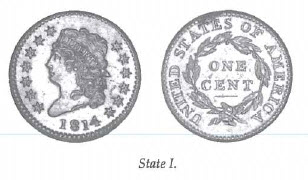
Die stales: I. Perfect dies. No clash marks. No crack from rim to truncation. Without raised ridge at STATES OF. This distinguishes it from any later state with dies lapped to remove clash marks.
II. Clash marks from leaf at the nose (often mistaken for double profile), from C(E) before mouth, from O(N) at neck, and from wreath below truncation (later fading). Faint crack from rim to end of truncation. Reverse raised ridge along dentil tips above STATES O. Smith (1985A).
III. Heavier obverse clash marks from leaves. Reverse has light clash marks from the profile left of O(N) and c(E).
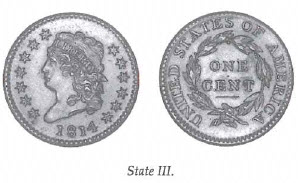
IV. Arc crack from rim through 11th star to the curl. No crumbling at 11th star.
V. The crack becomes heavier and extends through 8 to the rim.
VI. The clash marks are gone-effaced or worn off. VD. Crumbling develops along bottom of the 11th star.
Reverse flow lines from letters to rim. Smith (1985).
VIII. Small chip at junction of the jaw and throat. Rust pits develop around ITE.
IX. Chips or crumbling below lower lip and center of throat line. Tops of ATES OF merge with the rim. Smith (1985). McGirk 2B.
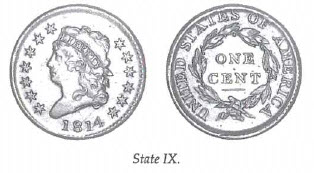
X. Dies lapped to remove clash marks. Dentils above ITE are smooth.
XI. Crumbling extends almost half way to the chin. Smith (1985). This and the next few are often sold as "beard variety." McGirk 2C.
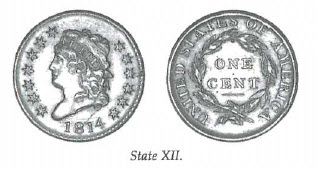
XII. Additional crumbling progresses below the chin, eventually merging with that below the lower lip, and joining that on throat. The crumbling below the jaw extends into the field, eventually becoming very prominent. Dentils become weak. Smith (1985). McGirk 20.
XIII. Rim break above D. Centering may not permit this to show.
XIV. Rim break above TA. Same comment. Smith (1985).
Equivalents: Proskey 2. Doughty 225. McGirk 2A-20. Clapp 2. Sheldon 295. EAC 2. Encyclopedia 1789.
Rarity 1. Possibly the commonest of all early cents. Remarks: Many high-grade, lightly circulated examples survive, suggesting that the public saved them as last of their kind. Cents were not issued from January 1815 to November 1816, after which a new design was introduced.
Reverse is almost always found rotated about 10° to 15°.
One is known which is about 25% off center in K-1.5. Often reported with double and triple profiles. Some of these proved to be normal state II coins.
On the Downing specimen, 1952 ANA (New Netherlands Coin Co. #38); 2003, the entire obverse was double struck (die chatter). Many similar examples have shown up in lower grades.
Evidently these dies remained in use long after they would normally have been discarded, apparently in an effort to strike all the remaining blanks without taking time to make a third obverse die.
Jan Valentine has one with an apparent rim break touching the bust point and obliterating the first star. It is too worn to show the arc crack of state IV or the rim breaks of states XI-XIV, though it does have the crumbling of state XII.