Walter Breen's Encyclopedia of Early United States Cents
Walter Breen
The "1804 Restrike"
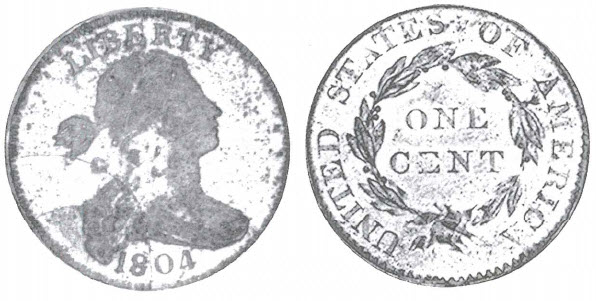
This so-called coin has been a subject of fantasy and speculation for generations, often even under the misnomer "Mint Restrike." "Editors note: for more information regarding the 1804 and 1810 "restrikes," along with the 1823 "restrikes," see: Mark Borckardt, "Restriking the Issues, the Large Cent Restrikes of 1804, 1810, and 1823," Coinage of the Americas Conference, New York: American Numismatic SOciety, 1998. Paper presented in November 1996." Its name exemplifies the "Guinea Pig Principle" (guinea pigs have that name because they are neither pigs nor from Guinea). There are three major reasons why:
1. The variety is not from 1804 dies. The obverse is the badly rusted die of 1803 number 20, crudely altered from 1803 to 1804 by parties unknown. Its reverse is a die of 1820, rusted, reground, and retooled.
2. It is not a restrike but an antedated fantasy coin. Restrikes, properly speaking, are coins struck from genuine dies after the year of their date. Coins struck from copy dies (the Russian name is novodel) are also sometimes called restrikes. (i.e. 1801,1802, and 1803 "Restrike" silver dollars.)
3. It was not made in the Philadelphia Mint but by unknown parties at an unknown location.
Both dies were retrieved among other obsolete and damaged dies and hubs sold by the Mint as scrap metal. The obverse was probably included in a lot of dies discovered in 1816 and eventually acquired by Joseph J. Mickley, being sold as scrap metal. The reverse (being an 1820 die) could not have come from this 1816 cache. Its most likely source instead is a similar scrap metal sale of an unknown later date, purchaser unknown.
Proskey (Coin Collector's Journal, January 1881, p. 1.) called it "The Fradulent 1804," made possibly under the supervision of U. S. Mint officials at Philadelphia, within the past 20 years; but who influenced the manufacture of this disgraceful fraud we prefer not to say. Fraud it is, and intended for the greedy maws of unprincipled dealers and collectors and never for circulation, consequently it is not a coin; nor is it exactly a counterfeit; as it is in no way an imitation of the genuine cent of the date in question; but merits only the appellation we bestow upon it; it is considered a disgrace to any collection in which it may be found." Doughty, McGirk, and Rice each said it appeared about 1860. I have not been able to confirm this.
Earliest records of a public sale date to 1868, when Edward Cogan sold an example at auction. W. Elliot Woodward, in his 63rd sale of March 4-6, 1884, pointed out that Mickley had formerly owned the dies. The planchets are entirely unlike those used for Mickley's 1823 restrikes (which at least used an 1823 die for the obverse).
Later, Charles Steigerwalt noted: "It was supposed the 1804 came from the same source as the 1823, but the originator of those disclaimed any knowledge of the 1804."1 Whom did Steigerwalt mean by "the originator" and when did he make his inquiries? Mickley had died in 1878. The Mr. Miller of 7th Street, Philadelphia, who supposedly did the actual striking of the 1823 restrikes, is not identified; he may have been merely the owner of the shop housing the press on which the coins were struck. In 1871, Edward Cogan claimed to be the party who had the 1823 restrikes made, "for the owner of the dies." A more likely source is Capt. John W. Haseltine, who had made a dozen silver impressions in 1879 and more copper ones in later years, and who was, in 1907, still alive and in the coin business. Unfortunately, Haseltine told inconsistent stories about his own numismatic activities, and if he "disclaimed any knowledge of the 1804" that still does not prove him innocent, especially since his longtime associate Randall had been openly consigning them to auctions. (Randall later split with Haseltine, consigning coins to rival dealers. Perhaps not coincidentally Randall had worked on describing die varieties of quarters, halves and silver dollars, but in the "Type Table" collection, 1881, Haseltine used Randall's numbers without crediting him).
Copper specimens were more likely made in two batches close together in time rather than in driblets over several years. These two batches were produced before and after the obverse die was resurfaced. If they were made on many different occasions over the years, especially if by different makers, one would expect noticeable differences in planchets (weights, diameters, and textures), as in fact occur in the 1823 restrikes. Diameters actually vary around 29 millimeters but always exceed that of the federal cent, rims are sometimes beveled, and the coins were most likely not struck in a close collar. Too few have been weighed to ascertain if weights cluster around different figures (for different planchet sources), the actual range may be greater than that listed below.
The tin strikings were around in 1870; and the first one appeared in the Fewsmith sale in that year.