Walter Breen's Encyclopedia of Early United States Cents
Walter Breen
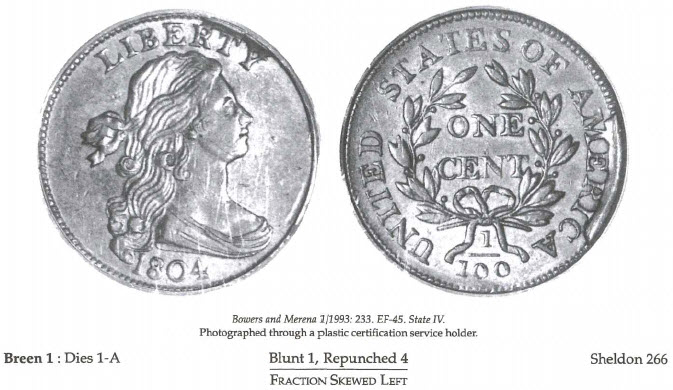
Obverse 1. Blunt 1 in date with the 4 originally triple punched to the right of its final position, then mostly effaced Remaining traces include lower part of one crosslet, upper part of another, and right end of extra base.
Reverse A. Large fraction and letters, as in 1803 reverse dies N, O, P, S, 1807 reverse C, and the unpublished die described at the end of 1806. Denominator is skewed left. (A)T leans right, bases of TE(S) are close, and (unlike 1803 reverse P) ES are not high. CE lean right and touch at their tops and bases with this E touching the left foot of the adjacent N. Long spine extends from leaf tip left of C(E) pointing at O(N). All berries have long stems except the two at outer left, which are very short.
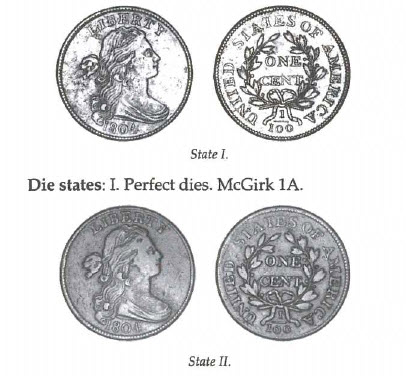
II. Obverse crack through tops of ERT, at first faint. Later with a reverse crack through MERIC. Clash marks from leaves below the ribbon and before the face and throat.
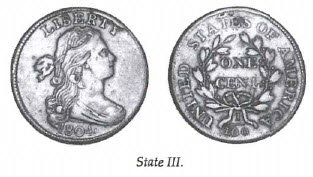
III. Rim break on RTY. Proskey 1, sub-variety A. McGirk IB.
IV. Reverse rim break on MERIC. Faint clash marks from the drapery at S OF and from the bust below M to wreath.
Proskey 1, sub-variety B. McGirk 1C.
Equivalents: Proskey 1. Doughty 198. McGirk lA, IB, 1C, Clapp 1. Sheldon266. EAC 1. Encyclopedia 1760. Rarity 2.
Remarks: Because Proskey called the states of 1804 with one and two rim breaks "Sub- Variety" A and B, he gave this term confusing ambiguities: die breaks, official weight changes, edge changes. In the present study numbered subvarieties designate intentional changes in edge or weight within a die marriage. Die breaks and mint errors do not qualify as subvarieties.
For over a century mistakenly catalogued as rare. Of a total estimated population probably approaching 1,000, over half are state IV, many so worn as to be identifiable only by the rim breaks. State III is popularly believed scarcest, but is usually available for a price-if you are not fussy about condition. Many upper grade examples of all die states have been recolored or in some other way "improved" to their detriment. If you are holding out for a Mint State 1804, you may have to wait decades.
For over a century, fake 1804s have plagued coin collectors. Among the commoner post-Civil War pastimes among the ungodly were making cast and electrotype copies of genuine coins, and altering genuine common date coins to simulate rarer ones. Electrotype copies were legitimate methods for conveying the appearance of the originals, in an epoch when coin photographs were rarer than the coins; regrettably, in later decades, many were resold as genuine. However, no such excuse ever existed for casts or altered dates. Most of the latter were from 1801s. Aside from fraction size (all 1801s have small fraction), the traditional test has been die alignment. On the genuine 1804, the 0 in date lines up with O(F)-a position allegedly not found elsewhere among Draped Bust cents except occasionally in 1807 number 6. (Most date alterers were too stupid to use this variety; its reverse, unlike the real 1804, has centered fraction and outer berry at E(O) half buried in a leaf). If your 1804 has this 0/0 alignment, check its edge for traces of a seam which would indicate an electrotype.
George W. Rice claimed that one of the 1801s with 1/000 shows this same alignment, attributing the observation to Jeffries Wyman.1 I do not recall seeing any 1801 with this die alignment altered to 1804.
The leftward skewed fraction resembles that on reverse P of 1803 numbers 19 and 20. These dies may have been made around the same time.
Planchets in this variety are very similar to those of 1803 numbers 23 and 24, suggesting that they came close together in time. This may explain why many survivors, even in high grades, have problems (often granularity or even pitting), and why many have been recolored.