Walter Breen's Encyclopedia of United States and Colonial Proof Coins 1722-1989
Walter Breen
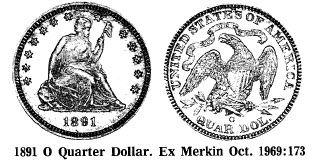
1891 O Quarter Dollar. (1) Dunham: 629, Atwater: 800, Cass, "Empire": 1144. (2) Pvt. colI., ca. 1968. One of these was in LM 10/69: 173, later Kamal Ahwash colI. Occasion: resumption of coinage of this denomination at New Orleans (interrupted 1860).
1891 O Dollar. "Dupont": 2594. A second reportedly in Amon Carter coll., unverified.
1892 O Dollar. Amon Carter Sr. estate, unverified. 1893 O Dollar. "Dupont":2600.
1895 O Quarter Dollar. LM 10/69:182. Excellent quality.
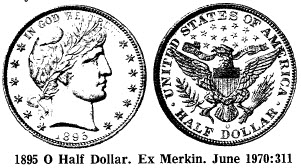
1898 O Half Dollar. 1976 NERCG Publick II: 1140. Slightly impaired.
1899 O Quarter Dollar. Mason-Dixon 10th Sale:841 (10/31/56), "superb."
1854 S Double Eagle. [1+] Unique, probably the first piece coined. Robert Aiken Birdsall (S.F. Mint Superintendent), Mint Director James Ross Snowden for Mint Cabinet, No. 26, Division V ("Coinage of 1852-59") in Mint Cabinet display system, Feb. 1858, SI. When I saw it in 1951, neither Stuart Mosher (then curator as well as Numismatist editor) nor I had any idea it was a branch mint coin, and great indeed was our astonishment at finding the S mintmark. It would .have passed as a Philadelphia proof had I not looked at the reverse. (It was then convenient to check in detail, as the case was specially left open; I had just finished checking the 1849 for hub differences from 1850, and tested Coiner Franklin Peale's claim that the 1849 would not stack - which claim proved false.)
1855 S Quarter Dollar. [1+] Supt. Birdsall, W. W. Long Museum as "first quarter dollar minted in California," Dr. Edward Maris; probably same coin reappearing as Grant Pierce: 655, $2,100, "Groves" sale at $6,500.
1855 S Half Dollar. [1+] Occasion, first coinage of the denomination. Variety without drapery at elbow. (1) Supt. Birdsall, J. R. Snowden, Mint Cabinet, Div. V, no. 79 (an odd place for it, as this section consisted mostly of patterns and pioneer gold), SI. (2) Bolender, March 1956; I saw this,and it too could have passed for a Philadelphia proof. (3) Baldenhofer: 723, Reed Hawn: 188, $3,900, a Hollywood firm, reoffered at $25,000.
1870 S Silver Dollar. There is some reason to believe that either 10 or 12 were made, that they were intended as proofs (accounting for their absence from coinage reports), the occasion being the new mint building cornerstone -note that one of them plus the gold dollar and $3 went into it. Unfortunately, none is well enough preserved for certainty, though at least three survivors show some signs of proof surface, and none show any mint lustre.
1870 S Gold Dollar. Amon Carter Sr. estate, ex Belden Roach. Unverified.
1871 S Dime. Neil: 1391, selling at the then stupendous price of $217.50. Neil's notation on the coin seems to indicate that Newcomb had seen it. I have not, unfortunately. Occasion unknown.
1871 S Half Dollar. "Dupont":2192, ex one of the Chapmans about World War I. Doubtful.
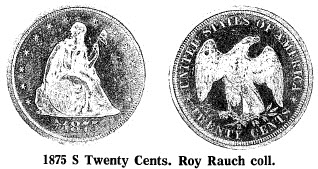
1875 S Twenty Cents. [12] Obv. Horizontal die file marks in shield below BER, spine left from pole just below little finger. Rev. Left pendant of T and left foot of adjacent S broken away in CENTS. Die file mark from leaf point above that T runs into S. Broad borders, knife-rims, quality comparable to Phila. proofs. Struck about June 3, 1875; occasion, the new denomination. Discovered by Emerson Gaylord, but the discovery (in the early 1930's) was promptly forgotten by the numismatic world. Rediscovered at the 1964 ANA Convention (Cleveland), when one James Studley turned up one and claimed to have positive knowledge of a second (which did not materialize, as Studley later vanished). This coin was authenticated by the present writer as the discovery piece (no. 3 below). To date the following are traced, all showing some impairment. (1) Emerson Gaylord, B. Max Mehl, R. ByronWhite. (2) "Midwest dealer," R. Byron White. (3) James Studley, Jonah R. Shapiro, 1973 GENA:248, $5,800, Mark Leach. Long lint mark on upper rev. from top of wing to M. (4) Roy Rauch, discovered at 1975 N. Y. Metropolitan Convention. By far the best of these. (5) Harold Whiteneck, November 1950, Joe Eisel, not seen. The sixth specimen listed by Rauch (ex Steve Ivy) has been drastically cleaned and no proof surface remains. Unfortunately, as the same dies were later used for business strikes, both before and after the rev. cracked through legend (at least four seen in all states), the presence of these dies must be taken only as a necessary condition of proof status, but not as sufficient evidence thereof. The entire subject was lucidly treated in the March 1974 Numismatist by R. Byron White, and in Gobrecht Journal, vol. 1, no. 3, August 1975, by Roy Rauch. (It is as yet unknown if the Carson City mint struck any proof 20¢ pieces for the same purpose June 1, 1875.)