Walter Breen's Encyclopedia of United States and Colonial Proof Coins 1722-1989
Walter Breen
XIII. BRANCH MINT PROOFS
If early presentation pieces and pre-1858 proofs are caviar to the average collector, then branch mint proofs are perhaps to be compared to dishes of peacocks' tongues. Most collectors have never seen one; many have doubted the existence or authenticity of any of them, as I did until I saw several in the Smithsonian and learned of the circumstances of their presentation. The list to follow is the most nearly complete attempted to date. This is, naturally, confined to coins issued by the official branch mints, not including the U.S. Provisional Mint at San Francisco (U.S. Assay Office, 1851-53).
Now that it is known that proofs were madeprior to 1893 by giving coins additional blows on an old screw press, rather than by using a hydraulic press, the appearance of branch mint proofs is quite understandable. Many of the employees of branch mints went to them from Philadelphia where they would have learned the techniques for making proofs. Any branch mint could have struck proofs, though there is no evidence that Charlotte or Dahlonega actually did. Facilities for buffing dies, strip, or blanks certainly existed, or could be improvised, and the trick of replacing a coin onto the lower die within the collar (with gloved hands, first deactivating the automatic feeder mechanism or making sure no blanks were in the hopper) was well known.
The tests for real branch mint proofs are the same as for Philadelphia proofs.
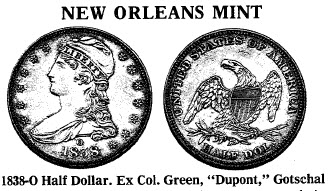
*1838-O Half Dollar. [20] These were struck in January 1839, ostensibly to test a recently arrived press of the largest size. No accounting of them was madein reports by the superintendent of the New Orleans Mint to the Director at Philadelphia. The mintage figure comes from Rufus Tyler, at that time Coiner - what person in a better position to know? Long ago believed to be of the highest rarity. Beistle (1929) claimed only three struck, which meant only that Col. Green was unwilling to show him his others. Green eventually owned at least seven specimens, according to Wayte Raymond. Between us we were able (1951) to enumerate eleven different ones.
(1) Superintendent, N.O.Mint, Mint Cabinet (in the 1858 layout, no. 6, division III), SI. Proof.
(2) Col. Green, B. G. Johnson, Wayte Raymond, J. G. MacAllister, Menjou:1073, R. E. Cox: 1873 $9,500, Empire Coin Co., "Century": 1151, $8,250. Proof.
(3) John H. Clapp, Louis Eliasberg. Proof.
(4) J.N.T. Levick, W. Elliot Woodward, Oct. 1884, R.Coulton Davis:655, J.B. Wilson:346, Waldo Newcomer, Henry Chapman (1928), $2,000, Col. Green Maurice A. Ryan, Mehl 6/45, $1,875, W.W. Neil: 580, J.A. Stack estate:415, $50,000. Proof.
(5) Col. Green, B. Max Mehl, Atwater: 555, unknown intermediaries, Reed Hawn: 122, $41,000. Proof, nicked up.
(6) Col. Green, unknown intermediaries, Baldenhofer:708, Pelletreau:783, $3,800, Jerry Cohen, Lester Merkin, private coll., Lester Merkin, Q. David Bowers, Charles Jay: 181, Dr. E. Yale Clarke: 253, $43,000. Impaired proof.
(7) Col. Green, Wayte Raymond, F. C. C. Boyd, WGC:410, "eastern collector," F. S. Guggenheimer:830. Impaired proof.
(8) Col. Green, unknown intermediaries, "Dupont": 2104, Gotschal, 1957 ANA sale, $4,450, believed bought by D.N. for the owner of the "TAD" collection. Impaired proof.
(9) C. A. Cass, "Empire": 1344, $4,000, playing Musical Chairs for awhile, later to New Netherlands at $6,500, by whom resold at $7,750 to Jerry Cohen, later KS 4/67: 1065. EF, impaired, obviously formerly proof.
Those owned by Col. Green certainly included nos. 2, 4, 5, 6, 7 and 8, and possibly either no. 3 or no. 9, unless indeed no. 9 was a more recent discovery.
The original W. M. Friesner coin (Friesner: 583, Frossard, 1894), recorded in Numismatist 4/94, p.198, "The 1838 Half Dollar New Orleans Mint," was a proof, accompanied by an old piece of paper inscribed as follows:
"The enclosed specimen coin of the U.S. branch mint at New Orleans is presented to Pres. Bache by Rufus Tyler the Coiner. It may be proper to state that not more than 20 pieces were struck with the half dollar dies of 1838."
When this was published, nobody had seen the New Orleans Mint records outside the Mint Buteau itself. In 1951 I found them in the Archives, and among them were many documents sent by the New Orleans Mint superintendent to the Director in Philadelphia, in which Rufus Tyler's name figured prominently as Coiner in both 1838 and 1839. Note alsothe use of the term "specimen coin" to mean proof. This particular example is not now identified, though as it was in 1894 an unimpaired Proof, it may be no. 2 or 3, or even part of some estate, ready to spring a surprise on the numismatic world. I have been unable to trace the other two examples known to Wayte Raymond, though they are doubtless still around, probably in estates.