Walter Breen's Encyclopedia of United States and Colonial Proof Coins 1722-1989
Walter Breen
The twelve Chapman proofs are from a different pair of dies and are very brilliant.
Peace Dollar. Regular dies. (I) Satin finish proof, different from the matte proofs below. Obv. Scattered die file marks, slanting up and down, crossing each other in upper left fields and through and around upper parts of letters in LIBERTY, these mostly parallel to horizontal elements of letters; others in approximately concentric arcs of circles. Triangular pellet stop after (S)T in unusually high relief, even more than the other stops. Rev. Rays in high relief; similar die lines. Two seen, one discovered at the 1975 ANA Convention.
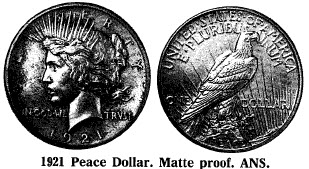
(II) Fine grain matte proof. (1) Smithsonian Institution, from Mint Cabinet; dull gray tone, lacquered and with a rim nick. (2) ANS, found April 11,1963 in a tray of medals with the label "By Anthony de Francisci". (3) Geiss: 407, ex Col. Green. (4) The former Kagin specimen. (5) That in LM 6/71: 813 at $9,000, now in a midwest coll. Note that the central details are much more boldly struck up on this coin than on any uncirculated Peace dollar.
Commemoratives. Unverified rumors have been heard of 1921 Pilgrim, Missouri 2x4 and Alabama 2x2 half dollars in matte or sandblast proof. These would be identified by exceptional central sharpness and matte surfaces, but authentication would be necessary.
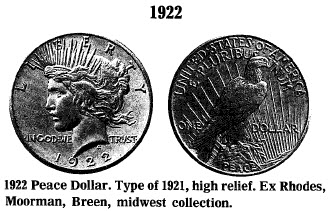
Silver Dollar. Type of 1921, concave fields, high relief. Fine grained matte. Five known. (1) Chase Manhattan Bank Museum of Moneys of the World, presumably ex Farran Zerbe. (2) Lester Merkin, obtained on the West Coast many years ago. (3) The specimen bought by this writer from Grace A. Moorman shortly after her husband's death, November 1960. Lewis Moorman had been one of my closest friends in the coin business for several years, and I could think of no finer way of expressing my appreciation for his memory than by vindicating him in his widow's eyes. Mrs. Moorman had not approved of Lew's purchase of the coin for $3,100 in a 1958 auction of the late Donald Rhodes. This piece has been illustrated several times, including NSM July 1961, p. 1722, and Taxay, U.S. Mint and Coinage, 357; it was exhibited about a dozen times by Moorman and twice by me. Note that Hydeman: 696, represented as a proof, turned out to be a regular 1922 dollar ruined by acid or the like. One eastern specialist flew out to Los Angeles specifically to see that coin; he did not bother to bid on it. The slur in the Hydeman catalogue against the Moorman coin was based on misunderstandings; Mrs. M. had offered the coin to several dealers before 1 bought it.
There was a standing offer (1965-70) of $15,000 for the Merkin specimen from an East Coast dollarspecialist, and there have been other nibbles at it and at the Moorman coin. Two others have since shown up,both impaired.
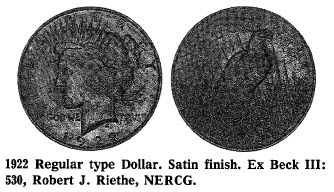
Regular type, satin finish. No mint frost, no "cartwheel" (cold flow radial lines), no monkey business; finish similar to the 1921 satin finish dollars. Rims are built up far more strongly than on business strikes. Inner coronet line exceptionally strong. Full central hair, full feathers, even on upper wing and breast! Lettering is all in noticeably higher contrast with fields, apparently higher relief, than on business strikes; edges of letters sharply defined, especially in mottoes on both sides. NERCG, ex Beck 111:530 as part of a lot of four 1922 Peace dollars, via Robert J. Riethe. I examined this piece at the Feb. 1977 Long Beach (California) convention, and it "carries its own credentials. "
Not to be confused with the "processed" coins emanating from the Los Angeles area (1965), with mirrorlike fields; those deserve no comment but a Bronx cheer loud enough to be heard on both coasts.
Commemoratives. Grant Half Dollar with star. Sandblast type. Exceptional sharpness on beard, hair, and leaves. (1) Ex J. R. Sinnock estate. (2) Ex C. E. Green. (3) S. A. Tanenbaum:417 ("Under 6 known"). Others reported.
Reports recur of the Grant Star gold dollar; unconfirmed but probable.
1923
Reports recur of at least two Monroe commemorative half dollars in matte proof; unconfirmed but probably true. These coins would have exceptional sharpness on portraits and on the allegorical figures on reverse - a sharpness never present on uncirculated pieces.
1924
A rumor of a single Huguenot commemorative half dollar in matte proof has been heard, from the same source as last.
1925
Reports recur of matte proofs of the Lexington, Stone Mountain, California Diamond Jubilee (without S mint mark on reverse) commemorative halves. Same source and I tend to credit these.
- Fort Vancouver Centennial half dollar. One matte proof seen, two others reported. Surfaces entirely different from the regular; extreme and unwonted sharpness on Dr. McLoughlin's hair and the frontiersman's buckskin suit.