Walter Breen's Encyclopedia of United States and Colonial Proof Coins 1722-1989
Walter Breen
X. THE CLANDESTINE YEARS, 1917-1935
At first ostensibly because of the war, later more likely because of the administration changes (there being no coin collectors in high office until William H. Woodin became Secretary of Treasury, 1933); no proofs were publicly sold. The few made went to VIPs, and most are controversial. The only ones to reach public notice were the 1921 dollars and 1928 Hawaiian commemorative halves.
1917
Cent. One seen, from a set (below), rev. not proofed, drastically cleaned; obv. has matte finish, like 1916.
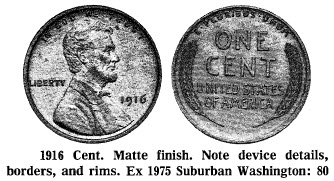
Five Cents. Two seen, the broken die coin (breakfrom rim through L into field) from the same set as thecent, the perfect die coin a later discovery. Both havematte finish, like 1916, with the same detail definition. Both have knife-rims in the same part of circumference.
Dime. Probably exists from the set but not verified to date.
Quarter. Type I (no stars below eagle). Two seen,one from the same set, cleaned, but sharp enough onrelief details to make the usual "full head" coins look weak; dozens more drapery folds near waist than usual; all ten toes clear. Matte finish, similar to 1916 cents and nickels.
Half Dollar. Two seen outside the set, matte finish; full head, sharply defined branch hands. A third, from the set, has not been available for examination.
Set. Ex Ira Reed in 1930's, to a collector in Philadelphia who stopped in 1942, and whose holdings were sold early 1976 to Joel Rettew. The set has been broken up. No duplicate is reported.
Commemoratives. McKinley Gold Dollar. Brilliant, similar to 1916. Three seen. (1) Phila. Estate. (2) Miles:315. (3) Private collection.
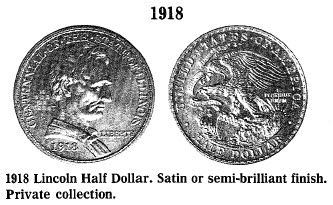
Commemoratives. Lincoln Half Dollar. Semi-brilliant or satin finish. Two seen. May also exist with matte finish.
1920
Commemoratives. Maine Half Dollar. Reportedly at least one in matte finish, ex John R. Sinnock estate; one other allegedly ex Ira Reed, unverified.
-Pilgrim Half Dollar. Reportedly at least one in matte (?) finish, ex John R. Sinnock estate; one other allegedly ex Ira Reed. Also unverified.
1921
Silver Dollar. Morgan design, modified (note parallel arrow feathers). Zerbe strikings: *Obv. Small die scratch up to r. from left tip of serif of left upright of second U in UNUM to border (hold coin so that this U is upright). Left base of first 1 above center of dentil, r. base of second 1 slightly r. of left edge. Central details far sharper than on regular uncirculated pieces. Rev. Very faint recutting visible on left upright of T in UNIT~D. Horizontal die file marks plainly within ribbon bows and at left and right of them; vertical die file marks at inner berries nearest to left base of N and T in UNITED. Eagle's breast feathers unusually sharp. Brilliant proofs as in 1904 and earlier years, carelessly made, almost all cleaned to death! (l) Smithsonian. (2) ANS, purchased May 10, 1921 - source not named. (3) Neil: 101, ex Philadelphia Mint, 1921. (4) Newcomer collection: 1263 in his private catalogue, where claimed that only 20 were struck; cost him $50 at some time prior to 1926. This piece later reappeared in the Major Lenox R. Lohr collection, auctioned in 1956: 908 at a low $175. It has been cleaned, like most of these. (5) One, really brilliant, authenticated about 1965 for Don Thompson, then of the New China Club, Reno, Nevada; this was part of his personal set of dollars. I have since learned that when he moved away from Reno, he disposed of the set of dollars, and young dealer Philip Moore sold this 1921 together with the brilliant proof 1895 and the uncirculated 1893-S, all authenticated, for $15,000. At then current (1966) price levels for the other two, that would mean that his customer must have valued the 1921 in excess of $5,000, which is not unreasonable for a brilliant proof. This coin occasioned several slanderous attacks by persons convinced that no genuine 1921 Morgan proofs were made. The coins in Smithsonian and ANS should be sufficient evidence to the contrary even if all the rest are unreasonably disbelieved. (6) One I authenticated for Stephen Ruddel, (7) Amon Carter Sr. & Jr. I have since seen and authenticated six others, impaired to varying degrees by cleaning and scrubbing. Some of the above may be reappearances of earlier numbers, e.g. 1975 ANA: 1179,1975 GENA II: 1268. Compare also lot 244, 1955 New England Numismatic Association auction followed by two first strikes accompanying it for comparison. The story has been told that Farran Zerbe had these proofs made - some say 20, some 24, some 25, other 200, exact quantity not known - as a kind of consolation for his not being able to get the Peace Dollars into the public's hands during the calendar year 1921.