Abe Kosoff: Dean of Numismatics
Q. David Bowers
After the boom period of 1936, commemoratives went begging in many instances. Such an issue was the 1936 Robinson-Arkansas half dollar. Abe Kosoff recalled:
"One day while lunching with Wayte Raymond, he asked me if I would like to buy 8,000 Robinson half dollars at 70c each. Now, here was a coin which I believed sold originally for $1.85.
"I thought that that sounded like a pretty good deal, so I said okay. Wayte called the bank, I believe it was the National City Bank on 23rd Street, and arranged for me to pick up the 8,000 coins at 70c each, and he pocketed $800 for his trouble. It happened that a well-known New York City collector, Elliott Smith, had financed the deal for a New York dealer who handled the distribution of the coins. These remained and were put on the market. I sold these in lots of 200 at $1.10 each, and I seem to recall that Howard MacIntosh at the Tatham Company in Springfield, Massachusetts, bought 1,000 coins."
In 1937, after spending six years attending night school and studying on other occasions, the "A. Kosoff" shingle went out, and Abe declared himself to be a full-time professional numismatist.
One of his first transactions after making the decision was with I. Snyderman, who had opened a shop at 1 East 59th Street and who acquired a large quantity of minor United States Proof coins. Such pieces were in abundance in New York City in the 1930s and for the most part came from the estate of David Proskey. Wayte Raymond had large batches of them, Proskey's son had many in his possession, and other groups existed here and there. It could have been the first day of his independent business career, but it was certainly in the first week, when he bought $1,000 worth of Proofs from Snyderman, ran an ad in the Numismatic Scrapbook Magazine, and was overwhelmed with orders.
Another of Abe's early advertising efforts was a quarter-page display in The Numismatist. Offered for sale were such varied items as a 1903 Louisiana Purchase Exposition Jefferson gold dollar, Uncirculated, for $7, a 1905 Proof quarter eagle for $9, and Proof $3 pieces of 1883 and 1887 for $18.50 and $15. At the time his address was 82 Bowery, New York City. In this and other advertisements he noted that he wanted to purchase United States and foreign gold coins, a continuing need.
He attended his first American Numismatic Association convention in 1937, the event held that year in Washington, D.C. From that point he continued an unbroken string of convention attendance for decades afterwards.
The second annual banquet of the Albany Numismatic Society was held at the Wellington Hotel, Albany on May 12, 1938. Among the out of town guests was Abe Kosoff, who brought with him some exhibits described as "interesting and valuable" in a subsequent report in the Numismatic Scrapbook Magazine. Julius Guttag, old New York City, was guest speaker at the event.
In the meantime, Abe Kosoff continued to attend the monthly meetings of the Brooklyn Coin Club. The October 1938 meeting of this group saw 18 members and two guests present. Abe Kosoff spoke on the subject of the United States quarter eagle and why it was one of the most interesting denominations to him. Years later, he was to focus on the 1841 $2.50 rarity as one of his favorite coins.
At the November 1938 meeting of the Brooklyn Coin Club, Abe Kosoff was nominated to be treasurer of the group. At the same event, J. Henry Ripstra, the Chicago numismatist, discussed the benefits that numismatics can bestow upon the youth of the country.
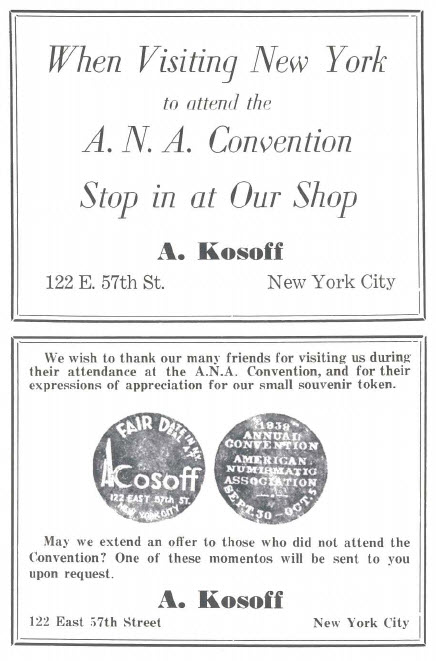
Advertisements placed in August and October 1939 invite and then thank those attending the World's Fair. A small souvenir token was minted to commemorate the occasion. By this time Abe Kosoff had relocated from 82 Bowery to 122 East 57th Street, New York City.
The Numismatist and the Numismatic Scrapbook Magazine, the two main hobby publication: at the time, carried Abe Kosoff's advertising. In the former publication in December 1938 he offered for sale the following commemoratives: a pair of 1938 Denver and San Francisco Boone hall dollars for $7.50; the scarce 1935 Old Spanish Trail for $4; a 1924 Huguenot for $2.25; a 1927 Vermont, typically designated as a "Bennington' issue, for $2.25; a 1935 Connecticut at $3; a 193c Bridgeport for $1.75; and a 1936 Lynchburg f01 $2.40. "We are still in the market for all types of foreign and United States gold and will pay highest cash prices," the advertisement continued. "Why not send us your list for our offer?"
On May 1, 1939, Abe Kosoff relocated from his former premises at 82 Bowery, New York City, to 122 East 57th Street in the same city. Apparently this was favorable for his trade, for a subsequent advertisement noted:
"Wanted-all types of United States and foreign coins of all metals. It is necessary for us to acquire a number of coins, due to an increase in business at our new address."
At his new location Abe Kosoff rented part of an antique shop from Alfred Rich & Sons, who had been established in the area for a long time.
"Actually, I had a little bit of space in the back where I put up a partition. I had a desk and a secretary-that was about it. I had a little showcase outside toward the back of the rather long shop," Abe Kosoff later recalled.
His gold-buying advertisements were a success, and in 1939 the dealer noted that "due to an over-supply at the present time" he was offering gold dollars for $2.25 each, an example of the 1911-D quarter eagle for $6.75, and a 1926 sesquicentennial quarter eagle for $4.75. It was the year of the World's Fair in New York, and Abe Kosoff issued a small token as a memento of the occasion. Advertisements invited those in town for the event to stop by and conduct business at his office.