Abe Kosoff: Dean of Numismatics
Q. David Bowers
"One of the things I recall is that after certain meetings held at the St. George Hotel we would walk to the subway. The boys hated to break it up, so they stopped for a beer, but as I didn't drink the bartender had to dig up a glass of milk for me. It was a standing joke among the fellows. 'Let's go in to get Kosoff a glass of milk' was the cue that they wanted to stop for a beer!"
In 1932 the price of gold and the stability of the American dollar were two hot topics in the press as well as at coin club meetings. Rumors were rampant that the American dollar would be devalued, following the lead of the British pound. Gold prices were rising around the world, and many thought that in the United States the price of gold would be raised from $20.67 per ounce to double the value, or $41.34. In anticipation of this, a gold double eagle of a common date was bringing close to $30. When the gold revaluation came a year later, the increase was to $35, a figure which remained in effect until the late 1960s, when gold was set free from its government posting in order to seek its own level on the market.
The following year, 1933, was one of the most important in Abe's life. While still a student, he married his first sweetheart, Molly Katzke, on December 24th. Molly lived in Coney Island on Mermaid Avenue, near 24th Street. Abe's parents, like many who lived in New York City, used to come to Coney Island in the summer. During one visit, Abe came to Coney Island and joined a group of people, all of whom knew each other except Abe and another person, a girl, who were strangers and were left out. Molly, the other stranger, introduced herself, and their friendship ensued, ripening to a romance and then marriage. Molly was Abe's first-and only-sweetheart.
In the meantime, Abe continued his studies at New York University and received a Bachelor of Commercial Science degree. He also studied the disciplines of mineralogy and gemology at Columbia University, New York City. It wasn't until the mid-1930s that he knew for sure that being (3 professional numismatist was his calling. Month by month his business grew, his inventory increased, his circle of friends and customers widened, and before long the profits made from coin trading exceeded those he could have made in the accounting profession. Thus the choice was made.
By the autumn of 1935, Abe Kosoff was one of the most active dealers in New York City. He was in the hobby when the commemorative boom started, a phenomenon which vastly changed numismatics. In the autumn of 1935, Frank Dunn, the distributor for the Boone commemorative half dollars, announced that just 2,000 pairs of a new rarity, Denver and San Francisco mint 1935 Boone half dollars with a small "1934" on the reverse, would be issued. Advertisements were sent to numismatic publications and news releases were distributed. Before notices appeared in The Numismatist and other publications read by collectors, a series of newspaper articles on the subject attracted New York City readers. This generated a rush, and by the time that established collectors learned about the issues they were "sold out" to the early birds who had ordered from the New York City press releases.
Abe Kosoff checked into the situation and found that if a buyer visited the distributor in Kentucky, who did business from a hotel room, he would find that no sets remained. However, it so happened that in another room at the end of the hall a "local dealer" just happened to have a few sets. The trouble was that the price was $25 per pair; or about six times the official issue price!
In the meantime, in 1936 there was an active trade in commemoratives in New York City. Rather than deal with the issuing commissions, which were often erratic and which were usually bogged down in paperwork, Abe Kosoff and other dealers would buy from Joe Barnet, the Brooklyn dealer, who acted as a wholesaler and bought quantities from issuing commissions at favorable prices, usually below those published in official price schedules. A typical commemorative cost Barnet $1, he would mark it up to $1.25, and Abe Kosoff and others would sell them around town for $1.50. Handled in this way were various Texas, Boone, Arkansas, Oregon, and other issues. Some pieces were cheaper, far cheaper. At one time, Abe Kosoff purchased 2,200 Stone Mountain half dollars at 52c each and wholesaled them to dealers in groups of 100 coins at 65c each.
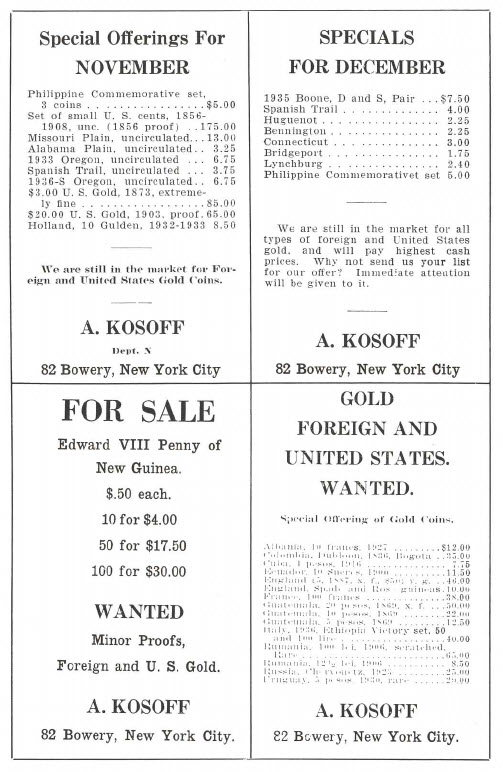
Four advertisements, each of quarter-page size, from "The Numismatist." The year was 1938, and Abe Kosoff's business was steadily increasing.