Silver Dollars & Trade Dollars of the United States - A Complete Encyclopedia
Q. David Bowers
The 1960s
By 1962 I was well established in the rare coin business, had been issuing price lists and catalogues for a number of years (since 1955), and, in fact, may have had the largest coin business in the United States. Located in Johnson City, New York, the Empire Coin Company, Inc., jointly owned, by Jim Ruddy and me, had sales over $1 million in 1961, which we advertised as an unprecedented volume. The only challenger was a New York City dealer who called to say that no dealer could ever sell a million dollars worth of coins per year. But, we did. Back then coins were worth tiny fractions of what they would sell for later.
No coin collection sold at auction ever approached the $1 million figure at the time. A "large collection" was apt to sell for $50,000 to $100,000-and this included some of the biggest properties of the time. Probably a typical collection worth $100,000 back then would be worth $3 to $5 million, if not more, today! All things are relative; a business lunch was apt to cost $1 to $2, and a single room in the Park Sheraton Hotel in New York City cost $16, including parking.
In the late 1950s and very early 1960s, interest in silver dollars increased. Norman Shultz and Bebee's were two of several dealers who frequently ran lists of dollars in the leading publication of the time, the Numismatic Scrapbook Magazine. Norman Shultz in particular specialized in dollars. Bebee's-the partnership of Aubrey and Adeline Bebee-was more cosmopolitan and dealt in commemoratives, currency, Proof sets, and other issues as well. Still, interest in Morgans was not all that great. Dealer Abe Kosoff once took a survey of the most' popular collecting series. According to his findings, Buffalo nickels headed the list, and. Morgan dollars weren't even in the top 10!
Harry J. Forman, who began business in the mid-1950s, was one of the few dealers who handled silver dollars in bulk. As he has already related, it was a good deal to buy a $1,000 bag and make a profit of $50 on it. I recall buying a bag of 1885-CC dollars from Harry in the late 1950s, and around the same time I bought a bag of 1878-CC dollars for $2 each from Rev. Edward W.W. Lewis, a Connecticut minister who collected and traded in coins.
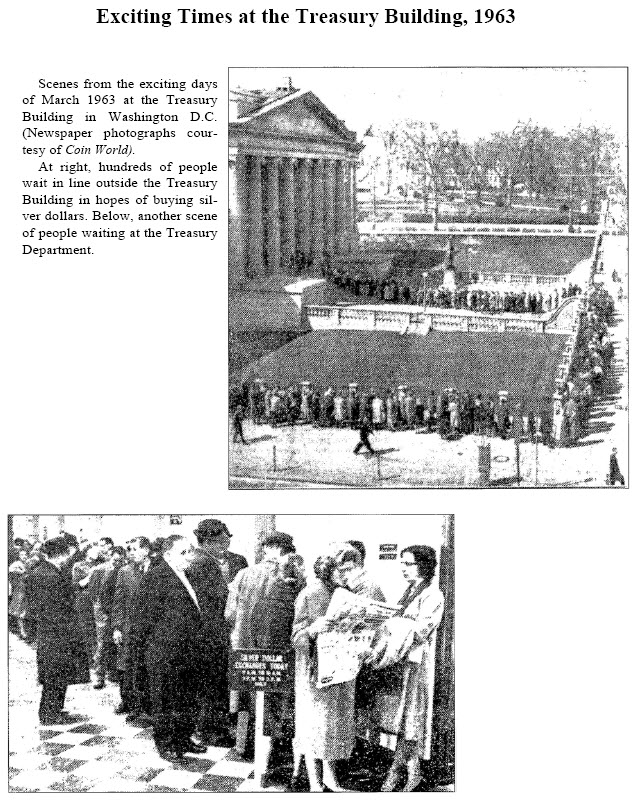
Harry and I were friends, and in autumn 1962 he called me at Empire Coin Company to relate the unbelievable: bags of Uncirculated 1898-O, 1903-O, and 1904-O dollars were coming on the market! The news was electrifying. As I mentioned, I had never seen or owned an Uncirculated 1903-O. The coin catalogued for $1,500 in the Guide Book, but probably an offer of $10,000 cash on the barrelhead would not have produced one-until autumn 1962. The 1898-O and 1904-O Morgan dollars were worth $300 to $500 per coin in Uncirculated grade, if you could find one, but no one had any of these either.
It is difficult today in the 1990s to describe how it felt to be a coin dealer in 1962 and have one of the most expensive coins in the Guide Book now available by the thousands. A coin cataloguing $1,500 then is equivalent to a coin cataloguing, say, $50,000 or more today. Imagine, if you can, the Treasury Department announcing that it found a bagful of 10,000 1876-CQ 20-cent pieces (a coin worth in the $75,000 range) and these were now available by the dozens and hundreds. Your entire perspective would change. You would have to rearrange your thinking. The order of the numismatic universe would become different.
No one knew back in 1962 what else would come out of the Treasury and the Federal Reserve System, and anyone owning 1903-O and other newly-released dollars was content to add a small mark-up and sell them. After all, a million more might be released tomorrow. Nothing was sacred!
Rumors abounded, and those who knew the truth didn't want to tell the details, as it was not a good thing to say that one owned a full bag of this rare coin or that one. Predictions were common that the market was finished, and that silver dollars would sink, and sink, and sink some more in value. There would be no market.