Silver Dollars & Trade Dollars of the United States - A Complete Encyclopedia
Q. David Bowers
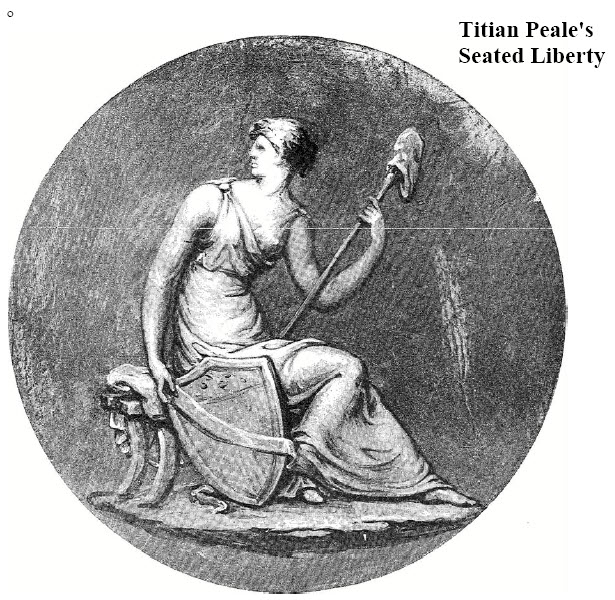
A portrait in oil on cardboard of the seated figure of Liberty by artist Titian Peale (1799-1885). Peale was well known as a painter and a naturalist. In The American Numismatic Association Anthology (1991) Elvira Eliza Clain-Stefanelli noted that Director Pollock required that the "figure be in a sitting posture-sitting, for example, on a rock. To be distinctly 'emblematic of Liberty' I would propose that the figure hold in her right hand the liberty pole, surmounted by the pileus-an emblem not unclassical, and which is universally understood. I would also suggest that the left hand be made to rest on the United States shield on which the word 'Liberty,' required by law, may be inscribed."
Mrs. Stefanelli noted concerning Peale's adaptation of this commission: "Peale's painting shows a seated, slender figure with the left leg stretched out and the right leg bent slightly backwards. The figure is turning its head and upper body slightly backward, bending at the same time forward while implanting with her left arm the pole topped by the liberty cap; her right arm is gracefully resting on a shield placed on the ground against her right thigh; she is seated on a bench with curved legs. All her movements are perfectly coordinated and so are the folds of the long, tightly adhering sleeveless gown of classical design, fastened over her shoulders with clasps. Her hair, gathered in a bun in the back of her head, is unadorned. This unadorned head and the fluidity of the motion of her body set her completely apart from the classical and British models." (Photograph courtesy of the American Philosophical Society, Philadelphia)