The Early Quarter Dollars of the United States
A. W. Browning
Quarter Dollars of 1825
Total number of pieces coined 168,000. The coinage of this year appears to have been made from obverse dies of previous dates. Three varieties are known.
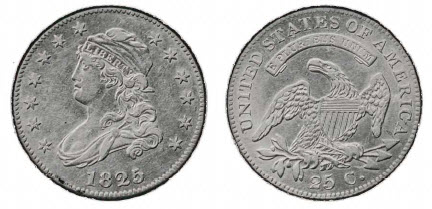
No. 1
Obverse: 1825 over 1822, the upper and lower part of 2 showing plainly under the 5. Date spaced similar to the regular die of 1822, but upper right star is close to cap, nearer than in any of the three foregoing dies, 1822, 1823, and 1824.
Reverse: From the same die as the reverse of 1824.
Dies perfect. A rare variety, very rare if sharp.
Widest date.
Spine from lower arrow barb; chip between final S of STATES and S of motto.
Browning-1; Clapp-1; Duphorne-48; Breen-3908; Haseltine-1.
Rarity-5
Die States: I. Perfect.
II. Die crumbling within 5 of date, right of upright.
Doubtless from a second 1822 obverse, though often miscataloged as "1825/4," and it may have been originally overdated to 1824. Usually in low grades. Mintage figure of 168,000 probably means at least 144,000 dated 1825, plus part of the initial 24,000 delivery (together with the 1824s).
The best ones auctioned are as follows:
The best ones auctioned are as follows:
1. Kern:1410. Uncirculated. Probably same as either of next.
2. J.H. South:466, as "B-2a." Uncirculated.
3. Cass, "Empire":1020. Uncirculated.
4. Miles:895. AU+.
5. Ruby I:1147, Neggen Estate:543. AU. Possibly same as next.
6. Haseltine, Davis, Davis-Graves:335. AU. Not illustrated.
7. J.H. South:461. AU. (His "EF" in Lot 460 proved not to be B-2.)
8. J.A. Stack:25. AU. Not Illustrated. Possibly same as Brown Library:196 (Pine Tree 5/76.) "EF-AU," not illustrated.
9. Leon Goodman:909. "EF-45." (Illustrated).
10. Matthew Bryan:5097. EF+, cleaning, retoned.
11. Col. Green. EF. Plate V.
12. Bowers & Ruddy RCR 18.
13. Clapp, Eliasberg Estate EF?
14. Norweb:1541. EF. Not illustrated.
15. Boydm WGC:85. VF.
16. J.H. South:462. VF.
17. 1974 GENA:1342. Fine+.
18. Ruby Gilhousen:595. Fine+.
19. Ruby I:1148. Fine.
20. David L. Hirt, 1975 GENA:74. Fine.
The list may contain some duplicates owing to unillustrated coins.
Numerical Condition Census (RWM, Sr.): 60, 60, 60, 60, 55, 50.
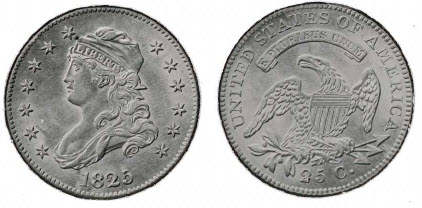
No. 2
Obverse: 1825 over 1823, the top of 3 showing under the 5. Date close and about equally spaced, 5 practically not under curl; upper right star distant from cap.
Reverse: Ends of scroll: left under upright of D; right under foot of A near right end. On scroll: I centered under T; S centered under S. Small 5 in value, 25 C.
Close date.
High 25, small 5.
Browning-2' Clapp-3, Duphorne-49; Breen-3909; Haseltine-2.
Rarity-2. Possible Rarity-1.
Die States: I. Perfect. Common. The two "subvarieties" in Duphorne (with upper berry merged into leaf, and normal T's; and separate stem to upper berry, and T's showing slight split in upright just above right base) respectively may represent coins struck before and after regrinding to remove clash marks.
II. Crack, rim to period, arrows, final A and rim.
III. Crack, rim through I of UNITED nearly to eagle. Very rare. 1975 Suburban Washington:162, EF.
Proofs: At least nine seen, some cleaned or impaired, including WGC:86, Kern:1411.See account in EPC.
Business strikes are plentiful in all grades; there are at least 30 different Uncirculated coins, mostly State I, and this is the variety normally represented in date collections.
Many specimens, normally EF to Uncirculated and in State I, come with the same E countermark found on 1815's (q.v.) Gilhousen:597, EF+, weighed 103.5 grains.
Few specimens, normally EF to Uncirculated, come with the same L counterstamp found on 1815's. These are also of normal weight. It has been suggested that the E and L may allude to different bullion sources or regions where the coins were to be sent. For a more likely explanation, see discussion at 1815. The Browning plate coin came from W.P. Brown, 1913, as "Uncirculated," at $2 to Browning.
Gale Harington reports that several dozen turned up with E or L counterstamps, 1968-1972, in the Tri-State area, from eastern Ohio to western Pennsylvania. Most likely they were a mixture of B-2 and B-3, predominantly the former. More L's on 1825, more E's on 1815, according to Robert W. Miller, Sr.; this fits [Breen's] observations.
Numerical Condition Census (RWM, Sr. [circa 1992]): 64, 64, 64, 64, 63, 63. Hoard coin.