The Early Quarter Dollars of the United States
A. W. Browning
Quarter Dollars of 1815
Total number of pieces coined 89,235. Following the year 1807, no quarter dollars were made at the Mint until 1815, when they appeared again in an entirely different design, practically the same as the second type of the half dollar of 1807. The obverse has a bust of Liberty, with the Roman mantle facing left. Upon the head is a Liberty cap inscribed with the word, LIBERTY. To the left of the bust are seven stars, and to the right six, thirteen in all. Below the bust is the date 1815. The reverse has an eagle with its wings expanded in flight, grasping three arrows in the left, and an olive branch in the right talon. Upon its breast is suspended the United States shield. The motto, E PLURIBUS UNUM, floats upon a scroll above. Legend: UNITED STATES OF AMERICA. Below the eagle is the value, 25 C. The size of the coin is also changed, the diameter reduced, with a consequent increase in thickness.
While but one variety has been found, apparently dies were engraved for a second obverse and reverse, which vary slightly from the regular dies of the year. See 1818 [Browning] 1.
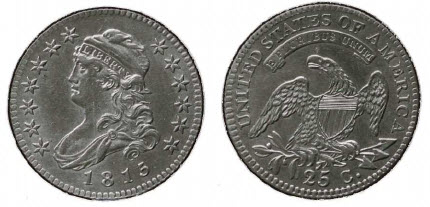
No. 1
Obverse: Date very wide, equally spaced, 5 not centered under curl, too far to right; large stars close to border; lower left star points to between first and second fold in drapery, and is nearer border than drapery.
Reverse: All letters in STATES close together. Ends of scroll; left under upright of D; right under center of left foot of M. On scroll: I centered under space between T and E; S centered under space between STATES and OF. Eight leaves and two berries on olive branch of this reverse, and all other of this type.
Dies perfect. Date rare when sharp.
Only the one variety; AT show repunching. Mintage 89,235, comprising 69,232 delivered Dec. 16, 1815, and 20,003 delivered Jan. 10, 1816 (the initial day after the Mint reopened, the day before the fire which destroyed the apparatus for making gold and silver planchets).
Browning-1; Clapp-1; Duphorne-20; Breen-3892; Haseltine-1.
Rarity-1. In demand among date collectors and those specializing in first year of a design.
Die States: I. Perfect.
II. Plain clash marks: obverse, from scroll, wings, arrows and branch; reverse, from head and bust. These are sometimes miscataloged as die breaks.
III. Dies relapped; clash marks gone, as is repunching on second T of STATES. This accounts for the claim "Smaller 5 in date" in Wolfson:1623. Cf. WGC:31; Neil:879, others.
On many specimens of State III, and on a smaller number of 1825 B-2, there is a small countermarked E (more rarely L) just above the cap. This was thought to represent Excess Weight or Light Weight – which would not have been legal to issue! – but that interpretation is now abandoned. Two specimens with E weighed 106 and 103.5 grains, and similar results are observed on the 1825s. As the countermark does not disturb any part of the reverse, it was long though to be official and inflicted while each piece was supported by the reverse die. At present even this is disputable. Specimens with the E are found in all grades, including Uncirculated, e.g. Haseltine Type Table:1313, R. Coulton Davis, Davis-Graves: 323, Winter: 1326, possibly the finest of these.
Browning's plate coin came from David Proskey, 1914, $12, as Uncirculated.
I conjectured in 1982 that these coins might have been school prizes (E=English, L=Latin); kept with other prizes, not spent. Gale Harington reports that several dozen with an E or L counterstamp turned up, 1968-1972, in the Tri-State Area, from eastern Ohio to western Pennsylvania. Others turned up in the Albany, NY area in the same period. According to Robert W. Miller, Sr., the E's are more often seen on 1815s, the L's on 1825s, but neither can be called rare.
There are at least a dozen Mint State survivors, but the number catalogued as "Uncirculated" is more than quadrupled by AU and borderline cases, many cleaned; illustrations are not a safe guide, even the coin on Plate II falling short of full Mint State.
Numerical Condition Census (RWM, Sr. [circa 1992]): 65, 64, 64, 64, 64, 63 (7) Hoard coin.
No quarter dollars were made in 1816, nor in 1817.