The History of United States Coinage As Illustrated by the Garrett Collection
Q.David Bowers
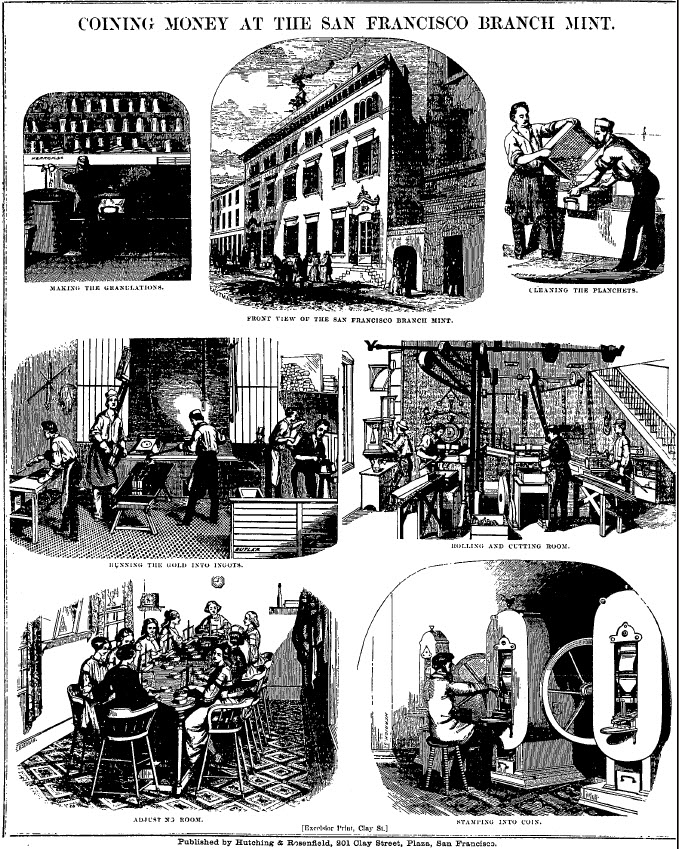
On May 29, 1854, Sen. Gwin again brought the coinage proposal before the Senate. The discussionwas delayed, but on June 16th the Senate overwhelmingly passed the bill. However, the bill never was voted upon by the House of Representatives, and the proposal died.
In 1855 the need for large coins was met by the round $50 pieces made in large quantity by Wass, Molitor & Co. To a lesser extent the similar coins of Kellogg & Humbert, about which little information exists, may have played a part.
Notwithstanding several years of private coinage and intermittent intervals during which California's problem of coins in circulation seemed to be solved, by late 1855 there was still much confusion, as an October 23rd article in the Alta California indicated:
There probably never has been any single State in the Union so imposed upon with a mixed and debased currency as California. Even before her adoption into the Union as one of the Federal States the evil began, and the old Spanish or Mexican currency of Ounces and Dollars and their subdivisions was interfered with by clipped coins from the southern coast, adulterated Dollars from Bolivia, "Milreis" from Brazil, and other pieces the value of which would puzzle the Director of the Mint to determine. The discovery of gold in untold quantities in our mountains created a still greater demand for coin, which had to be supplied by some means or other, and in the absence of legalized issues private coiners commenced operations, and we had "Beaver" pieces from Oregon, Mormon coin, both from Utah and various points in the State, not to speak of "S. M. V.," "Wright's Miners' Bank," "Baldwin's Half Eagles," etc. These have all passed away, although many of them were practically a "shave" on the recipient, in value, they answered a good purpose. The presence of an assayer, be he good or bad, helped the miners by establishing a standard of gold, and by the time that Mr. Humbert (a man who has done more than any single person we know of, and has met with no reward at all commensurate with his services) had got through his labors as a United States officer, most of them had disappeared.
The age of gold having passed away, that of silver came into full operation and we were deluged with Francs, Pistareens, Double Reals, and countless other pieces all going to repre-sent Quarter Dollars, and ranging in value from 16 to 183), cents. We need not recall to the recollection of our readers the position of our currency a year ago. It presented a perfect anomaly. Four single Francs for all purposes of business equalled in value a single piece of Five Francs. Four Pistareens (sixty-four cents) ranked as equal to a Spanish milled Dollar, worth with the premium certainly $1.05. The New Granada eighty-cent Dollar was equally worth $1.05 (the Spanish milled Dollar), and sixty-four cents (say, four pistareens). Everything in a word was confusion, worse confounded.
The evil at last was so great that it became imperative on the part of the bullion dealers to make an effort to stop its course. The importation of Francs, which had been carried on to a great extent by outside operators at a few foreign houses, was stopped by the action of the bankers in refusing to take them for more than twenty cents, which, although representing a trifle over their real value, sufficed to drive them out of circulation. In fact, as soon as the rate became reduced in banks the value sank still further outside, and in common trade they were passed for only 12 1/2 cents, or 71/2 cents less than they were actually worth.
The movement made last year was a good one, but it did not go far enough. We might almost say now that the ages of both silver and gold were passed, but that the age of brass had set in. We have at present in circulation a Pistareen (value 16 cents); the Chile Double Real (value about 19 cents); the Rupee (value 44 cents), and a number of German and Spanish coins, the value of which we cannot at the moment determine, but which all pass in common for twenty five cents, the Rupee ranking at fifty cents, or six cents more than its actual value. We also have the Sovereign, passing for $5, when its actual value is but $4.85; the Napoleon, value $3.88, passing for $4, and Thalers, $3.88, and Double- Thalers, $7.74, circulating for a large advance on their actual worth....
By early 1856, notwithstanding the mint production of several million dollars' worth of gold each month, private coins circulated as extensively as ever in San Francisco and made up nearly the entire bulk of pieces seen in trade. At the time no private coins were being struck, Wass, Molitor & Co. and Kellogg having ceased operations the year before. It is estimated that early in 1856 from $5 to $8 million worth of private coins were in circulation. By the end of 1856 several conferences were held by merchants and bankers for the purpose of restoring the state's currency to a more stable basis. On March 25, 1856, at the office of Alsop & Co. it was resolved that:
In our opinion the time has arrived for placing the currency of the State on a sound basis, and that to continue to receive as currency private coinage is attended with present inconvenience and possible loss to the community. Resolved, that we use all legitimate means to discountenance the circulation of private and illegal coin.
The San Francisco Bulletin, April 10, 1856, commenting on the situation among merchants and bankers, told of an interesting coinage of Mexican pieces in San Francisco, and gave other views:
... The fact that the meeting seems to have been confined to the larger class of houses, comprising by the way some of the best names in the city, however objectionable it may seem (and it does so seem to us), on the ground of its being a movement restricted to a few persons and therefore liable to the suspicion of having private ends in view, should not prevent a fair inquiry into the case. The interests of larger merchants are undoubtedly more directly affected at present then the smaller ones; but a further inquiry will show that, in looking after their own interests, they are also acting for the good of all. At some time or other this private coinage must cease, and that of the Mint be the only currency. It is right that it should be so, because in the Mint, the public has the only sure guaranty that they will be protected. In the absence of a Mint to supply our wants, private coinage has been of much benefit to our people; but that time has passed, and the question arises whether this coinage should not be stopped at once? We think it should be, and the loss of one-half percent had better be suffered now at the present then at the latter on a much larger sum. The bankers of course feel a reluctance to start this matter, because it will be thrown back at them that they had an active part in getting the money in circulation, and this the bankers cannot deny. They will, however suffer their proportion of the loss, for until there be a general agreement to refuse this coin the bankers cannot do otherwise than take it at the counter, and all their efforts to "work it off" will prove ineffectual.
The American decimals are not the only coins that have been made in this city. It is well known that Woods had a contract with Santa Anna to coin Mexican Ounces in this city, under the sanction of the Mexican Government. Woods sent Sam Ward to Mexico, and Ward agreed to pay the one legged Dictator a certain sum for the privilege. Drafts were drawn on Adams & Co., and, as we understand, were cashed in Mexico, Santa Anna pocketing the proceeds. Woods accepted the drafts here, but as far as we can learn they were never paid, as before they became due Adams & Co. had failed. The Ounces were coined on Montgomery St., and when, after the failure of Adams & Co., we heard of the gold dust "doctoring," we once suspected that there was some doctoring about these Ounces which we believed were all shipped to China, through Bolton & Baron, who bought them of Woods' broker without knowing anything about where they were made. It was thought best to say nothing about this affair until a return from China could be had, to see if the Ounces were of good weight and fineness. We were subsequently told that returns had been received and the coin [found to be] both of full weight and fineness, and then so far as Woods was concerned, the matter was dropped, for it was very questionable whether with the sanction of the Mexican Government any law had been violated, unless it could be proven that the coin fell short of the value it purported to be.