The History of United States Coinage As Illustrated by the Garrett Collection
Q.David Bowers
The same monograph noted that on the American River:... [gold] is found at a depth of three feet below the surface, and in strata of soft sand rock. Exploration made southward to the distance of 12 miles and to the north of 5 miles reports the continuance of this strata and the mineral equally abundant. The vein is from 12 to 18 feet in thickness. Most advantageously to the new mine, a stream of water flows in its immediate neighborhood, and the washing will be attended with comparative ease.
In early May the merchant Samuel Brannan, leader of the Mormons in California, held a bottle of gold dust in one hand and swung his hat in the other hand and went along the street shouting. "Gold! Gold! Gold from the American River!"
The gold fever continued to spread. Recalling the events of the time one person later wrote:
A. frenzy seized my soul Unbidden, my legs performed some entirely new movements of polka steps; I took several. Houses were too small for me to stay in. I was soon in the street in search of necessary outfits. Piles of gold rose before me at every step. Castles of marble, dazzling the eye with their rich appliances, castles of slaves bowing to my beck and call, myriads of fair virgins contending with each other for my love, were among the fancies of my fevered imagination. The Rothschilds, Girards, and Astors appeared to me to be but poor people. In short, I had a very violent attack of the gold fever.
Exodus to the Gold Fields
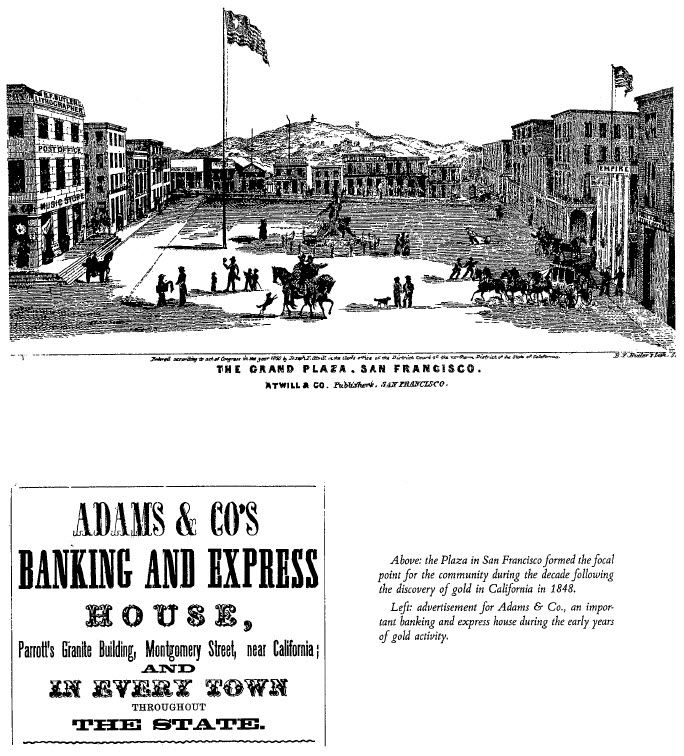
Nothing except the new gold discoveries attracted popular attention. Business affairs were put in order, offices were closed, real estate was put up for sale, and other activities were set aside for the exodus from San Francisco and other cities to the mines.
The quickest route to the gold fields was by water, up the bay into the Sacramento River. Others went to Sausalito by boat, and then by foot or horseback by way of San Rafael and Sonoma. Still others went around the southern end of the bay and through Livermore Pass.
The March 1848 census reported 810 people in San Francisco, of whom 177 were women and 60 children. In the month of May it was estimated that at least 150 adult males had left San Francisco, a figure equal to a quarter of the male population at the time.
There was a shortage of ships. It was reported that a $50 rowboat would sometimes command $400 or $500 from someone eager for quick passage. In the San Francisco area a pack animal could still be obtained for $15, although it was reported that one rider who took animals to the mines was able to rent them for $100 per week upon arrival there. Charles 1. Ross, who wrote a manuscript, "Experiences of a Pioneer of 1847 in California," for historian Hubert H. Bancroft, noted that by the middle of May at Martinez there were 200 wagons waiting to cross at the ferry:
Having collected there in that short time, within two weeks, men, women, children, families who had left their homes ... They had organized a committee; each man was registered on his arrival and took his turn at crossing. The boat ran night and day, carrying each time two wagons and horses and the people connected with them. Some had to camp there quite a while. After a time somebody else got a scow and started another ferry, and they got across faster.
Semple, who operated the ferry and who earlier had expressed disbelief in the gold discovery, now was charging $20 each for some crossings. He worked alone at his business, but then one man offered to help him for a term of just two weeks at $25 per week.
By the middle of June 1848 three-quarters. of San Francisco's male population had left for the mines. On May 27th The Star reported:
Stores are closed and places of business vacated. A large number of houses tenantless, and various kinds of mechanical labor suspended or given up entirely, and nowhere the pleasant hum of industry salutes the ear of late; but as if a curse had arrested our onward course of progress, everything wears a desolate and somber look, everywhere all is dull, monotonous, dead.
In the same issue of The Star appeared an advertisement which noted: "The highest market price will be paid for gold, either cash or merchandise, by Mellous & Howard, Montgomery Street."