The History of United States Coinage As Illustrated by the Garrett Collection
Q.David Bowers
On May 26th or 27th, 1652 (the records of the House of Magistrates give the date of May 26th; the House of Deputies records show the May 27th date) an act was passed which provided that a mint be established. With regard to this, John Hull, who was appointed mint master, noted in his diary:
Also upon occasion of much counterfeit coin brought into the country, and much loss accruing in that respect (and that did occasion a stoppage of trade), the General Court ordered a mint to be set up, and to coin it, bringing it to the sterling standard for fineness, and for weight every shilling to be 3 pennyweight; that is, 9 pence at 5 shillings per ounce. And they made choice of me for that employment; and I chose my friend, Robert Sanderson, to be my partner to which the Court consented.
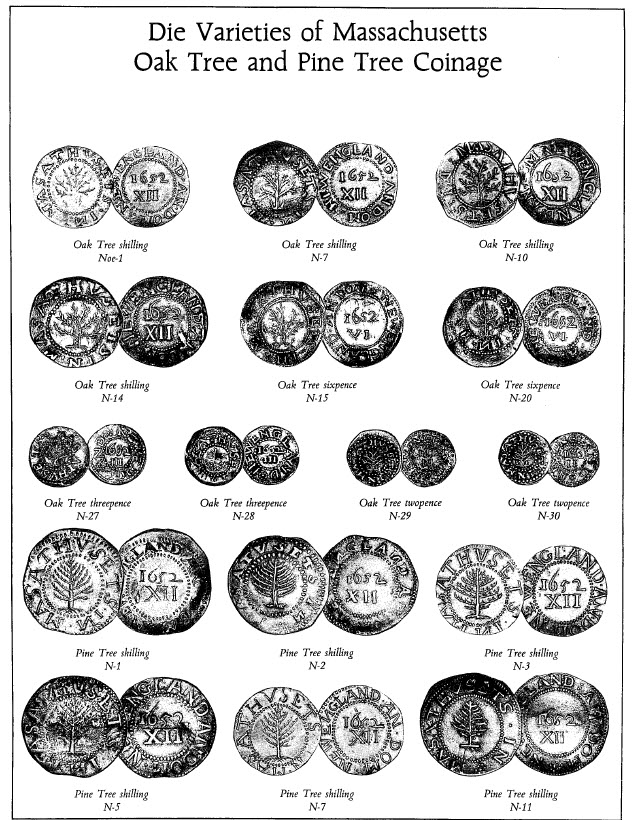
The act noted in part: After the first of September the money hereafter appointed and expressed shall be the current money of this commonwealth and no other, unless English, and except it be at the receiver's consent thereunto. In pursuance of the intent of this Court, herein be it further enacted, ordered, and enacted by the authority of this Court, that all persons whatsoever have liberty to bring into the mint house at Boston all bullion plate or Spanish coin there to be melted and brought to the alloy of sterling silver by John Hull, master of said mint, and sworn officers, and by him to be coined into 12 pence, 6 pence, and 3 pence pieces which shall be for form and flat and square on the sides and stamped on the one side with NE and on the other side with the figure XII, VI, and III-according to the value which shall be each piece, together with a privy mark-which shall be appointed every three months by the governor and known only to him and the sworn officers of the mint.
And further the said master of the mint aforesaid is hereby required to coin all the said money of good silver of the just alloy of new sterling English money and for value to stamp two pence in a shilling of lesser value than the present English coin and the lesser pieces proportionately; and all such coin as aforesaid shall be acknowledged to be the current coin of this Commonwealth and passed from man to man and all payments accordingly within this jurisdiction only.
And the mint master for himself and officers for their pains and labor in melting, refining, and coining is allowed by this Court to take one shilling three pence out of every twenty shillings which he shall stamp as aforesaid. And it shall be in the liberty of any person who brings into the mint house any bullion plate or Spanish coin as aforesaid to be present and see the same melted, refined, and alloyed, and then to take a receipt of the master of the mint for the weight of that which is good silver alloyed as aforesaid, for which the mint master shall deliver him the like weight in current money; that is, every shilling weighing three penny troy weight and lesser pieces proportionately, deducting allowance for coinage as before expressed. And this order being of so great concernment may not in any particular thereof fall to the ground it is further ordered that Mr. Richard Bellingham, Mr. William Hibbens, the present Secretary Capt. John Leueret, and Mr. Thomas Clarke be a committee appointed by this Court to appoint the mint house in some convenient place in Boston, to give John Hull, master of the mint, the oath suitable to his place, and to approve of all other officers and determine what else shall appear to them as necessary to be done for the caring and end of the whole order ....
On June 22, 1652, the committee met and determined that a mint house would be built and the necessary tools and implements would be procured. The mint site was determined:
The said mint house shall be set upon the land of the said John Hull; and if it is agreed between the said committee and said John Hull that when either by his death or otherwise the said John Hull shall cease to be mint master, then the country shall have the ground ye house stands upon at such price as two indifferent men, equally chosen by the country and ye said John Hull or his assigns shall determine, or else the said John Hull on the light term shall have the said house as two indifferent men shall judge it to be worth at the choice of the country.
It is provided that the mint house be "16 feet square, 10 feet high, and substantially wrought."