The History of United States Coinage As Illustrated by the Garrett Collection
Q.David Bowers
In the same era several new dealers joined the numismatic arena. Thomas L. Elder, a native of Pennsylvania, offered nearly 300 auction sales from 1903 to 1940. Such notable collectors and dealers as Peter Gschwend, Peter Mougey, William H. Woodin, Henry C. Miller, Lyman H. Low, D. W. Valentine, S. H. Chapman, George Alfred Lawrence, Edgar H. Adams, and many others sold their collections through Elder. He published a monthly catalogue from 1906 to 1909. With Gilbert he wrote Varieties of the United States Cents of 1796 in 1909. In later years, perhaps envious of the success of B. Max Mehl's Star Rare Coin Encyclopedia, Elder issued avolume quite similar in format and intent, The New Rare Coin Book, 100 pages in length, which offered prices for various United States coins in different grades.
Elder was one of the most controversial dealers of the early 20th century. He was ever ready to voice an opinion concerning the current political situation, coin market, economy, competitors' personal habits (not to overlook their auction sales and other offerings), or almost any other aspect of numismatic or American life. His opinions on politics in particular were stated on various medals which he had struck to order. Toward the end of the first decade of the 20th century Wayte Raymond, who pursued the occupation of bank teller, entered professional numismatics. He proposed to B. Max Mehl that a partnership be formed, but Mehl, preferring independence, declined. Later, Elmer Sears joined Raymond in the United States Coin Co. In 1912 Raymond penned one of the first advertisements which promoted rare coins on an investment basis:
COINS AS AN INVESTMENT. Many harsh words are said about collectors who interest themselves in a natural speculation as to whether or not the coins they are buying today will have appreciated in value ten years from now.
Numismatists of the old school tell us that the true collector is not interested in any such appreciation in the value of his collection but derives his entire profit and pleasure from the coins while in his hands.
We feel, however, that the average American collector, while he greatly enjoys his coins, also feels very pleased if on disposing of his collection he realizes a profit ...
Still later, he became associated with James G. Macallister in the field of numismatic auctions which were held on the premises of Morgenthau & Co. For a long period of time Raymond was connected with the Scott Stamp & Coin Co.
Raymond devoted vast amounts of time and expense to numismatic research. His Standard Catalogue of United States Coins, first published in 1934, was the first catalogue of coin mintages and prices produced on a regular basis. His "National" line of coin albums did much to advance the hobby during the 1930s as did his magazine, The Coin Collector's Journal, named after the 19th-century Scott Stamp & Co. publication of the same title. Still later, in the 1950s, he paid Walter Breen to engage in research in the National Archives. Numismatic scholar and dealer John Jay Ford, Jr. also received much encouragement from Raymond about the same time.
While Raymond engaged in many successful coin sales and promotions, including distribution of several commemorative half dollar issues, he is remembered today for his numismatic research and publications. Raymond, who died in New York City on September 23, 1956, at the age of 70, was considered a knowledgeable and friendly man who enjoyed art, fine food and wine, and luxurious surroundings. He considered his personal time to be valuable, so it was a rare beginning collector who had the opportunity to spend extended periods in conversation. But, for the numismatic scholar it was different. Raymond loved and enjoyed history and never tired of talking about it.
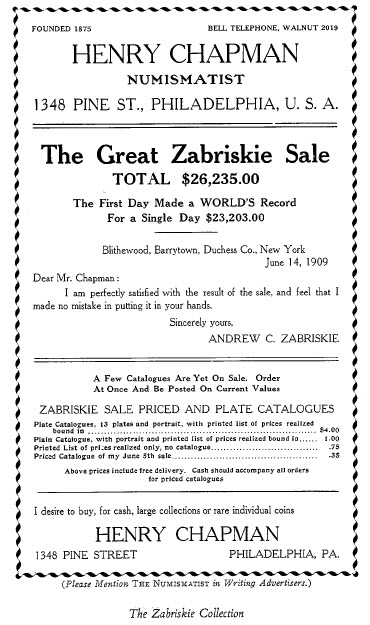
The collection of Capt. Andrew Zabriskie of New York City was sold at auction by Henry Chapman in June 1909. Zabriskie, who had been president of the American Numismatic Society, was one of the oldest collectors in the United States. Included in his holdings were many important pieces. Of these, Chapman noted:
Of paramount importance is the magnificent 1787 New York Brasher doubloon, almost as fine as the one which made the world's record price for a single coin, either at public or private sale! Think of it!
Capt. Zabriskie some years ago had the good fortune to purchase from his executors a collection of coins left by Mr. Humbert, the California assayer, and from which collection he derived many of the most memorable of his pioneer gold coins which, added to his collection that has been forming for many years, makes his pioneer gold the best ever offered at public sale.