Walter Breen's Encyclopedia of Early United States Cents
Walter Breen
Descriptive Method and Format Date
(mintage)
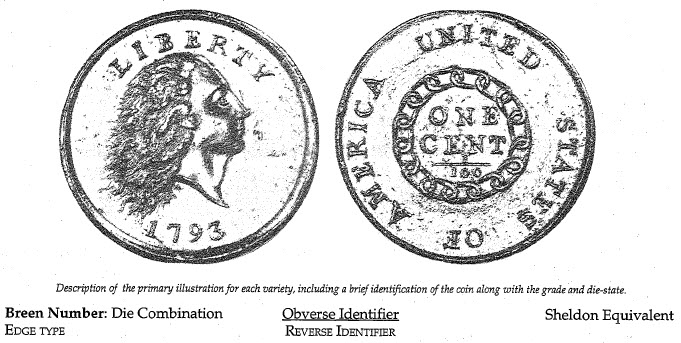
Obverse: Number and description. Diagnostic features are in bold type.
Reverse: Letter and description. Diagnostic features are in bold. type.
Edge: Characteristics creating a sub-variety.
Die States: These are given Roman numerals to indicate that some new event occurred in the history of one or both dies, such as clashing or breakage. Intermediate states occur with the growth of the cracks; new cracks are designated by subsequent Roman numerals. In some instances, when many cracks occur almost simultaneously, it is not always possible to tell which crack began before which, and a given Roman numeral may prove to designate only approximately the true order.
Equivalents: These are numbers given the variety in previous reference books, in chronological order of publication: Crosby-Levick (for 1793 only); Maris (for 1794 only); Frossard (for 1793 and 1794 only); Pros key; Doughty; Hays (for 1794 only); Crosby (for 1793 only); Gilbert (for 1796 only); McGirk; Ross (for 1794, 1796, 1800, 1802, and 1803); Chapman (for 1794 only); Newcomb (for 1801,1802, and 1803); Clapp (for 1798 and 1799); Clapp (for 1804-1814); Clapp-Newcomb (for 1795, 1796, 1797, and 1800); Sheldon; EAC; Encyclopedia (Walter Breen's Complete Encyclopedia of U. S. and Colonial Coins). Further details regarding the above references may be found in the "Survey" chapter and in the Bibliography.
Rarity: On the modified Sheldon scale; if high or low within a rarity level; that will be described. The specific rarity at the higher end of the scale (R-5through R-8) is fairly easy to determine. An exact Count of currently known specimens is quite possible. For the lower rarities, the specific rank is a reasonably accurate estimate based on input from several advanced collectors and dealers. Del Bland has updated rarity ratings.
Remarks: Anything not already covered including planchet peculiarities, hoards, anomalies of all kinds, overstrikes, discoveries and discoverers, human interest details, major mint errors, documentary evidence, and other comments.
Condition Census: Enumeration of the finest known specimens with pedigrees. It is not always possible to rank-order these into the finest known, second finest, and so forth, as often there are several specimens that will be closely matched in grade. Despite extensive searches, completeness cannot be guaranteed; new top-grade coins occasionally show up in estates, institutions, among coins brought back from Europe, or among coins in long-term "date collections" and "type collections." Pedigree chains are extremely accurate; any incompleteness results from the omission of illustrations in auction catalogues, and sometimes from the owners' refusal to divulge their earlier sources. Each entry includes the grade, pedigree list, die state where known, photographic appearances in previous references where known, and occasional additional comments regarding a specific coin listed. Auction price records' are as complete as possible to provide some idea of price history and current value, in full awareness that price levels change from one year to the next, and often from one month to the next, or perhaps even more often. It is likely that this publication will affect demand and later price levels as well.
Unlike Sheldon's "Condition Census," this census listing is not restricted to the best six. If there are eight, ten, or a dozen that clearly stand out over all the rest known of a variety, those will be listed. If fewer are known, all will be listed. The few varieties that exist through hoards, such as the 1796 and 1797 Nichols Find varieties, are not listed on an individual coin basis, as it would be pointless to list dozens of similarly graded specimens.
The Condition Census listed herein is a result of the long, hard efforts of Del Bland and Jeff Peck, who assisted with this project for many years prior to the current publication. Bland has personally examined and graded most of the specimens listed. Those that he has examined and graded have the grade listed in bold type. Others, which he has yet to review in person, have the grade listed in italics. The Condition Census as presented is as written by Del Bland and Jeff Peck, with the exception of a few additional comments throughout. Auction appearances are generally listed by the name that appears on or in the catalogue. Each listing provides the firm name, month and year: lot number, and price. Auctions listed in bold type include a plate of the specimen being offered. Those in italics were not plated or were illustrated with stock photos. Listings in plain text indicate the catalogue has not been checked. Collectors are listed, followed by the date they sold the coin, if known.
Del Bland has assigned grades for each specimen. Other observers (including the various certification services) may, and have, come to different conclusions. When one person assigns grades to almost every coin, a degree of consistency can be reached. Such consistency is not possible when various people examine smaller portions of the population. The ultimate goal is to be consistent over all coins in the Census, not to have each person agree with every grade.
There are over 25,000 individual entries summarized in the Condition Census. Listing each with the full, unabridged catalogue information would add hundreds of pages to this work. Complete information regarding the most important auction sales and fixed price lists will be found in Appendix A.
Dr. William H. Sheldon and the ANS: An extensive collection of United States large cents, approximately 1,500 coins, was donated to the American Numismatic Society in 1946 by George H. Clapp. A number of these coins were later removed from the ANS by Dr. Sheldon, in a substitution scheme whereby Sheldon switched these coins with lesser grade examples of the identical varieties. Many of these coins were later sold, traded, or otherwise disposed of by Sheldon over several years. Finally, Dr. Sheldon's remaining collection was sold to California collector R. E. Naftzger, Jr. in 1972. Duplicates from Naftzger's collection were sold by New Netherlands Coin Company in an auction held in November 1973.
In February 1991, the ANS made public information that 129 large cents were involved in Dr. Sheldon's scheme. Of these, 38 coins remained in the possession of Naftzger and another 20 had been sold by him. The balance are in the hands of other parties. The case was heard in California Superior Court with title awarded to ANS. This case is currently being appealed. Condition Census in the present work contains entries for many of these coins and is presented as written by Del Bland. Further information, including the court's Statement of Decision and Judgement, may be obtained by contacting the ANS.